 |
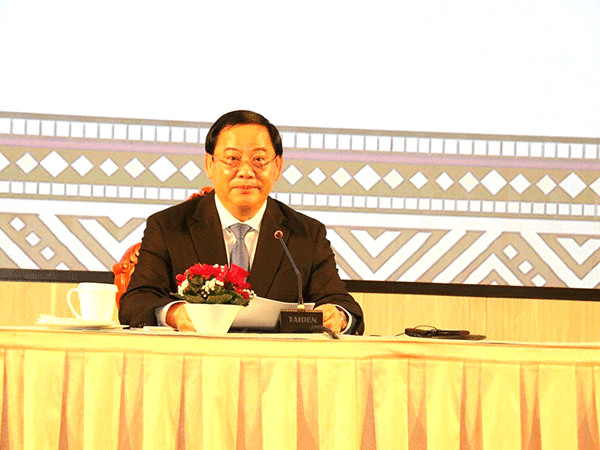
| Prime Minister Sonexay Siphandone attends the 10th Asia Pacific Leaders’ Summit on Malaria Elimination in Vientiane. |
Laos nears malaria elimination as indigenous cases fall to 269
Laos has made remarkable progress in its fight against malaria, reducing indigenous malaria cases from 15,497 in 2016 to just 269 in 2025, health officials announced at the 10th Asia Pacific Leaders’ Summit on Malaria Elimination held in Vientiane on Friday.
Speaking at a press conference following the summit’s opening ceremony, Deputy Minister of Health, Dr Phayvanh Keopaseuth said the significant decline reflects the success of the government’s malaria prevention and control programme, particularly through improved diagnosis, treatment and surveillance systems in rural communities.
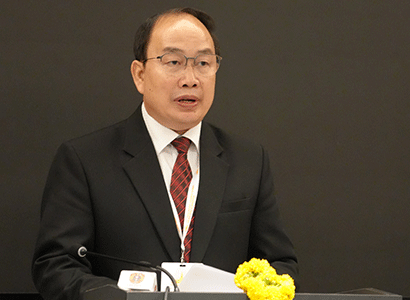 |
| Speaking at a press conference to highlight Laos’s achievements in malaria prevention and control following the summit’s opening ceremony, Dr Phayvanh Keopaseuth. |
“We have achieved substantial progress in reducing malaria transmission and are committed to reaching zero indigenous malaria cases by 2030,” Dr Phayvanh said.
The summit was chaired by Prime Minister, Dr Sonexay Siphandone and attended by Minister of Health, Mrs Baykham Khattiya, representatives from Cambodia, China, France, Japan, Myanmar, Thailand, Timor-Leste and Vietnam, along with development partners and other stakeholders.
Malaria prevention and control remain a priority for the Ministry of Health, which has allocated significant resources to reduce mosquito populations and strengthen prevention measures in high-risk areas.
Over the past year, health authorities have intensified malaria control activities and public awareness campaigns in provinces most vulnerable to transmission.
Under the National Strategic Plan, Laos aims to eliminate Plasmodium falciparum and Plasmodium vivax malaria from all northern provinces and achieve nationwide malaria elimination by 2030.
Health officials attributed the decline in cases to targeted interventions, including effective case management, vector control, and community engagement programmes implemented through health facility catchment areas across the country.
In malaria elimination zones, active surveillance measures, including case and focus investigations, are being used to quickly identify and stop transmission.
The strengthened surveillance system has enabled timely detection and response to malaria cases, supporting targeted interventions in higher-risk communities.
In his opening address, Prime Minister Sonexay Siphandone highlighted the region’s shared commitment to malaria elimination, recalling the joint declaration signed by Greater Mekong Subregion (GMS) countries in Geneva in 2018, which set a target of eliminating malaria by 2030.
The Prime Minister said the initiative has contributed to the broader goal of achieving a malaria-free Asia-Pacific by 2030. Confirmed malaria cases across the GMS declined by 36 percent between 2015 and 2024, demonstrating the impact of regional cooperation and coordinated action.
Prime Minister Sonexay credited the progress to strong partnerships among governments, international organisations and development partners.
He reaffirmed Laos’ commitment to achieving malaria elimination by 2030 and stressed the need for sustainable financing, stronger national ownership, effective programme management, and greater accountability.
At the same time, he acknowledged continuing challenges, including cross-border transmission, conflicts, population displacement, and limited access to healthcare services among vulnerable populations.
Despite these challenges, Laos remains on track to meet its malaria elimination target, contributing to regional efforts to make the Asia-Pacific malaria-free by the end of the decade.
By Phetphoxay Sengpaseuth
(Latest Update June 8, 2026)
|

