 |
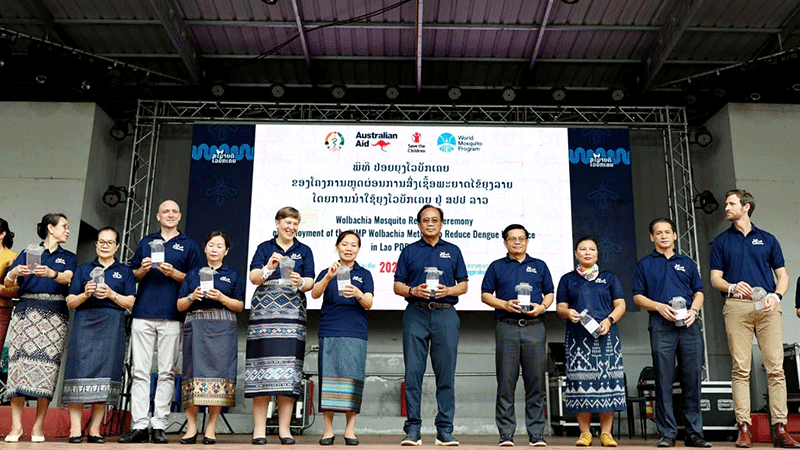
| Officials and partners hold up release containers during the launch ceremony of the Wolbachia mosquito release program in Luang Prabang, marking a significant milestone in the fight against dengue. |
Wolbachia mosquito releases combat dengue across Laos
The Ministry of Health’s Department of Communicable Disease Control, in partnership with Save the Children International and supported by the Australian Government and the World Mosquito Program, has officially expanded its national initiative to combat mosquito-borne diseases.
The latest release of Wolbachia-carrying mosquitoes, a core component of the “Driving Down Dengue in Laos” project, marks a significant milestone in strengthening dengue prevention efforts in northern provinces.
This initiative harnesses the power of Wolbachia, a naturally occurring bacterium that prevents Aedes aegypti mosquitoes from effectively transmitting dengue viruses.
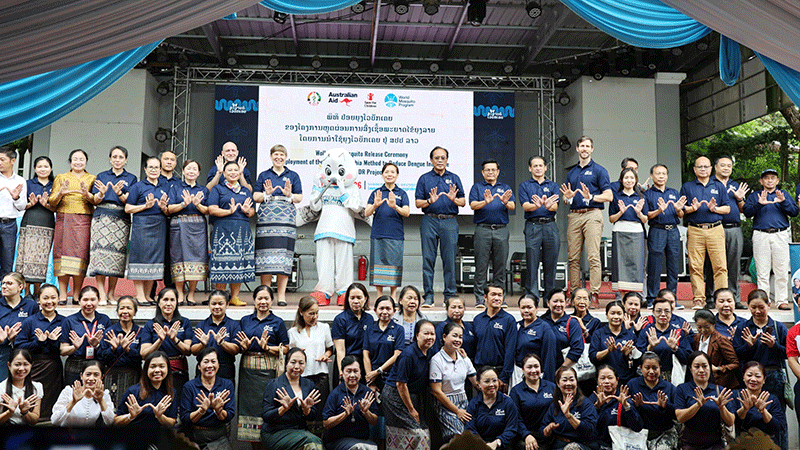 |
| Representatives from the Ministry of Health, development partners, and local communities unite for a group portrait at the Wolbachia mosquito release event in Luang Prabang. |
The expansion is now underway in Vientiane, as well as Oudomxay, Luang Prabang, Savannakhet and Champasak provinces. This milestone follows intensive planning, technical preparation, and grassroots community engagement conducted between April and June 2026.
Public health innovation relies heavily on the trust of the communities it serves and, in Laos, that confidence has been earned village by village. Between April and June 2026, the project trained 336 village health volunteers across 197 villages in the target provinces.
These efforts included training sessions, community advisory meetings, and gender and social inclusion workshops. As a result, public acceptance in the five target areas reached over 88 percent, demonstrating strong confidence in the Wolbachia method and its potential to curb dengue transmission.
Dengue remains a formidable challenge in Laos, particularly during the rainy season. Between 2025 and mid-2026, 1,494 cases were reported nationwide, causing significant disruption to families and communities.
Evidence from the World Mosquito Program offers real hope. In North Queensland, Australia, Wolbachia has made dengue a concern of the past.
Meanwhile, a landmark trial in Yogyakarta, Indonesia, recorded a 77 percent reduction in dengue cases in treated areas. The method provides a durable, self-sustaining layer of protection that complements existing prevention measures.
Speaking at the launch, Minister of Health Dr Baykham Khattiya said: “The use of this new innovation in dengue control may be an effective way for us to control dengue disease. Therefore, on behalf of the leadership of the Ministry of Health, I call upon all relevant sectors to pay attention and actively contribute to the implementation of this project with the highest efficiency and effectiveness. I am confident that with the cooperation between the Ministry of Health, development partners, and all levels of local authorities, we will certainly be able to achieve success.”
Chairman of the Luang Prabang Provincial Administrative Committee, Dr Bounleua Sinxayvoravong, added: “Dengue fever was once mainly a rainy-season disease, but it can now occur year-round. Major outbreaks in Laos occurred in 2013, 2019, 2022 and 2023, causing significant loss of life and property. Dengue remains a serious public health challenge, requiring everyone’s cooperation to stay vigilant and prevent its spread.”
Country Director for Save the Children International in Laos, Luke Ebbs, said: “Dengue continues to affect too many families across the country, underscoring the urgent need for new approaches. This initiative is not only about the release of mosquitoes—it is about fewer children falling ill, stronger communities, and a healthier future for Laos. It also reflects the strength of partnership between government, communities, and development partners.”
“Together, we are reducing the burden of dengue while advancing innovation, delivering hope, and creating safer, healthier environments for children and families.”
Australian Ambassador to Laos, Ms Megan Jones, remarked: “Australia is pleased to support Laos in applying the World Mosquito Program’s Wolbachia method as an innovative, evidence-based approach to reducing dengue transmission.”
“We are also very proud that the technology enabling this program is Australian. This collaboration showcases the power of innovation in tackling global health challenges and our shared commitment to protecting families, safeguarding children, and building healthier, more resilient communities across Laos.”
This nationwide rollout builds upon a phased expansion that began in Vientiane in 2022. Having successfully completed trials across all nine districts of the capital, the project is now scaling up to cover 25 square kilometres across the four key provinces. This expansion aims to bring long-term, sustainable protection to more than 1.2 million people across the country.
By Times Reporters
(Latest Update July 14, 2026)
|

