 |
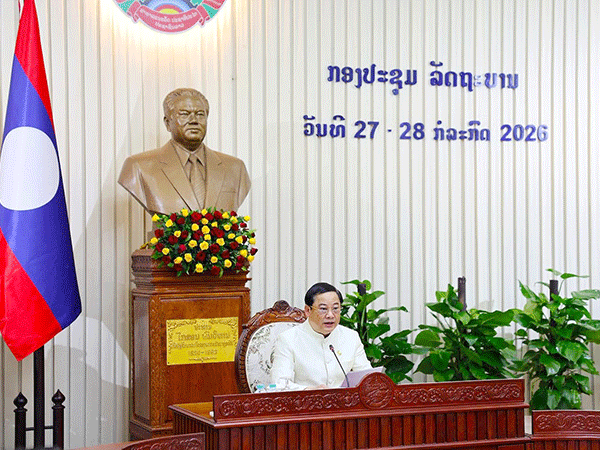
| Prime Minister Sonexay Siphandone chairs the government’s monthly meeting at the Prime Minister’s Office on Monday. |
Government moves to reduce impacts of fuel price hikes
The government is preparing new measures to limit the impact of rising fuel prices and global uncertainty on people’s livelihoods and the national economy.
The government’s ordinary monthly meeting for July opened on Monday under the chairmanship of Prime Minister Sonexay Siphandone, bringing together deputy prime ministers, cabinet ministers and senior officials to review work carried out in July and set priorities for August.
Prime Minister Sonexay urged ministers and senior officials to focus on practical solutions based on prevailing conditions, calling for direct, concise and constructive discussions so that clear decisions could be made and put into action.
A key focus of the two-day meeting is the growing pressure from global instability, which the government warned could increase fuel prices, raise business costs, and drive up the cost of living even further.
The meeting heard that conflicts in the Middle East, the situation in Ukraine, tensions in the South China Sea, and developments in neighbouring countries continue to create uncertainty in the global economy.
The Prime Minister’s Office said prolonged instability could push up international fuel prices, increasing the cost of imports, transport, production and services across Laos.
It also warned that currency exchange rate fluctuations caused by the strengthening of foreign currencies, together with extreme weather events, could raise the price of imported goods, reducing purchasing power and increasing costs for businesses and households.
Ministers agreed that timely action is needed to lower these risks before they place greater pressure on people’s livelihoods, civil servants and the country’s socio-economic development.
The renewed focus on fuel prices follows a series of emergency measures introduced earlier this year after global energy prices surged.
In March, the government issued Prime Minister’s Order No. 40 on strengthening measures to address the impact of rising fuel prices while improving Laos’ long-term energy security.
The government reduced the fuel excise tax on petrol from 25 to 15 percent and removed the 10 percent excise tax on diesel, providing tax relief worth about 1,935 billion kip.
According to Prime Minister Sonexay’s report to an Extraordinary Session of the National Assembly earlier this month, the government also injected 493.79 billion kip from the Fuel Subsidy Fund to slow increases in retail fuel prices and allocated US$414.4 million in foreign currency for fuel imports.
At the same time, the government introduced measures to reduce dependence on imported fuel by promoting the use of electric vehicles, renewable energy and public transport.
The Bus Rapid Transit scheme, electric taxis and electric two- and three-wheelers were introduced to help ease transport costs.
Over the medium and long term, the government plans to diversify fuel import sources, expand national fuel reserves, and accelerate the transition to electric vehicles and alternative energy sources.
The meeting takes place as the Party and government continue to implement the resolutions adopted by the 12th Party Congress and the 10th Five-Year National Socio-Economic Development Plan.
It also coincides with the government’s plans to elevate rural development and poverty eradication to a national agenda, reflecting the government’s efforts to improve living standards and narrow development gaps between urban and rural communities.
Alongside economic issues, ministers are reviewing several major policy and legal reforms that will shape the country’s development over the coming years.
Cabinet members are also discussing progress on draft laws to be submitted to the second ordinary session of the National Assembly. These include a draft Law on Deposit Protection, a draft Law on Land Traffic, and a draft Law on Officers of the Lao People’s Army.
The meeting is also considering a draft resolution on developing quality human resources to meet the country’s changing development needs, recognising that a skilled workforce is essential to support economic growth and improve national competitiveness.
Another key agenda item is a review of the list of business activities regulated under the Law on Investment Promotion as part of wider efforts to improve the investment climate and encourage greater private sector investment.
By Times Reporters
(Latest Update July 28, 2026)
|

