 |
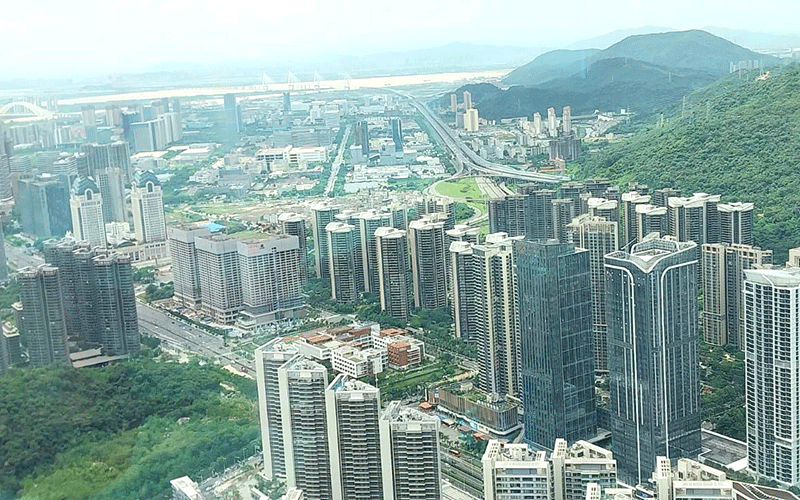
| A panoramic view of Zhuhai and Macao, highlighting their waterfront landscapes, and close connection across the Pearl River estuary. |
Beyond the skyline: Discovering Zhuhai’s vision for the future
The journey to the Asia-Pacific Media Forum in Shenzhen began with an opportunity to discover a remarkable city in southern China — Zhuhai, a coastal city where modern development, technological innovation, environmental sustainability and regional connectivity come together.
Ahead of the forum, which was held in Shenzhen from September 3 to 5, eight media representatives from the Lao Press in Foreign Languages, Pasaxon Newspaper and Vientiane Mai Newspaper travelled to Zhuhai as part of a media tour arranged by the organisers.
The visit offered the Lao editors and journalists an opportunity to see several of the city’s major development projects and landmarks first-hand and to gain a deeper understanding of Zhuhai’s rapid transformation.
The programme included visits to the CSG Hengqin Digital Zero-Carbon Island Shared Laboratory and the 220 kV Qinyun Substation, Zhuhai Tower and the Hong Kong-Zhuhai-Macao Bridge Blue Dolphin Island. Each destination offered a different perspective on the city’s development, from clean energy and digital technologies to urban planning, tourism and infrastructure connecting communities across the Greater Bay Area.
 |
| |
In Zhuhai, the delegation also attended the Asia-Pacific Media Sub-forum, where media representatives from different countries and regions gathered to exchange views and learn more about the city’s development.
Mr Chen Yong, Party Secretary of the CPC Zhuhai Municipal Committee and Secretary of the Hengqin Working Committee of the CPC Guangdong Provincial Committee, delivered the opening speech, welcoming the foreign delegates and briefly introducing Zhuhai’s development.
His remarks highlighted the city’s efforts to pursue high-quality development while making full use of its geographical advantages, technological capabilities and natural resources. For the visiting editors and journalists, the sub-forum provided an opportunity not only to hear about Zhuhai’s development but also to observe it directly through visits to key projects and landmarks.
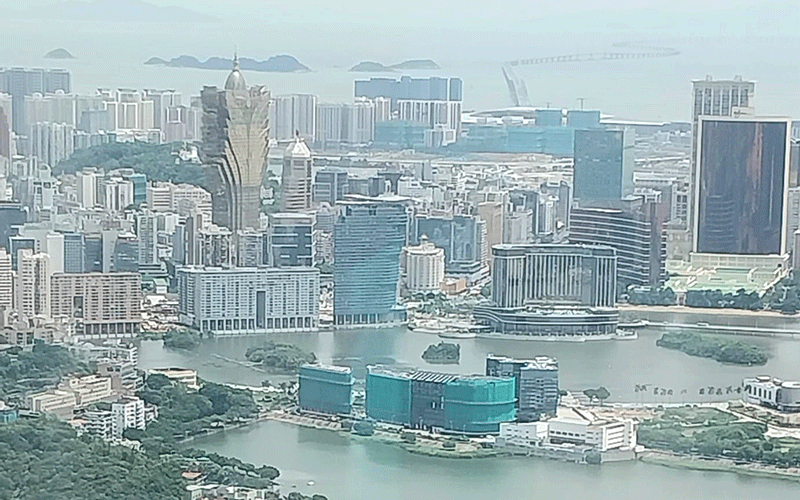
One of the most memorable experiences was visiting Zhuhai Tower, which rises more than 70 storeys above the city. From high above the ground, the panoramic view revealed a city where modern buildings stand alongside green spaces, mountains and waterways.
The landscape offered a striking impression. Despite being a rapidly developing urban centre, Zhuhai has retained a strong connection with nature. Its green surroundings, fresh atmosphere and pleasant weather added to its appeal and helped explain why environmental quality has become an important part of the city’s development identity.
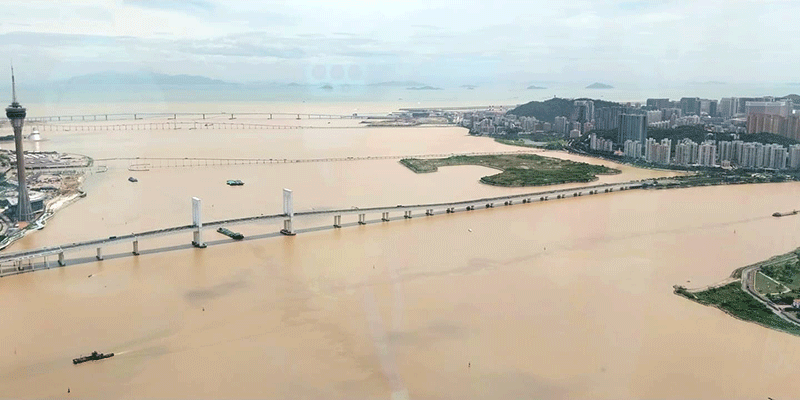
Located in the southwest of the Pearl River Delta in Guangdong Province, Zhuhai borders Macao to the south and occupies a strategically important position in southern China. It is the only mainland Chinese city connected by road to both Hong Kong and Macao through the Hong Kong-Zhuhai-Macao Bridge.
 |
| |
This geographical advantage has helped make connectivity one of the defining features of Zhuhai’s development. The city is also one of China’s major port cities and boasts 10 national category-one ports. Zhuhai administers three districts — Xiangzhou, Jinwan and Doumen — and covers a land area of 1,725.07 square kilometres, with a permanent population of approximately 2.54 million.
Known as the “City of a Hundred Islands”, Zhuhai is rich in marine resources and is distinguished by its coastline, islands, mountains and waterways. Its close links with Hong Kong and Macao have further strengthened its role in the development of the Guangdong-Hong Kong-Macao Greater Bay Area, creating opportunities for greater economic interaction, investment, tourism and people-to-people exchanges.
The Hong Kong-Zhuhai-Macao Bridge has become one of the most visible symbols of this connectivity. The bridge does more than shorten travel distances. It represents the increasingly close links among cities in the Greater Bay Area and demonstrates how major infrastructure can support wider regional development.
Zhuhai’s economic performance also reflects its continuing transformation. In 2025, the city’s GDP reached RMB 457.31 billion, while its per capita GDP exceeded US$20,000, ranking second in Guangdong Province.
Behind these figures is an increasingly innovation-driven economy. Zhuhai is promoting industries including next-generation information technology, new energy, biomedicine, smart home appliances, equipment manufacturing and fine chemicals. The city is also advancing emerging sectors such as artificial intelligence, the low-altitude economy and compound semiconductors, while strengthening marine infrastructure.
The visit to the Hengqin Digital Zero-Carbon Island Shared Laboratory and the 220 kV Qinyun Substation offered a practical glimpse into this approach. The projects illustrated how digital technology, modern energy systems and environmental objectives can be integrated into urban development.
For editors and journalists from Laos, seeing these projects first-hand was particularly meaningful. Rather than simply reading about technological transformation, the delegation was able to observe how innovation and sustainability are being incorporated into the development of a modern city.
At the same time, Zhuhai’s story is not only about economic growth and technology. The city places considerable emphasis on its ecological environment and quality of life. Its combination of mountains, coastline, islands, waterways and green spaces has contributed to its reputation as an attractive and environmentally friendly city.
Zhuhai has received international recognition, including the International Award for Best Practice in Improving the Living Environment from UN-Habitat. It has also been ranked among the “Top 10 Happiest Cities in China”, reflecting its efforts to create a pleasant environment for residents and visitors. Tourism is another important part of the city’s appeal. Zhuhai is the only city selected for its overall cityscape among China’s Top 40 Tourist Destinations. Island tours, hot springs and golf are among its attractions, while major international events have helped raise the city’s profile beyond China.
These include the China International Aviation and Aerospace Exhibition, the WTA Elite Trophy Zhuhai and the ATP World Tour 250 Zhuhai Championships. Such events bring international visitors to the city and create additional opportunities for cultural exchange and international communication.
For the Lao media delegation, however, the visit was more than a sightseeing programme before travelling on to Shenzhen. It was an opportunity to observe how a modern city presents its development story to an international audience.
In an increasingly interconnected Asia-Pacific region, media cooperation has an important role to play in bringing people and societies closer together. Journalists can help audiences understand places not only through statistics and official announcements, but also through direct observation and first-hand experience.
The visit to Zhuhai therefore provided a valuable complement to the Asia-Pacific Media Forum in Shenzhen. While the forum focused on media cooperation and communication, the journey through Zhuhai offered a practical example of the wider developments taking place across the region — developments driven by connectivity, innovation, technology, environmental awareness and international exchange. For Lao journalists, the experience also offered useful perspectives on issues that are increasingly relevant to Laos, including digital transformation, green development, tourism promotion, infrastructure connectivity and the role of the media in communicating national development to international audiences.
Looking across Zhuhai from the top of its tower, the city’s skyline told only part of the story. Behind the buildings and roads was a broader vision of development in which economic growth is increasingly linked with innovation, environmental protection and regional connectivity.
Zhuhai’s transformation is still continuing. As the city strengthens its position within the Greater Bay Area and develops new industries and technologies, it is also seeking to preserve the natural qualities that have long distinguished it.
For the Lao media delegation travelling onward to Shenzhen, Zhuhai was therefore more than the first stop on the way to a regional media gathering. It was a window into a city seeking to connect its natural heritage and urban development with a rapidly changing future.
And perhaps that was the most valuable lesson from the journey: in today’s Asia-Pacific, the strength of a modern city is measured not only by the size of its economy or the height of its buildings, but also by how effectively it connects people, embraces innovation, protects its environment and communicates its story to the wider world.
By Phon Thikeo
(Latest Update September 17, 2026)
|

