Yakou village: Where China’s rice fields brought us closer to home
The journey to China was more than an opportunity to attend the Asia-Pacific Media Forum in Shenzhen from September 3 to 6. For the Lao media delegation, it was also a chance to travel beyond the conference room, experience local life, and see different sides of China with our own eyes.
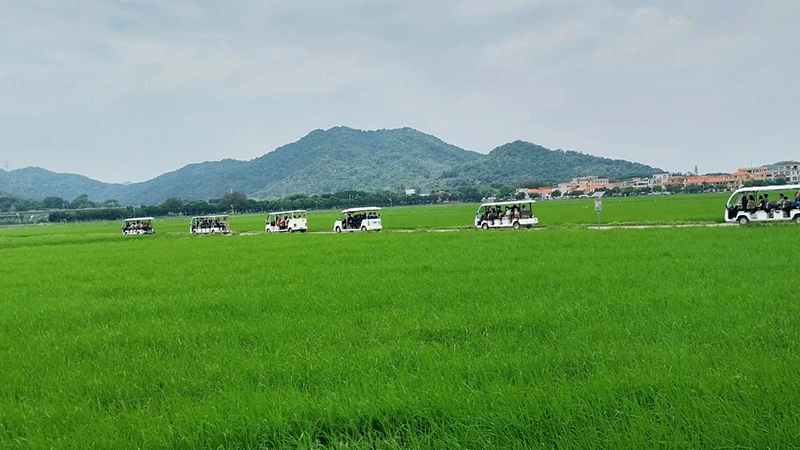
The visit to Yakou village in Zhongshan City, Guangdong province, was one of the most memo-rable moments of the trip. Away from the busy streets and modern skyline, Yakou offered a peaceful rural landscape of green rice fields, fresh air, gentle mountains and quiet village life. Yet, despite being thousands of kilometres from Laos, there was something remarkably familiar about the place.
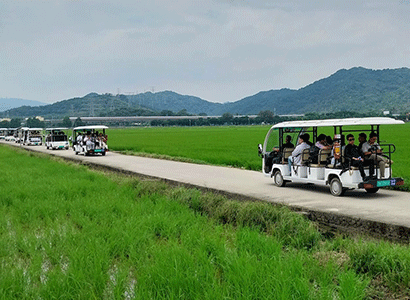
As our vehicle moved through the countryside, the landscape gradually opened into wide stretches of rice fields. Green rice plants stood in neat rows, swaying gently in the breeze. The scenery was simple, peaceful and refreshing. Through the open windows came a light, cool wind carrying the soft, fragrant smell of rice plants.
Sitting on the moving vehicle and watching the rice fields pass by, many members of the Lao delegation could not help but feel a sense of familiarity. The smell of the rice, the cool breeze and the endless green fields immediately brought memories of the countryside in Laos.
For a moment, the distance between China and Laos seemed much smaller.
Some members of the delegation began singing the familiar Lao song “Yen Sabai, Yen Sabai, Xao Na”—a song celebrating the peaceful life of farmers.
 |
 |
| |
|
The sound of singing filled the vehi-cle as the rice fields continued to stretch along both sides of the road. It was a joyful and spon-taneous moment, but at the same time, it carried a deeper emotion.
One member of the delegation quietly said, “I miss the rice fields. I miss my parents back home.”
Those simple words captured something that photographs alone could never fully express. For many Lao people, rice fields are more than agricultural land. They are part of childhood memo-ries, family life and the hard work of parents and grandparents. They represent home.
As we travelled through Yakou village, the similarities became even more striking. The rice plants growing in the fields looked much like those cultivated in villages across Laos. The sight of farmers working among the fields, the fresh countryside air and the peaceful rhythm of rural life created a feeling of familiarity that was difficult to ignore.
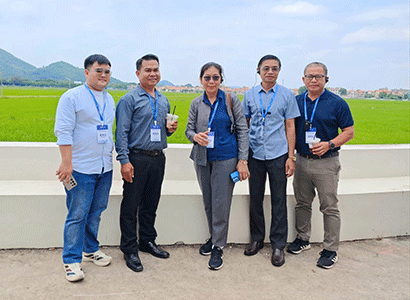
The delegation naturally began taking photographs. Some stood beside the rice fields, while others captured the surrounding landscape. Cameras and mobile phones were everywhere as everyone tried to preserve a little piece of the moment.
After travelling through the village, we also had time to sit, relax and enjoy coffee beside the rice fields. Each person held a cup of coffee while looking out over the green landscape. The coffee itself was delicious, but drinking it in such a peaceful setting made the experience even more enjoyable.
There was also something familiar about the coffee. Sitting there with a warm cup in hand, sur-rounded by nature, it felt almost like enjoying coffee somewhere in Laos. The taste, of course, was part of the experience, but the atmosphere was what made the moment special: the green fields, the gentle breeze, the open sky and the quiet countryside.
For editors and journalists, experiences like this are valuable because they provide something that cannot be gained entirely from documents, reports or second-hand information. Seeing a place directly, meeting people and experiencing the environment allows journalists to under-stand a story from a more personal and human perspective.
That was one of the important values of this trip. The Asia-Pacific Media Forum provided an opportunity for media professionals to exchange ideas and discuss the changing media land-scape, while the field visits allowed the Lao delegation to experience China beyond the confer-ence hall.
We would like to express our sincere appreciation to Xinhua News Agency, as a partner, for providing the opportunity and support that made this journey possible. Such exchanges give Lao media professionals the chance not only to learn and exchange experiences, but also to see, feel and understand China through direct experience.
Sometimes, understanding another country does not begin with a conference or a formal presentation. Sometimes, it begins with something much simpler—a cool breeze passing across your face, the fragrance of rice plants in the fields, a song sung by fellow travellers, or a cup of coffee enjoyed while watching the countryside.
Yakou village may be just one rural community among many in China, but for the Lao delegation, it became much more than a place to visit. It became a place that awakened memories of home.
Standing among the rice fields of China, we were reminded of the fields of Laos. Looking at the rice plants, we thought of our villages. Feeling the cool breeze, we remembered home. And while sharing coffee together, we realised that sometimes the most meaningful moments of a journey are not found in the busiest cities or grandest events, but in the quiet places that unex-pectedly remind us of where we come from. In the middle of China’s rice fields, we somehow heard the voice of home.
By Phon Thikeo
(Latest Update September 18, 2026)
|