 |
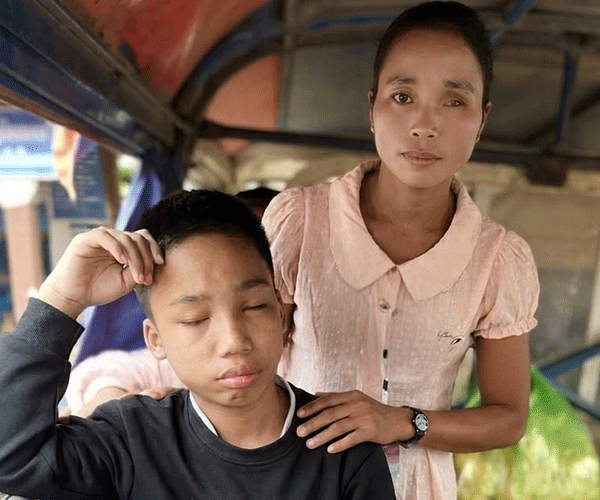
| Mrs Tieng Mangang and her son Loi. |
A mother and son living with the legacy of UXO
For Tieng Mangang, an explosion that occurred more than a decade ago changed her life. She was about 20 when she was injured by a device that exploded while she was cutting long grass in Hinlab village, Bualapha district, Khammuan province.
Thirteen years later, the same danger returned to devastate her family, this time leaving her 13-year-old son, Loi Mangang, blind in both eyes.
The two incidents happened years apart, but for Tieng, the memories of her own accident came rushing back when she learned that her son had also become a UXO victim.
“I fainted when I heard that my son had been injured,” Tieng said.
She herself was injured in 2012 while cutting down grass on open land along with two other villagers. They worked separately, some distance from one another, when an explosion suddenly shattered the quiet.
“I was concentrating on my work when suddenly I heard an explosion. I felt completely dazed and could not tell where I was injured. I could not hear anything,” she said.
 |
 |
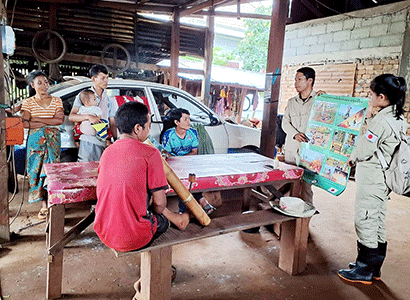
| Lao National UXO Programme staff explain the risks associated with unexploded ordnance. |
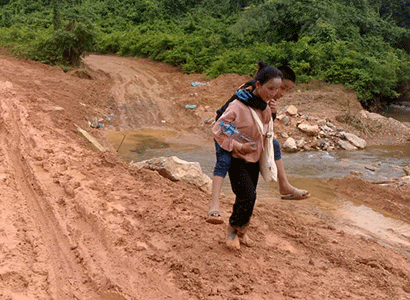
Loi depends on his mother to help him move around and carry out many everyday activities. |
Tieng spent two weeks in hospital. The cost of her treatment used up nearly all of her family’s savings and she was forced to complete her recovery at home.
It took almost two months for her wounds to heal, and more than four months before she was able to return to farming.
Although she eventually resumed her work, the accident never completely left her mind.
“Every day, I had to go out to earn a living while worrying that something like that could happen again,” she said.
But farming was not something the family could give up as the land was essential to their survival, and there were six children to support.
Then, in November 2025, her fear of another accident became a reality.
Her son Loi and four friends had gone to a rice field near their village to dig for crabs for lunch. This is a common activity for children in rural areas, where foraging for food is a part of everyday life.
But a cluster munition exploded without warning, seriously injuring the boys.
Loi, who was in the second year of secondary school at the time, suffered serious injuries, including damage to his internal organs. He underwent surgery and spent about two months in hospital. The explosion left him blind in both eyes, while one of his friends lost his right hand.
Loi’s life has changed dramatically since then.
Before the accident, he went to school, spent time with his friends and thought about growing up and helping his parents. He had hoped to work, earn money to help support his younger siblings, and reduce the burden on his family.
Now, he depends on relatives to help him move around and carry out many everyday activities. He also continues to take medication regularly.
“When I think about the future, I don’t know what I will be able to do. But I still want to go back to school and study like my friends,” Loi said.
For his mother, seeing her son struggle has brought back memories of her own recovery.
She remembers how difficult it was to return to farming after her accident. Yet she also knows that fear doesn’t put food on the table.
“Unexploded devices are buried in the ground, and no one knows exactly where they may be,” Tieng said.
“We have to forage for food and work in the fields in order to survive. No matter how afraid we are of being killed by one of these devices, we can’t change our way of life.”
The family had always warned their children about the dangers of unexploded ordnance, teaching them to be careful and how to recognise suspicious objects, as there are several types of UXO.
Despite those precautions, Loi became a victim while doing something that was an ordinary part of rural life.
Following the accident, the parents of all five children sought assistance through the authorities, including support from the Lao National UXO Programme, and Loi’s family received help with his treatment.
For Tieng, that assistance was crucial. Her own treatment more than a decade earlier had already consumed almost all of her family’s savings.
“I would like to thank the government, the Lao National UXO Programme and everyone who helped save my son’s life,” she said.
“Without this assistance, our family would not have had the means to keep him alive.”
Today, mother and son are living with the consequences of two UXO-related accidents.
Tieng has returned to working the land despite the fear that remains with her. Loi, meanwhile, is adjusting to a life without sight while holding on to one important hope – to return to school and learn alongside his friends.
For a family that has experienced terrible accidents twice, UXO is not simply a reminder of a war that ended decades ago. It is something that has shaped their health, livelihood, finances, education and hopes for the future.
And for Tieng, the land remains both a source of survival and a place where an unseen danger can still be lurking.
By Lamphone Pasanthong
(Latest Update September 21, 2026)
|

