 |
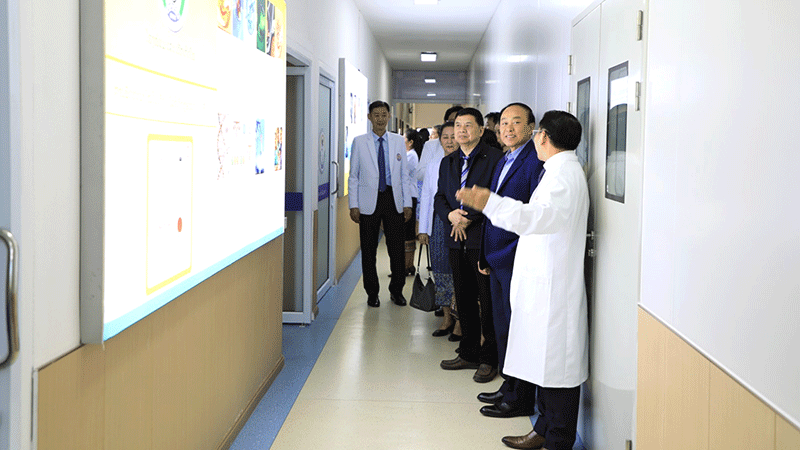
Specialists describe the success of in vitro fertilisation at the Mother and Newborn Hospital in Vientiane.
|
First in vitro fertilisation clinic opens at Vientiane hospital
There is now more hope for infertile couples in Laos with the opening of the first in vitro fertilisation (IVF) centre, which greatly increases the chance of conception and successful pregnancy.
The clinic, which is located at the Mother and Newborn Hospital in Vientiane, uses intracytoplasmic sperm injection (ICSI), a technique widely used by specialists to improve fertilisation outcomes.
The centre was established in cooperation with New Hope Sole Co., Ltd. Under the partnership, the company is supporting the hospital by providing modern medical equipment and technology for use in infertility treatment.
Speaking at the opening ceremony of the centre, Director of the Mother and Newborn Hospital Dr Sivanhxay Chanthavongsak said the number of couples seeking infertility treatment at the hospital has increased in recent years.
Although he encourages couples to try to conceive naturally, he advises them to consult a doctor if pregnancy does not occur after one year of marriage.
The opening ceremony was attended by the Director of New Hope Sole Co., Ltd., Mr Anixay Sukhavong, hospital administrators and medical staff.
ICSI is used to prepare reproductive cells to develop embryos that can be transferred to a woman’s uterus. To reduce the risk of multiple pregnancies, insemination may not be carried out if more than three follicles develop or if two or more mature follicles are detected.
The procedure may be performed during a natural menstrual cycle without medication or with ovarian stimulation using oral anti-estrogens or gonadotropins. Ultrasound monitoring is used to assess ovarian response throughout the process.
Specialists say that children born through assisted reproductive technologies may face higher health risks than those born through natural pregnancy and may therefore need special treatment.
Thailand and several other ASEAN countries have been successfully using the ICSI method for many years.
The Mother and Newborn Hospital has been providing treatment for infertility since 2012.
From 2012 to 2016, an infertility treatment unit at the Department of Obstetrics and Gynecology offering basic treatment, counselling, ovulation-inducing medication, hormonal therapy, ultrasound monitoring and diagnostic surgery.
In 2016, the unit was upgraded to the Assisted Reproductive Technology Department. Although government funding in 2017 enabled the purchase of more equipment, limited resources prevented the provision of IVF treatment.
In 2019, the hospital introduced intrauterine insemination (IUI) services, which continue to be offered and in 2021 the department was renamed the Infertility Treatment Department.
From 2012 to 2024, a total of 7,008 infertile couples received advice and/or treatment at the hospital.
By Phetphoxay Sengpaseuth
(Latest Update December 31, 2025)
|

