 |
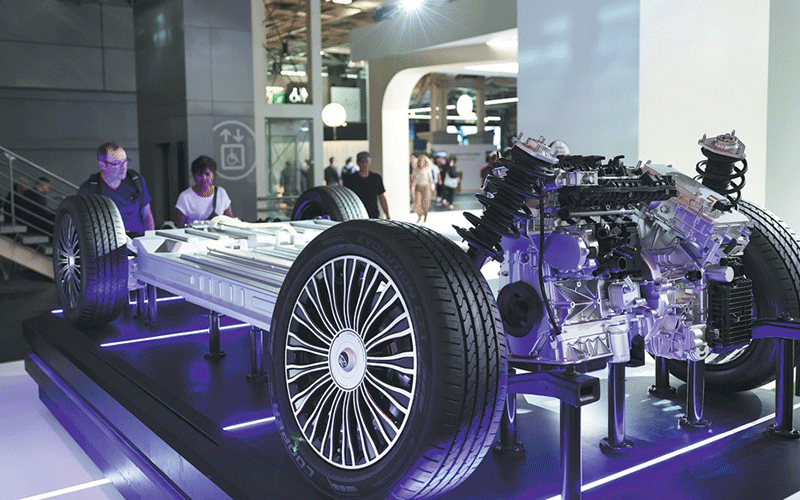
Visitors view an intelligent electric vehicle powertrain platform at Chery's booth during the 2026 Paris International Motor Show on Oct 13. Photo XINHUA
|
China-EU auto ties seen shifting up a gear
(China Daily/BRNN) -- Cooperation between China and the European Union in intelligent connected vehicles (ICV) is undergoing a profound shift from "product trade" to "system building", said Wang Zhisheng, vice-president of the China Chamber of Commerce to the EU, in an interview with China Daily.
The transformation rests on technological complementarity, Wang said. China leads in autonomous driving algorithms, power batteries and over-the-air iteration speed, backed by the world's richest complex-road data. Europe offers a century of automotive craftsmanship, stringent safety standards, premium brands and global sales networks. "It is a deep coupling of the world's most active new technology application market with its most mature industrial system," he said.
The market shift is equally striking. In May, Chinese brands' monthly new car registrations in Europe surpassed Japanese automakers for the first time. Chinese carmakers held 9.5 percent of the overall European market in the first half of 2026 and nearly 11 percent of the electric vehicle segment, Wang said, quoting data from the European Automobile Manufacturers' Association, which is known as the ACEA.
"Chinese brands have gained a firm foothold; the question now is how to stand more firmly and go further," Wang said on the sidelines of a forum on innovation ecosystem for ICV brands, which was held in Beijing last week to discuss the strategies needed to help Chinese ICV companies expand their overseas presence.
The forum came after the second meeting of the China-EU trade and investment consultation mechanism, held in Beijing earlier this month, produced 16 consensus points, including a World Trade Organisation-compliant understanding on hybrid vehicle trade.
"Policy certainty is improving. This provides stable rule expectations and returns competition to technological innovation and market openness," Wang said.
To deepen their presence, Chinese brands must advance localisation — moving from "selling cars to Europe" to "building cars in Europe". BYD's Hungarian plant is set to begin mass production in the fourth quarter of 2026, while Chery's joint venture with Spain's Ebro will start production by the end of 2026.
Compliance is another hurdle. "Compliance is not a cost; it is the ticket to entry in Europe," Wang said.
Brand narrative also needs rebuilding. German consumer surveys show that after test drives, many rate the driving experience provided by Chinese EVs as above traditional European brands. "Novelty is turning into trust," Wang noted.
The overseas expansion of software faces distinct barriers centred on "data sovereignty and compliance continuity", Wang said, including localised data storage and algorithm compliance review, as high-risk artificial intelligence systems must be registered in an EU database.
He advises companies to embed compliance architecture at the design stage, form local policy research teams, co-build research and development ecosystems with European partners and use European standards to force product upgrades.
On the EU tightening of hybrid quotas and price commitments, Wang said at the 2026 Paris International Motor Show held earlier this month, the number of Chinese brands exceeded the combined total of French and German brands for the first time.
This shows that China has moved from "follower" to "leader", but exhibition presence does not equal market success, he said.
Wang urged a phased approach: stabilising in the short term by aligning with the quota mechanism, which uses the 2025 baseline of 302,000 units and allows growth while curbing pace; deepening localisation in the medium term, with 10 Chinese companies' production projects in Europe announced since September 2023; and pursuing standard-setting leadership in the long term.
The hybrid trade consensus marks a shift from "opportunistic" to "strategic" overseas expansion, Wang said, requiring three fundamental changes: from product exports to capacity overseas — BYD's Hungarian plant and CATL's Hungarian investment are real commitments; from single-point breakthroughs to ecosystem coordination through industrial parks and supply chain alliances; and from domestic competition to global brand building through premiumisation in Europe.
(Latest Update October 28, 2026)
|

