 |
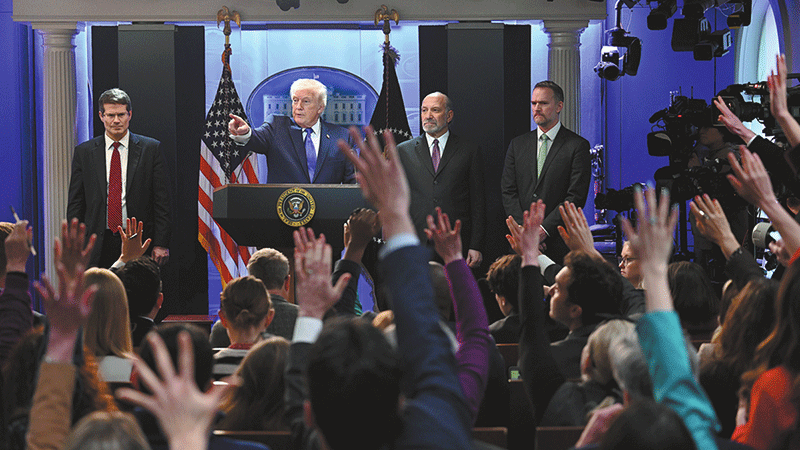
| United States President Donald Trump holds a news conference on the Supreme Court’s ruling at the White House in Washington. |
US tariffs deepen Asia’s uncertainty
(China Daily/ANN) -- The United States’ decision to impose a 15 percent global tariff has cast fresh uncertainty among Asian economies that have spent months securing reduced rates by offering trade and investment concessions to the US.
Analysts said the US announcement on Saturday could ease pressure on most Asian economies, such as India, Malaysia and Thailand, which were subjected to “reciprocal tariffs” ranging from 19 percent to 41 percent. These levies have been in effect since August.
In a social media post, US President Donald Trump stated, “I … will be, effective immediately, raising the 10 percent worldwide tariff … to the fully allowed, and legally tested, 15 percent level.” The administration would soon issue new tariffs “to continue our extraordinarily successful process of Making America Great Again”, he added.
The announcement was made a day after the US Supreme Court ruled that the president’s use of the International Emergency Economic Powers Act to justify “reciprocal tariffs” is unconstitutional.
Analysts said this raises questions about the validity of the bilateral deals — some of them including commitments to eliminate or reduce tariffs on certain US goods, as well as commitments to buy US energy and aircraft in exchange for lower rates — that were sealed between the US and individual Asian economies.
The Supreme Court ruling also left unclear whether tariffs already collected under the disputed policy would be refunded.
Mustafa Izzuddin, an international analyst at Solaris Strategies Singapore, said the latest salvo on tariffs reflects the US government’s penchant for “unilateral economic transactionalism”.
James Chin, a professor of Asian studies at the University of Tasmania in Australia, said most Asian economies “are just taking a wait-and-see attitude” as the US tariffs have long been factored into their policy planning.
However, some private export companies might seek to recover their refunds from the US, as the tariffs were declared to be unconstitutional, Chin said.
Malaysian private equity investor Ian Yoong Kah Yin said the US tariff announcement is “a catalyst for equity markets outperformance” in most Asian economies, especially in Southeast Asia, because they were earlier imposed tariffs above 15 percent.
The exemption is Singapore, which was charged with a 10 percent levy, he said.
Indonesia, the latest country to conclude a trade deal with the US, is “prepared for all possibilities”, President Prabowo Subianto said in a statement to the media.
“We respect the domestic politics of the United States, and we will monitor the developments,” he said.
In South Korea, senior presidential, government and ruling party officials held a meeting on Sunday to discuss policy coordination in response to the US Supreme Court’s decision, Yonhap News Agency reported.
Japanese trading company Toyota Tsusho said it would monitor the situation, while imaging and electronics company Ricoh said it would examine the latest court decision, The Japan Times reported.
(Latest Update February 24, 2026) |