ASEAN braces itself for economic fallout from Mid-East crisis, warns of ‘prolonged instability’
MANILA (The Straits Times/ANN) -- ASEAN economic ministers warned that prolonged geopolitical instability from the escalating conflict in the Middle East could threaten economic security across Southeast Asia, disrupt supply chains and hinder the region’s growth.
“A prolonged period of geopolitical instability could pose sustained challenges to the global economic outlook, which has already been battered by multiple headwinds in recent years,” read a joint statement issued after the ASEAN Economic Ministers’ Retreat held in Manila.
“It will also impact economic security and stability and the livelihoods of millions of people in the region, and hinder economic progress in ASEAN,” added the economic ministers, who were hosted by the Philippines as chair of the regional grouping in 2026.
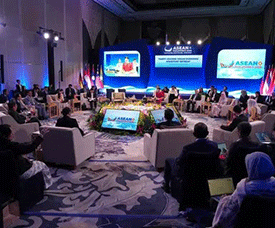 |
| Economic ministers attending the 32nd ASEAN Economic Ministers’ Retreat and Related Meetings in Manila. |
Their warning comes as tensions in the Middle East have risen sharply following the US-Israeli strike on Iran at the end of February, which has triggered retaliatory attacks across the region and raised fears of a wider conflict.
The violence has already pushed global oil prices higher and threatened key shipping routes linking Asia with Europe and the Gulf.
The ASEAN economic ministers pledged to work together more closely, and to keep ASEAN markets open for trade and investment “by maintaining a transparent and predictable regional economic architecture”.
They echoed the March 4 statement of ASEAN foreign ministers calling for de-escalation of the conflict through diplomatic and peaceful means.
“We reaffirmed that long-term regional economic predictability and investor confidence, which are inextricably linked to the consistent application of international law and the swift resolution of humanitarian crises, remain the foundation of a stable global trading architecture,” the economic ministers said.
They said they remain “steadfast” in advancing key regional initiatives, including upgrading the ASEAN Trade in Goods Agreement and signing the ASEAN Digital Economy Framework Agreement to accelerate regional digital trade.
Economists say the conflict could ripple across ASEAN economies through multiple channels beyond oil prices.
“The Middle East conflict threatens to unleash a stagflationary shock on the global economy and ASEAN,” Maybank economist Brian Lee told The Straits Times.
Stagflation occurs when there is high inflation, high unemployment and stagnant economic growth.
He noted that the Gulf region is a major producer of not only oil and gas, but also key industrial commodities such as fertiliser, sulphur, plastics, aluminium and helium, which feed directly into transport, petrochemical, construction and agricultural supply chains.
A prolonged closure of the Strait of Hormuz, a vital maritime chokepoint linking the Gulf to global markets, could therefore trigger widespread supply disruptions.
“For governments that subsidise fuel prices, keeping fuel prices unchanged in the midst of surging oil prices will pressure their fiscal balances... ASEAN countries generally have relatively limited fuel reserves to cushion the impact of a fuel price shock,” Mr Lee said.
ASEAN’s scheduled meetings and summits in 2026 have now become even more crucial platforms for member states to coordinate responses and avoid trade restrictions that could worsen regional supply shortages, said Assistant Professor J.C. Punongbayan from the University of the Philippines-Diliman School of Economics.
“Since some member countries are exporters, some are importers (of oil), if we can kind of help one another in these challenging times, ASEAN will be quite crucial in that,” he told ST.
However, he warned that prolonged uncertainty could tempt countries to adopt protectionist policies to safeguard domestic supplies.
“There could be a temptation for some countries to restrict exports, especially if there is a huge cloud of uncertainty about how long the crisis will last,” he said.
In their joint statement, the ASEAN economic ministers highlighted the region’s vulnerability to global energy market shocks, noting the grouping’s reliance on international oil and liquefied natural gas supply routes.
They pushed for the grouping to diversify energy sources and accelerate investment in renewable energy and other alternatives, as well as to advance existing energy cooperation frameworks, including on petroleum security and a regional power grid.
Prof Punongbayan said the crisis could serve as a catalyst for ASEAN governments to accelerate the transition towards cleaner energy.
(Latest Update March 17, 2026)
|