Oil crisis forces airlines to slash seats
(The Nation/ANN) -- Global airlines have cut 2 million seats from their May schedules as concerns grow over jet fuel supplies in the weeks ahead, the Financial Times reported.
Data from Cirium, a leading global aviation and travel analytics company, showed that thousands of flights have been canceled, while several airlines have switched to smaller or more fuel-efficient aircraft in an effort to conserve fuel as they prepare for supply disruption.
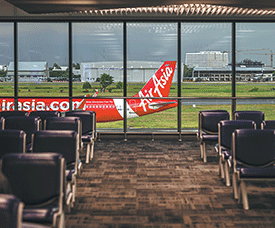 |
| An AirAsia aircraft taxis down the runway at Don Mueang International Airport in Bangkok, Thailand. |
Since the US and Israel launched airstrikes on Iran in late February, jet fuel prices have doubled, forcing airlines to raise fares. The closure of airports in the Persian Gulf, which handle up to one-third of travel connections between Europe and Asia, has also thrown global travel into turmoil.
Cirium data showed that Gulf carriers such as Emirates, Etihad and Qatar Airways, whose flights are still recovering from disruption in the early stages of the conflict, have revised their May schedules, including canceling some services.
Total seats available across all airlines in May fell from 132 million to 130 million between mid and late April.
International carriers ranging from British Airways and United Airlines to Japan’s All Nippon Airways, or ANA, have either reduced or added large numbers of flights as they restructure their networks to ease bottlenecks in global travel.
Aviation analyst John Strickland said no European airline would send aircraft to Asia to meet demand from the Gulf, only to find the planes stranded there without enough fuel to return. While jet fuel prices were often volatile, he said he had never seen a shortage of this kind in his career.
Air France said it had been asked not to add special flights to Singapore or Tokyo’s Haneda Airport, as two of Asia’s major connecting hubs attempt to limit jet fuel consumption.
Asia has been the region hardest hit by the supply disruption because of its reliance on fuel from the Strait of Hormuz, where flows remain almost completely disrupted due to threats of Iranian attacks and a US maritime blockade.
Benjamin Smith, chief executive of Air France-KLM, said the disruption to these travel routes had created a major imbalance between global travel supply and demand.
Kim Beom-ho, acting chief executive of Incheon Airport in Seoul, said fuel “price and demand” had become far more important since the conflict began. He added that the airport was trying to find solutions for passengers.
Vietnam has begun rationing jet fuel, while Japanese airlines have benefited from rising demand in Europe but warned that they would be hit by sharply higher oil prices. ANA said it would have to spend an additional US$754.5 million on fuel through March next year, while Japan Airlines said its profits would fall by one-fifth because of higher costs.
US carrier Delta Air Lines has cut its service network by 3.5 percent in the second quarter to save fuel, while EasyJet and Virgin Atlantic have both expressed caution over profits during the crisis.
(Latest Update May 26, 2026) |