 |
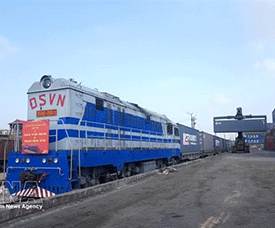
| Qinghai (China)-Dong Nai (Vietnam) is one of the new international intermodal container transport routes put into operation by the Vietnamese railway industry. |
Rail freight opens new logistics links between Vietnam, China, ASEAN
HANOI (VNA) -- Faster transit times, round-the-clock train operations, and the growth of two-way freight services are expanding logistics possibilities, while building rail transport corridors linking China, Vietnam, ASEAN, and beyond.
The Qinghai (China)-Dong Nai (Vietnam) route, one of the new international intermodal container rail services launched by Vietnam’s railway sector, is a case in point. The new route spans nearly 4,000 km, including nearly 2,200 km across China and over 1,700 km through Vietnam.
Thanks to direct, continuous train operations, the total journey from Qinghai to Trang Bom station has been reduced to about seven days, including customs clearance, from 12-15 days previously.
International intermodal rail freight has recorded strong growth in recent years. In 2024, freight volume reached 1.15 million tonnes, up 43 percent year-on-year. The figure exceeded 1.4 million tonnes in 2025, up 23 percent, with exports rising 2.7 percent and imports 51 percent.
Nguyen Hoang Thanh, deputy general director of the Railway Transport and Trade JSC, said that under the railway sector’s policy of bringing border-gate functions deeper into the hinterland, trains departing from inland Chinese locations such as Qinghai, Nanning and Suzhou can run directly into Vietnam’s interior.
Instead of concentrating cargo at border hubs, the international rail network can carry goods closer to production and consumption centres, giving businesses more options for organising transport chains, particularly for large consignments requiring stable delivery schedules.
However, expanding similar routes will depend on establishing stable cargo sources and ensuring efficient operations. A key challenge is to prevent freight flows from developing in only one direction.
Thanh said Vietnam’s railway sector was working to develop two-way services. In addition to receiving cargo from China, it is developing plans to transport Vietnamese goods to China, helping avoid empty return trips and improve operational efficiency.
Stable cargo flows in both directions would enable better use of train capacity while allowing businesses to develop long-term logistics plans.
More broadly, Vietnam’s advantage lies in connecting its railway network with seaports and domestic economic and production centres. With synchronous investment, goods from China could be transported to Vietnamese logistics hubs and seaports for onward shipment to other markets, while Vietnamese goods would gain an additional means for access to the Chinese market and markets further north, according to Thanh.
(Latest Update September 14, 2026) |