 |
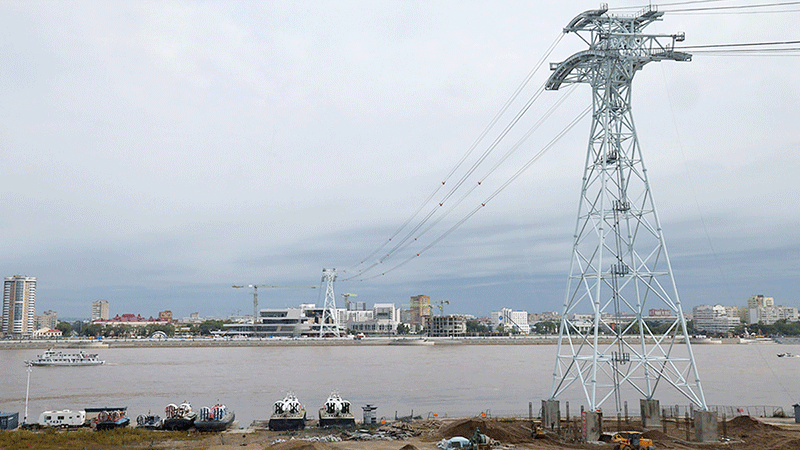
A view of the completed main structure of the Heihe-Blagoveshchensk cross-river ropeway, the first cross-border cableway linking China and Russia across the Heilongjiang River, in Heihe, Northeast China’s Heilongjiang Province.
|
China-Russia cross-border ropeway passes inspection
(Global Times/BRNN) -- The Heihe pedestrian port in Northeast China’s Heilongjiang province, which serves a cross-river passenger ropeway connecting Heihe with Russia’s Blagoveshchensk, has passed a national acceptance inspection, the Heilongjiang Daily reported.
The opening of the port will offer an additional travel option between the two cities and help turn closer people-to-people exchanges into opportunities for border tourism and consumption, a Chinese expert told the Global Times.
An interdepartmental team inspected passenger clearance channels, the monitoring and command centre and supporting facilities before approving the port’s readiness for opening. Heihe will improve coordination among departments and address follow-up requirements, the report said. It did not give a date for operations to formally begin.
Located on Daheihe Island in Heihe, the port serves what the report describes as the world’s first international cross-border cableway. The 976-metre route has a designed operating speed of 12 metres per second, with cabins set to accommodate 110 passengers each and an annual designed capacity of 2.5 million passengers. A one-way ride will take only a few minutes, according to the report.
The ropeway will join an expanding transport network between China and Russia that includes the Heihe-Blagoveshchensk highway bridge. Heihe’s highway port began handling freight in June 2022 and passengers in December 2024, according to the city government. The new transport link is designed specifically to carry people across the river.
Zhang Hong, a research fellow at the Institute of Russian, Eastern European and Central Asian Studies at the Chinese Academy of Social Sciences, said the ropeway would complement existing road and water links between the two cities, offering greater convenience for residents on both sides of the Heilongjiang River, particularly in winter. Its main contribution would be to passenger travel and sightseeing.
Russian residents already cross into Heihe for breakfast, shopping, dental care and other medical services. These everyday visits illustrate the close ties between communities on both sides of the river and the practical demand for convenient cross-border transport, according to Zhang.
This also reflects the practical needs of people living in neighbouring border cities. With visa-free arrangements facilitating short visits, the ropeway could further support this growing flow of travelers, Zhang said. More frequent exchanges would help stimulate retail activity and demand in Northeast China, while Chinese visitors would also bring business opportunities to the Russian side.
“For residents of both countries living on the banks of the Heilongjiang River, and for businesses on both sides, it could be a great help,” Zhang said.
Construction of the port began on July 18, 2019, and the State Council approved its opening to international traffic on January 28, 2020. The project is intended to strengthen connectivity with Russia under the Belt and Road Initiative and the China-Mongolia-Russia Economic Corridor.
(Latest Update September 29, 2026) |