 |
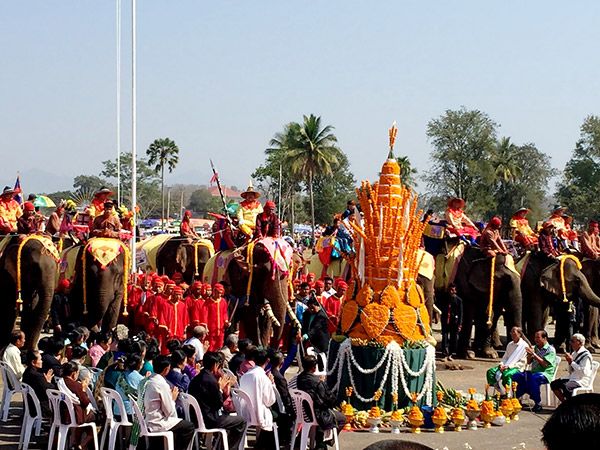
| A Baci-soukhuan ceremony held in honour of elephants at the Elephant Festival in Xayaboury province. |
The Baci-soukhuan ceremony, an age-old Lao tradition
The Baci-soukhuan ceremony is a respected tradition among Lao people, held to bestow blessings and call wandering spirits back to the body.
It is an animist tradition that is very important for Lao people before major events such as weddings, births, travel or when welcoming friends, to bring good luck.
The baci ceremony predates Buddhism’s influence and is not associated with a specific religion.
The baci ceremony calls the spirits to return to a person’s body so they can be healthy and happy. Strings are tied around the wrist to hold the spirits in place and prevent them from wandering away again. A baci ceremony brings good luck to the person, or people, being honoured and is a national custom.
A baci ceremony can be held for many different reasons and at almost any time of year. It is common to hold a baci ceremony for celebratory events such as a wedding or the birth of a child. It may also be held as a housewarming or at the start of a new business. When guests arrive, you may want to welcome them with a baci ceremony as their spirits may have been lost during the journey. The Lao New Year is another popular time to hold a baci ceremony.
During troubled times, a baci ceremony may be given to help improve an outcome. Families often hold a baci after there has been a death, to honour the spirits as well as help the family reunite.
 |
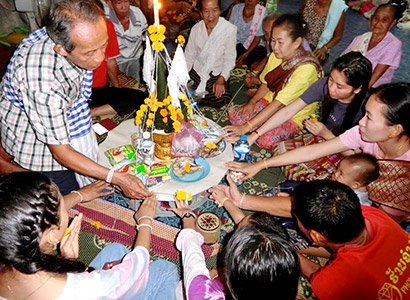 |
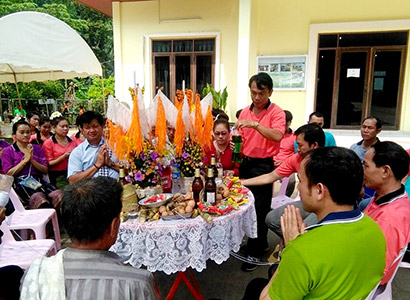
| People in Vientiane share in a Baci-soukhuan ceremony at Lao New Year. (File photos) |
A morphon leads a Baci-soukhuan ceremony. |
The ceremony is ingrained in Lao culture and has been practised since ancient times.
Its observance helps to strengthen social and family bonds and maintain balance and harmony among individuals and communities.
The word ‘soukhuan’, whose true roots are lost in the mists of time, stems from the ancient belief that there are 32 organs in the human body, each with its own guardian spirit known as ‘khuan’.
The soul, therefore, is a union of and under constant protection of these ‘khuan’.
These spirits often wander outside the body causing an imbalance of the soul, which might lead to an illness. The tying of the white string represents tying of the 32 spirits to the body, putting them back in harmony as well as bringing good luck and prosperity.
The Baci-soukhuan ceremony is held on many different occasions throughout the year. It can be held on any day of the week although it has to be on an auspicious day in the lunar calendar and is usually held before noon.
It may be held to comfort someone who is suffering, either physically or mentally, and to seek a cure for any form of ill health.
For example, a mother and her newborn baby are given a Baci-soukhuan after the mother has recovered, to welcome the baby as well as to call back any of the mother’s spirits that may have wandered away during childbirth.
The centrepiece of every Baci-soukhuan ceremony is the phakhuan, a colourful pyramid-shaped ornamental structure usually handmade by women. In towns, they can be purchased at markets.
Traditionally, the phakhuan is made from banana tree stems studded with orange marigolds, banknotes, and sticks of white thread which will later be used as good luck wrist ties.
Next to the phakhuan are placed a boiled chicken, boiled eggs, and glasses of locally-brewed alcohol. The white thread symbolises purification, peace, harmony, good fortune, good health and human warmth and community.
The size and appearance of the phakhuan depends on the status of the host family or group. The flower decorations may vary but will always be in close proximity to the white threads.
The phakhuan is placed on a white cloth neatly prepared on a silver or golden tray placed in the centre of the room and everyone gathers around it.
The host or the individuals that the Baci-soukhuan is intended to honour or benefit sit closest to the phakhuan facing the ‘morphon’, and other participants sit behind.
The morphon is the master of ceremonies and is usually a respected and knowledgeable person or a former monk.
After everyone is settled in, the Baci-soukhuan ceremony begins, starting with the “morphon inviting” session which is usually performed by an older man. He places a glass of rice spirit and a small amount of money, wrapped in banana leaf together with a pair of candles and flowers, on one hand and ties a white string around the wrist of the morphon while murmuring good wishes.
After that, the morphon lights a candle on top of the makbeng (a handmade pyramid made of banana leaves and flowers) and asks the host or the person being blessed to lay their hands palms down on the edge of the phakhuan. He brushes their hands with the white strings while reciting blessings and bestowing good wishes.
After this he takes the white thread connecting the phakhuan, placing one end in his hand and the other in the hand of the person receiving the blessings.
They place the string between their palms and pray while the morphon is chanting in the ancient Pali language, sometimes quoting from Lao poetry and proverbs.
At some point during the chanting, those taking part in the ceremony say together “please come back spirits” while someone throws rice in the air with the grains falling on everyone’s head. These rice grains represent the spirits, wealth, and the good luck that have been asked for.
After the morphon has finished chanting, he ties the first white blessing strings around the wrists of the main person being honoured, then everyone else follows suit. Those present also tie strings around each other’s wrists while bestowing good wishes on the recipient.
Some also roll up a small banknote and attach it to the thread which they tie around the wrist of the host, while others place a glass of Lao whisky or beer, fruit, an egg or any edible item on the phakhuan on the hand of the honoree and tie a string on their wrist.
The Baci-soukhuan ceremony finishes when everyone has tied white strings around everyone else’s wrists or when the white strings are all used up. The ceremony varies in length from 30 minutes to one hour.
Sometimes, at the end of the ceremony the morphon and other older people present examine the chicken carcass to see if the wings, claws and beak are pointing in the same direction, indicating that the spirits of the honoree are in their rightful place and the person has a propitious future ahead of them.
Usually, after the string tying has finished, all the participants are invited to eat and drink. In the case of a celebration, it’s time for the party to begin and the guests will eat, drink and dance.
A live band with a singer provides the music and members of the host family or group are invited to perform the first Lamvong (circle) dance together. Then other guests will also start dancing and the merriment increases as the tempo picks up and the beer flows.
After the ceremony, the phakhuan is kept until it dries out or at least for three days before it is thrown away, to ensure that all the good wishes come true.
It is also believed that if the receivers of the blessings want their wishes to come true they should keep the strings tied around their wrists for at least three days. When it comes time to remove them, they should untie instead of cutting them, as the good wishes might be severed.
An elderly man from Nongheo village in Hadxaifong district, Vientiane, Mr Thanva Thepbounheuang, said “My family sometimes hosts a Baci-soukhuan ceremony at Lao New Year and when we have a special visitor.”
“I often take part in ceremonies organised by my family, friends or neighbours and everyone always enjoys the rituals and celebrating a happy event.”
“I think the Baci-soukhuan ceremony is one of our greatest traditions, so it’s vital that we continue to practise it, both locally, regionally and internationally. It’s also important that young people show an interest in and preserve this age-old ritual,” he added.
The Venerable Phaivanh Malavong, a researcher in Lao language, literature and culture, and a SEA Write awardee in 2019, said the original name of the ceremony was ‘Soukhuan’ and its origins lie in animism and Brahmanism, with Lao influences also shaping the content.
“The Soukhuan ceremony can be held to bless humans, objects or even animals for a variety of reasons,” the Venerable Phaivanh said.
“It also celebrates the acquisition of a new house, the purchase of a new car or rice field, or something else entirely.”
“It may also be held to thank animals such as elephants, water buffalo and cattle for their hard work in farming activities. In the past people used these animals a lot in farming, with buffalo doing the ploughing and elephants hauling logs and other materials,” he added.
“The words that the morphon recites are a mix of Lao and Pali, which is an ancient Indian language that was in use during the lifetime of the Lord Buddha.”
By Times Reporters
(Latest Update July 3, 2023)
|

