 |
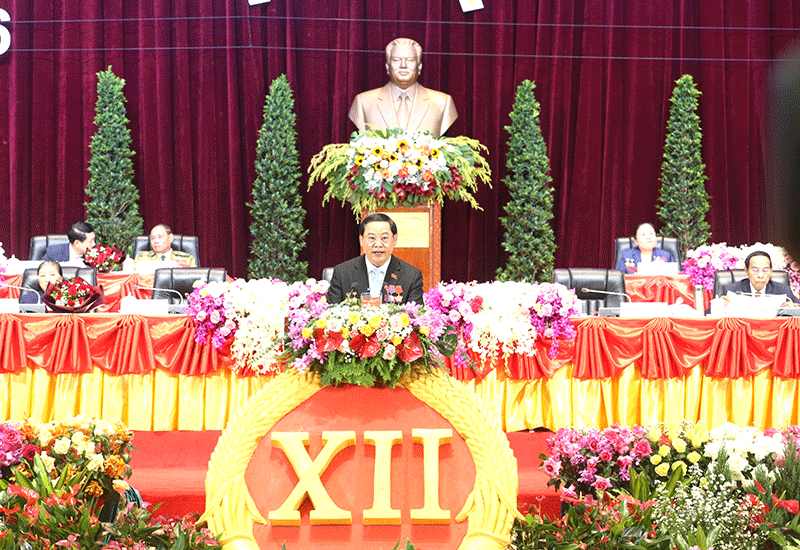
Prime Minister Sonexay Siphandone on Tuesday delivers a government report on economic developments over the past five years, and the goals for the next five years. |
Govt sets targets for growth and sustainability under 10th NSEDP
The government aims to achieve annual economic growth of at least 6 percent, GDP per capita of US$3,104, inflation of less than 5 percent, public debt of less than 70 percent of GDP, and 70 percent nationwide forest cover by 2030.
These targets were highlighted at the 12th National Congress of the Lao People’s Revolutionary Party (LPRP), presided over by Secretary General Thongloun Sisoulith and attended by over 800 delegates representing ministries, provincial authorities, the armed forces and mass organisations, and Party members from across the country.
A government report presented by Prime Minister Sonexay Siphandone stated that Laos had made significant progress over the past five years under the 9th National Socio-economic Development Plan (NSEDP) for 2021-2025, despite challenging situations in many parts of the world.
Economic growth was recorded at an average of 4.24 percent per year, exceeding the target of 4 percent.
Public debt was reduced from 112 percent of GDP in 2022 to 88 percent in 2025, and a trade surplus of US$8.4 billion was recorded.
The level of poverty declined from 18.3 percent in 2019 to 15 percent in 2025, while major infrastructure projects, including the Laos-China and Laos-Thailand railways, were completed, and 4G and 5G telecom networks expanded nationwide, improving connectivity and supporting economic development.
Building on these achievements, the 10th NSEDP (2026-2030) is designed to guide Laos towards graduation from Least Developed Country status, while ensuring rapid, green, and sustainable development.
The plan emphasises stronger national self-reliance and the building of an independent and resilient economy capable of withstanding internal and external shocks.
Another major goal is to achieve per capita GNI of US$2,914. Sectoral GDP growth targets include 4.1 percent in agriculture (accounting for 21.7 percent of GDP), 5.7 percent in industry (31.3 percent of GDP), and 7.1 percent in services (37.5 percent of GDP).
Revenue earned from taxes and customs duties is projected to grow by 5 percent, representing 10.5 percent of GDP.
State revenue is targeted at 554,400 billion kip (at least 20.95 percent of GDP), with domestic revenue contributing 528,000 billion kip (19.95 percent of GDP).
Expenditure is capped at 528,400 billion kip (19.96 percent of GDP), allowing for a budget surplus of 26,000 billion kip (0.98 percent of GDP). Public debt is projected to fall below 70 percent of GDP.
Inflation is expected to remain below 5 percent, with an allowable fluctuation of ±2 percent. Foreign currency reserves should cover at least five months of imports, non-performing loans (NPLs) should constitute less than 3 percent of all loans, and at least 75 percent of export payments are planned to be processed through the banking system.
Total investment is projected at 636,178 billion kip (at least 24 percent of GDP).
Of this, it is planned that domestic budget investment will contribute 116,000 billion kip (18.2 percent), official development assistance (ODA) 71,277 billion kip (11.2 percent), private and foreign direct investment (FDI) 409,470 billion kip (64.4 percent), and other investments will contribute 39,431 billion kip (6.2 percent).
The rice harvest is projected to yield 4 million tonnes annually, while the value of agro-forestry exports is expected to reach US$1.9 billion per year.
In tourism, the goal is to attract 22 million foreign visitors over the five-year period, generating approximately US$8 billion in revenue.
In the energy sector, electricity production is targeted at 327,317 million kWh, and the value of mined products is expected to reach 284,432.8 billion kip.
The plan also highlights the importance of human resource development, digital transformation, and modernisation of public administration to improve governance efficiency and strengthen the business environment.
Increased investment in education and healthcare is expected to support higher living standards and more inclusive growth.
Prime Minister Sonexay Siphandone said successful implementation of the 10th NSEDP is critical to ensuring that economic growth translates into tangible social benefits, strengthens national stability, and positions Laos for sustainable progress in the decade ahead.
The National Party Congress is the highest decision-making forum of the LPRP. It reviews the achievements of the past five years, assesses internal and external challenges, and sets the country’s political, economic, and social development trajectory for the next term.
This year’s congress, which continues until Thursday, will adopt key policy documents, including development strategies and major reform orientations, while also appointing a new leadership body.
By Times Reporters
(Latest Update January 7, 2026)
|

