 |
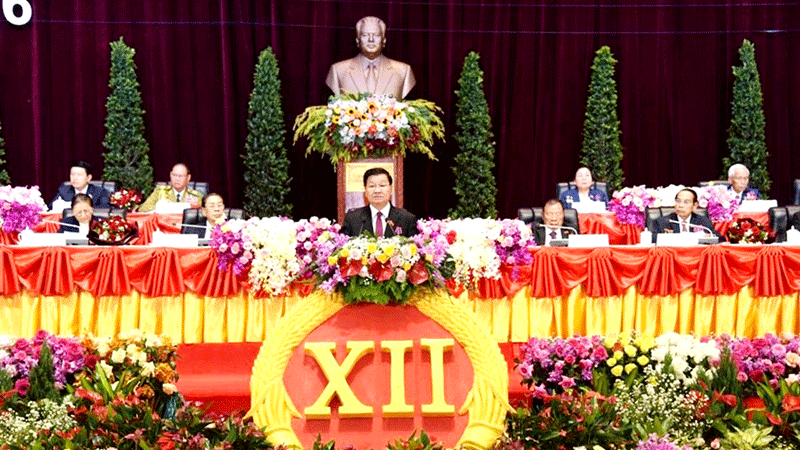
The opening day of the 12th National Congress of the Lao People’s Revolutionary Party. |
Party’s 12th National Congress opens, affirming leadership and development path
All Lao people across the country warmly welcome the 12th National Party Congress of the Lao People’s Revolutionary Party.
The Lao People’s Revolutionary Party (LPRP) opened its 12th National Congress on the morning of January 6 at the National Convention Hall in Vientiane, marking the start of a new phase of development for the Party and nation.
The congress is led by the Secretary General of the Party Central Committee, Thongloun Sisoulith, and attended by members of the Politburo and Secretariat of the Party Central Committee, former Party leaders Choummaly Sayasone and Bounnhang Vorachith, President of the Lao Veterans’ Federation Lieutenant General Sengnuan Xayalath, heads of central-level mass organisations, representatives of national heroes, and honoured guests.
The landmark meeting brings together 834 official delegates, representing 421,865 Party members nationwide. Delegates were elected at the Party congresses of ministries, ministry-equivalent organisations, and localities across the country, fully meeting requirements in terms of structure, quality, and representation of all classes, ethnic groups, genders, and age groups.
In addition, 388 invited guests are attending the congress.
The opening ceremony began with a salute to the national flag, followed by the presentation of bouquets by young people to Party leaders, symbolising the deep respect and trust of the younger generation in the Party.
Secretary General Thongloun presented a draft political report issued by the 11th Party Central Committee, which outlined the achievements, shortcomings, and lessons learned during the past five years of implementing the resolutions of the 11th National Party Congress.
The report noted that Laos has faced numerous economic and financial difficulties, alongside emerging societal challenges. However, under the leadership of the Party Central Committee, many important achievements were attained. The economy maintained continuous growth, macroeconomic stability improved, inflation was brought under control, exchange rates were reined in, and economic recovery gradually took shape.
At the same time, the Party and State firmly safeguarded the country’s independence, sovereignty, and territorial integrity, maintained political stability, social order, peace, and security, and effectively prevented and resisted destructive activities by hostile forces, including efforts to address drug-related problems.
Important progress was made in reforming a number of state-owned enterprises and expanding production by processing more products to add to their sales value.
New infrastructure systems were developed and put into operation, elevating connectivity to a higher level. Human resource development was identified as a top priority, with efforts made to improve the quality of education, address the teacher shortage and student dropouts, encourage scientific research, and foster innovation.
Public health and disease prevention were strengthened, healthcare services improved, and more was done to preserve and promote the nation’s fine cultural heritage. Labour management and skill development were enhanced, policies for national contributors were implemented, and social assistance programmes delivered positive results.
State organisations at all levels were streamlined and strengthened to improve their efficiency, alongside the strengthening of legislation to advance state and social management under the rule of law. Audit, inspection, and judicial processes were reinforced to ensure fairness, transparency, and compliance with the law.
In foreign affairs, the Party continued to pursue an independent foreign policy, proactively engaging in bilateral and multilateral diplomacy to elevate the role and prestige of the Party and the country on the international stage.
Ideological and political work was strengthened, with notable achievements in studies on Kaysone Phomvihane Thought and the sharing of theoretical and practical experiences with fraternal parties.
The report also pointed out shortcomings, including insufficient dedication and public service spirit among some Party members and management personnel, limitations in managing online social media, persistent economic and financial challenges, weak import-substitution production, slow industrial modernisation, and limited investment in human resource development.
Drawing lessons from the implementation of the 11th National Party Congress resolutions and more than 40 years of reform, the report stressed that strong and decisive leadership by the Party Central Committee is key in overcoming challenges and achieving success.
Looking ahead, the Party reaffirmed its overall guiding slogan: “Elevate the Party’s strong leadership role, actively build an independent and self-reliant economy, continue to nurture the people’s democratic regime, and advance steadfastly towards socialism”.
For the 2026-2030 period, the Party has set clear goals to ensure continued political stability, law and order, national unity, and the firm safeguarding of independence and sovereignty.
Other goals are for Laos to graduate from Least Developed Country status, create a more transparent and effective political system, and resolve economic and financial problems.
The target GDP growth rate has been set at an average of 6 percent per year, alongside efforts to foster sustainable development and gradually transform Laos from a consumer society into a production-oriented nation.
The Party will promote the sustainable use of natural resources, diversify electricity production including hydro, solar, wind, and other power sources for domestic use and export, enhance good governance, combat corruption, strengthen regional connectivity, improve the investment environment, reduce poverty levels to single digits by 2030, and set poverty alleviation as a national development task.
Priority will also be given to improving the standard of education, modernising health services, improving labour and social welfare systems, strengthening disaster prevention and response, preserving the nation’s cultural heritage, promoting tourism, and actively implementing foreign cooperation policies.
The Party reaffirmed its commitment to deepening its great friendship and special solidarity with Vietnam, expanding the comprehensive strategic partnership with China, strengthening relations with other neighbouring countries and strategic partners, supporting multilateralism, and continuing the overhaul of salary and welfare systems to meet new development conditions.
The 12th National Party Congress thus stands as a historic milestone, setting a strategic direction for the Party and nation in a new period of development.
By Khonesavanh Latsaphao
(Latest Update January 7, 2026)
|

