 |
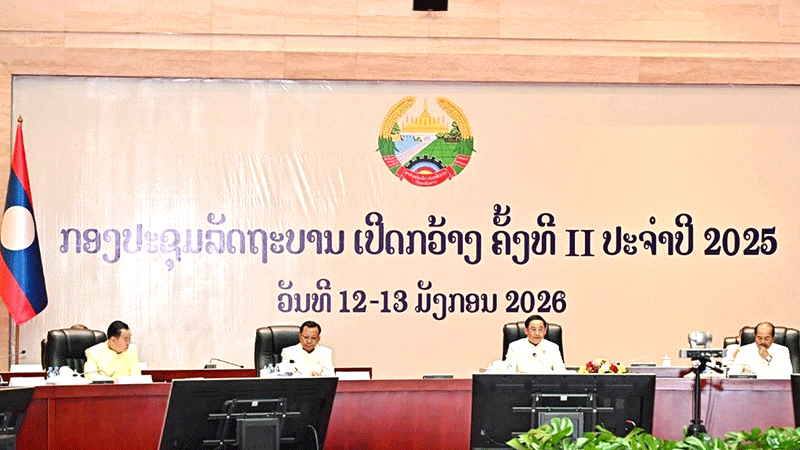
| Prime Minister Sonexay Siphandone (centre) chairs a government meeting which took place from January 12-13. |
Govt reaffirms drive for economic independence, self-reliance
The government has placed economic independence and self-reliance at the centre of its development strategy, identifying domestic production, fiscal discipline and macroeconomic stability as the main pillars for reducing vulnerability to external shocks and ensuring sustainable growth.
These priorities were reaffirmed at the government’s meeting with ministers, provincial governors and other key representatives of government bodies, held from January 12-13 and led by Prime Minister Sonexay Siphandone.
The meeting reviewed the government’s socio-economic performance over recent years and set strategic directions for 2026 and the 10th Five-Year National Socio-Economic Development Plan (2026-2030).
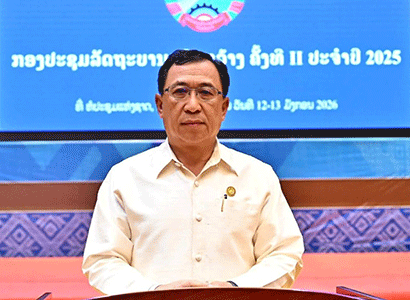 |
| Minister to the Prime Minister’s Office and Government Spokesperson Mr Sonexay Sithphaxay gives a briefing on the outcomes of the government meeting on Tuesday. |
Speaking at a press conference on Tuesday to publicise the results of the government’s meeting, Minister to the Prime Minister’s Office and Government Spokesperson Mr Sonexay Sithphaxay said participants assessed progress in strengthening macroeconomic foundations while approving updated measures to enhance domestic capacity, expand value-added production, and make more effective use of the country’s resources.
Despite global economic volatility, conflicts, the Covid pandemic and climate-related challenges, the government reported that political stability and social order were maintained over the past five years.
Annual average economic growth was recorded at 4.24 percent, rising to 4.8 percent in 2025, while total state revenue collection amounted to 252 trillion kip, exceeding the five-year target by 40 percent.
Macroeconomic stability, viewed as a prerequisite for economic independence, improved markedly. Inflation fell from a peak of 41 percent in 2023 to 5.6 percent in December 2025, while foreign exchange reserves increased to cover 6.45 months of imports.
Public debt pressure eased as repayment obligations were met in line with contracts, helping restore confidence in the government’s financial management.
Agriculture and domestic production were highlighted as core drivers of self-reliance. Over the past five years, rice production reached 18.9 million tonnes, ensuring food security, while the value of agricultural exports exceeded US$8 billion, surpassing planned targets by 35 percent.
The energy and mining sectors continued to support export earnings, with electricity generation reaching 251 billion kilowatt-hours and mineral sales valued at US$13 billion.
The meeting approved in principle a revised resolution on building an independent and self-reliant economy, with a focus on import substitution through domestic production, stricter management of the price of consumer goods, and increased value-added processing of minerals and agricultural products prior to export.
Greater use of the Lao kip and local-currency settlement mechanisms with neighbouring trading partners was also endorsed, to reduce external financial risks.
Looking ahead, the government set an annual economic growth target of 6 percent or higher under the 10th Five-Year Plan, aiming to raise per capita GDP to US$3,104 by 2030.
Fiscal discipline will remain a priority, with revenue collection targeted at no less than 20 percent of GDP, alongside the full modernisation of revenue collection systems by 2026 to enhance transparency and prevent budget leakages.
Key infrastructure projects supporting long-term economic independence were approved, including Phase 1 of the Laos-Vietnam Railway linking Thakhaek to the Mu Gia border, expansion of high-voltage power transmission networks, and reforms in education to better align human capital development with the country’s economic needs.
Several other agendas were approved in principle and assigned to the relevant sectors for implementation, with instructions to carry out policies with discipline and efficiency, practice frugality, address public concerns, and ensure that the benefits of development reach rural and remote areas, while stressing that strengthening self-reliance remains essential to safeguarding economic independence and achieving sustainable development.
By Times Reporters
(Latest Update January 15, 2026)
|

