 |
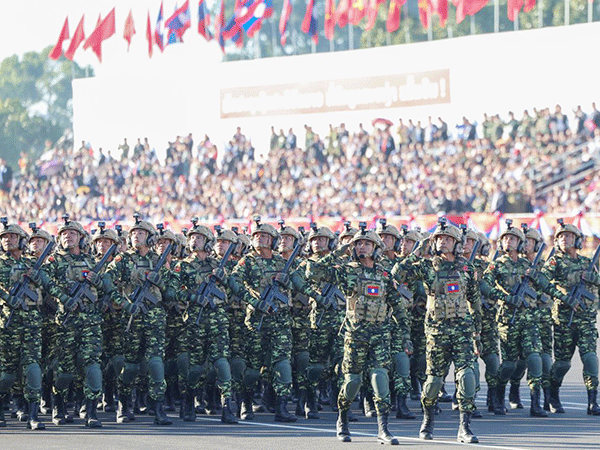
| A military parade in Vientiane. (File photo Vientiane Times) |
Lao People’s Army evolves into modern fighting force
The Lao People’s Army has undergone significant changes over the years and has become a more modern and stronger force under the leadership of the Lao People’s Revolutionary Party.
Today (Tuesday) is the 77th anniversary of the founding of the Lao People’s Army on January 20, 1949.
Over the past 77 years the Lao People’s Army has established an impressive legacy, particularly during the years spent on battlefields as the country struggled for liberation from foreign domination. Soldiers fought heroically and sacrificed their lives without surrendering.
The origins of the army date back to 1949, when it set up the basis of the revolutionary movement at Mae Cave in the Laohoung-Phiengsa area of Xiengkhor district in Huaphan province.
The army started out as the Lao Issara’s Latsavong unit in 1949, of which President Kaysone Phomvihane was the commander before it became the Lao People’s Army.
The Lao Issara spearheaded the fight against foreign invaders under the direction of the Indochina Communist Party, which continued until Laos was finally able to take full control of its own destiny in 1975.
President Kaysone and his comrades in arms fought bravely and did their best to liberate their country from foreign aggressors.
Step by step the army grew and its ranks swelled as the people’s revolutionary movement gained momentum. People of all ethnic groups banded together in cohesive units to take on the French and repel their fighting forces.
During the final battle against the French in 1953-54, the French positioned 176 battalions consisting of about 50,000 soldiers in the north, centre and south of the country, engaging in battle in these three areas.
The Lao Issara joined forces with Vietnamese volunteer soldiers to repel the French troops.
In Vietnam, Laos’ good friend and neighbour, soldiers there surrounded the French at Dien Bien Phu. The French forces were defeated as they had no reinforcements in the area and no way of escape. Ultimately they were forced to grant independence to Indochina, which comprised Vietnam, Laos and Cambodia.
Following the decisive defeat of the French and the Geneva Accord in 1954, the combined forces of the people of Vietnam, Laos and Cambodia kept the French out of Indochina for over 60 years.
The Geneva Accord also formally acknowledged the Lao army, which had bases in Huaphan and Phongsaly provinces.
But only a few months later, new aggressors returned to Laos and the struggle for freedom began for a second time. The Americans began a campaign of aerial bombardment and Laos once more found itself under attack.
Vietnam’s revolutionary President Ho Chi Minh decided to divide the Indochina Communist Party into three parties to fight the American forces, producing the Vietnam Labour Party, the Lao People’s Party, and the Cambodian People’s Party.
In 1960, American forces imprisoned several Lao leaders, but they and the second battalion were eventually able to evade their captors and returned to their northern stronghold to retake command and scale up their attacks.
The United States committed many troops to the war in Laos and used its air force to drop bombs across large swathes of land.
As a result of America’s aerial bombardment, Laos is the most heavily bombed country in the world, per capita. Over 2 million tonnes of explosive ordnance was dropped on Laos between 1964 and 1973.
Laos systematically resisted and fought against the Americans from 1954 until ultimately achieving victory and freedom in 1975.
According to Brigadier General Khamsouk Inthaphone, Military Chief of the Kommadam Military Academy in Phonhong district, Vientiane province, following liberation the Lao People’s Army continued to serve as the core force in safeguarding national defence and security.
“The fine traditions and values of the Lao People’s Army have been preserved and carried forward to this day,” he said, highlighting the army’s enduring role in protecting peace, stability, and national sovereignty.
By Khonesavanh Latsaphao
(Latest Update January 20, 2026)
|

