 |
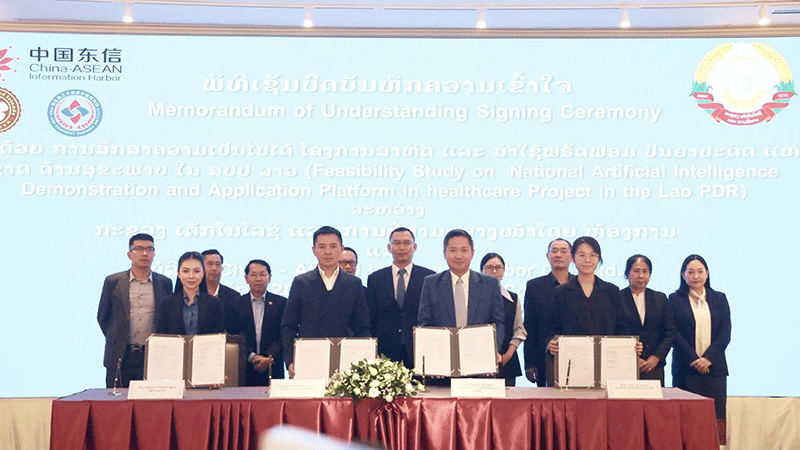
Lao government officials and Chinese company representatives display signed MoUs in Vientiane last week. –Photo Ministry of Technology and Communications
|
Laos, China partner in study of AI use in healthcare
A feasibility study on the demonstration and implementation of a National Health Artificial Intelligence (AI) Platform is to be conducted following the signing of an agreement between the Ministry of Technology and Communications and three Chinese partner companies.
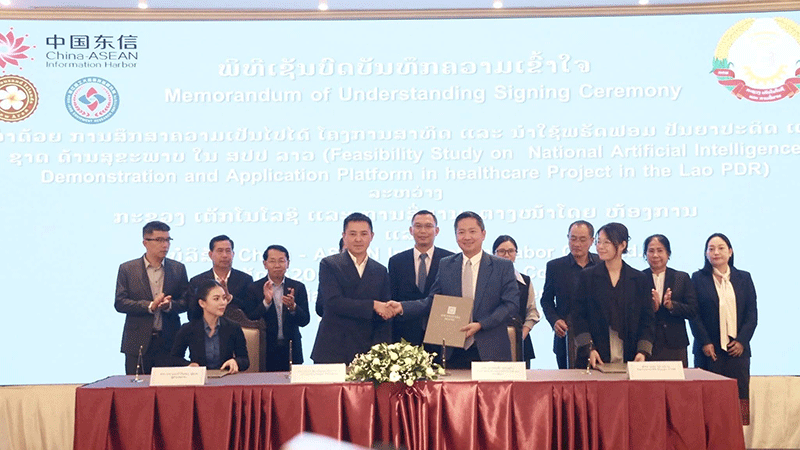
A Memorandum of Understanding on the initiative was signed in Vientiane on February 13.
 |
|
The partnership involves the Ministry alongside a consortium comprising 520 Medical Service Sole Co., Ltd. (a subsidiary of Sithandone Joint Development Co., Ltd.), China-ASEAN Information Harbor Co., Ltd., and the Zhenjiang Institute of Advanced Equipment.
The Memorandum of Understanding was signed by the Head of Office of the Ministry of Technology and Communications, Mr Phouangpaseuth Keosouvan; Vice President of China-ASEAN Information Harbor Co., Ltd., Ms Xuan Yi; and company representatives.
The signing was witnessed by Deputy Minister of Technology and Communications, Mr Keovisouk Solaphom, and attended by senior officials from the Ministry of Health, Mahosot Hospital, and corporate delegates.
The project is viewed as an important part of Laos-China cooperation under the “Belt and Road” framework. It will serve to align AI development between the two nations, with the healthcare sector identified as the primary field for initial implementation.
Under the agreement, the potential for AI to modernise medical services will be explored.
The study will focus on strengthening public health management, disease analysis, health screenings, and the digitisation of medical records.
By integrating these systems, the efficiency of medical professionals can be enhanced, and public access to treatment can be simplified.
It is envisaged that the healthcare sector will be the starting point for broader AI application.
Key objectives include improving diagnostic accuracy, optimising the allocation of medical resources, and supporting telemedicine services.
These advancements are expected to upgrade the overall capacity of the national health system and meet the needs of local communities, particularly those in remote areas.
By Souksamai Boulom
(Latest Update February 18, 2026)
|

