 |
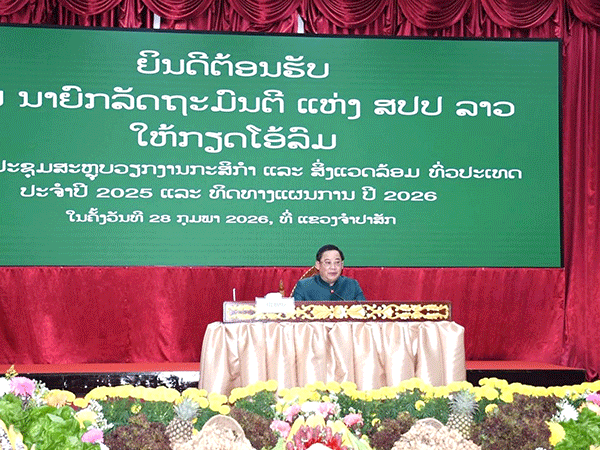
Prime Minister Sonexay Siphandone addresses the closing ceremony of the 2025 Agriculture and Environment review meeting in Champasak province on Friday.
|
PM calls for self-reliant growth with green focus
Prime Minister Sonexay Siphandone on Friday urged stronger agricultural production and trade while protecting forests, land and water on the path to building an independent, self-reliant economy.
Addressing the closing ceremony of the 2025 Agriculture and Environment Sector Review Conference in Champasak province, Dr Sonexay advised the Ministry of Agriculture and Environment to prioritise food security.
Laos must become self-reliant in terms of plant varieties, animal breeds, scientific techniques and other production inputs. The import of animal feed, fertiliser, pesticides and veterinary medicines should be reduced by expanding domestic production of these essentials, he said.
The Prime Minister also stressed the need to improve soil quality and protect good farmland, backed by proper irrigation and other infrastructure. Production zones should be clearly organised and focused, he added.
Water use must be optimised for the greatest benefit. During the rainy season, farmers should grow more rice, and in the dry season grow high-value crops that generate income.
Dr Sonexay said agriculture must go beyond subsistence and meet domestic food needs, with more crops grown and meat produced to replace imports and for sale to other countries. This is essential to generate more revenue for the state, as farm output has the potential to form the base of a stronger processing industry.
He urged the relevant sectors to improve plant health and the processing and distribution of goods between provinces. Seed reserves and food stockpiles should also be built up to respond to climate change, droughts and floods.
Farmers need support to upgrade production methods and improve quality so they can earn more money and enjoy a better standard of living, he said. All sectors must work closely and shift towards planned production with clear targets and stable markets.
Agricultural produce must meet the standards set by both domestic and foreign markets. Each area should build on its comparative strengths and link production to processing to create added value and distinctively Lao products, he advised.
The Prime Minister also called for talks with neighbouring countries to create more markets for Lao goods, especially for clean, fresh and pesticide-free produce. Policies should be formulated to encourage investment in on-site processing and value-added activities.
He also urged people to consume good-quality Lao products on sale at reasonable prices and encouraged more production to serve the tourism industry.
With regard to structural reform, Dr Sonexay highlighted the need to modernise agriculture through technology and large-scale, specialised production zones. Fragmented production must shift towards chain-based systems that increase volume, improve quality, cut costs, and strengthen competitiveness.
He also encouraged new forms of group and cooperative production, as well as farm-based models linked to scientific techniques and small- and medium-sized enterprises.
The Prime Minister also cited forest management as another priority. The government aims to achieve 70 percent forest cover, restore degraded areas, and carry out focused tree planting. Strict forest protection is needed to reduce the impact of droughts and flooding and ensure sufficient water is available for farming.
Land management also requires urgent attention. The National Master Plan for Land Allocation must be expanded nationwide to guide development and conservation. Land titles and use rights should be issued, including for people living in the three types of forest areas.
The Prime Minister called for stronger action against land grabbing, illegal transfers, duplicate land titles, and forest encroachment.
Environmental protection must move forward in a practical and green direction, based on far-reaching natural resource planning, effective zoning, and better waste management.
He proposed improved water governance, including the possibility of establishing a National Water Resources Management Committee. Water management should shift from sector-based control to watershed-based management.
The country must balance water releases from hydropower and irrigation reservoirs so they do not affect livelihoods. Disaster management should move from emergency response to proactive monitoring and early warning using modern technology.
Groundwater should be strengthened as a strategic reserve during droughts, while water pollution control and riverbank management must improve.
Rural development and poverty reduction remain central tasks. The government will draw up a strategic plan linked to stable settlement and livelihoods to reduce irregular migration. Private investment should be encouraged to create jobs and income in rural areas, alongside more widespread implementation of the Party’s Three Builds directive.
In conclusion, Dr Sonexay said agriculture, environmental protection and rural development must move forward together to secure long-term growth and stability for Laos.
By Times Reporters
(Latest Update March 3, 2026)
|

