 |
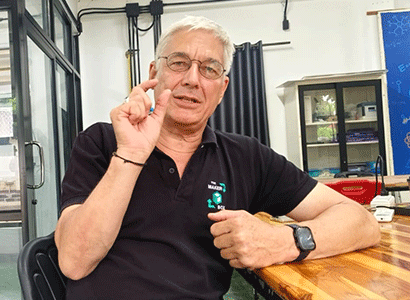
| Mr Ken Streutker says developing AI tools tailored to the Lao language could help improve accessibility while preserving the country's linguistic heritage. |
Local developer set to launch AI text-to-speech tool inspired by Covid-era challenge
A Lao start-up technology company is preparing to launch a locally developed Lao-language text-to-speech (TTS) platform in the coming months, a move that could make it among the first companies in Laos to introduce such technology and potentially improve accessibility and digital services in the country.
The project by Makerbox grew out of an unexpected challenge during the Covid-19 pandemic, according to the company's Chief Executive Officer, Ken Streutker.
Speaking in an interview with Vientiane Times, Mr Streutker said the idea originated in 2021 when he was serving as head of marketing at Lao Telecom and received a request from a United Nations agency seeking services to deliver Covid-19 awareness messages in audio form for blind and visually impaired people.
Initially, the request seemed straightforward.
"We thought it would be simple," Mr Streutker said. "But then we discovered there was no Lao text-to-speech capability available."
Without technology capable of automatically converting Lao text into speech, staff had to consider manually reading messages to recipients.
The experience highlighted a broader technological gap and later inspired a longer-term effort to develop Lao-language voice technology.
As pandemic restrictions eased, the concept resurfaced during a hackathon focused on disability-related solutions, where a student team created an early prototype that eventually evolved into a major project under Makerbox.
The company later received support from the Swiss Development Corporation (SDC), while UNICEF provided technical guidance related to AI and language-model development.
Beyond improving accessibility, the project also aims to address challenges linked to Lao language preservation and digital innovation.
Mr Streutker said one of the biggest hurdles in developing the system is the limited amount of digital Lao-language content available for AI training.
Unlike major languages such as English and French, Lao is considered a "low-resource" language in artificial intelligence development, meaning there is relatively little digitised data available to train AI systems.
Developers require extensive collections of digital text paired with audio data to teach systems how words should be pronounced and understood.
However, much Lao-language content remains in printed form rather than digital formats.
"Many books exist physically in libraries, but they are not available as usable digital text," Mr Streutker said.
The challenge extends beyond digitisation. Copyright considerations, variations in spelling across historical periods, differences in fonts, and linguistic complexities within Lao script all create additional barriers.
According to Mr Streutker, Lao's writing system presents unique technical difficulties because vowels can appear above, below, before or around consonants, making machine recognition more complicated than in some other languages.
To help build legally usable training data, Makerbox plans to launch a nationwide writing competition encouraging people to submit original Lao-language content. The initiative aims to generate copyright-cleared digital material that can be used to train optical character recognition (OCR) systems and AI language models.
The company is also developing speech-to-text technology that could eventually help professionals such as journalists, secretaries and office workers automatically convert spoken words into written documents.
The initial release is expected to include six AI voices — three male and three female — based on the Vientiane dialect, with plans to gradually expand to other regional accents.
Mr Streutker said cooperation among government agencies, academic institutions and private developers would be important in advancing Lao-language technologies.
As artificial intelligence continues to expand globally, he said locally developed tools could help ensure the Lao language remains relevant in an increasingly digital world.
By Souksakhone Vaenkeo
(Latest Update June 24, 2026)
|

