 |
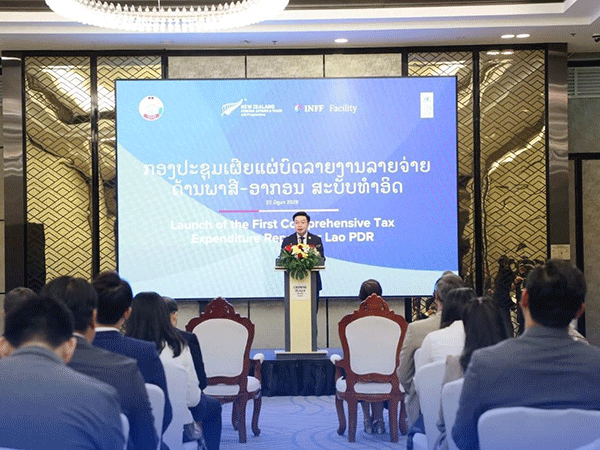
| The Deputy Minister of Finance, Mr Soulivath Souvannachoumkham, speaks at the launch of Laos’ first Tax Expenditure Report in Vientiane on June 22. --Photo MOF |
Tax report exposes rising cost of incentives
The Lao government has released its first Tax Expenditure Report, which revealed that revenue losses from tax exemptions and incentives rose to 876.42 billion kip in 2023.
The report, unveiled by the Ministry of Finance and the United Nations Development Programme (UNDP) in the Lao PDR on Monday, provides the country’s first comprehensive assessment of revenue forgone through preferential tax policies and marks a major step in strengthening fiscal transparency, the Ministry of Finance said.
Tax expenditures are revenues the government does not collect because of exemptions, reductions and other preferential tax measures. Measuring these costs gives policy-makers a clearer understanding of how tax incentives affect state finances and provides an evidence base for future reforms.
According to the report, tax expenditures increased significantly in recent years. Revenue losses stood at 114.86 billion kip in 2019, before jumping to 395.45 billion kip in 2020, partly due to tax exemptions introduced during the Covid-19 pandemic.
The figure fell to 287.57 billion kip in 2021 but rose again to 518.27 billion kip in 2022. By 2023, tax expenditures had reached a record 876.42 billion kip, equivalent to 0.6 percent of the country’s gross domestic product (GDP).
Value-added tax and import duty exemptions accounted for almost all of the forgone revenue. In 2023, value-added tax exemptions resulted in revenue losses of 483.43 billion kip, while import duty exemptions accounted for another 388.20 billion kip.
The report attributed the increase to investment incentive policies linked to concession projects and exemptions on imports of machinery and raw materials. Inflation and the depreciation of the kip also increased the value of tax expenditures when calculated in kip terms.
Speaking at the release of the report, the Deputy Minister of Finance, Mr Soulivath Souvannachoumkham, said assessing revenue losses is an important tool for improving fiscal management.
“By examining revenue forgone, the report provides an important evidence base to inform policy discussions, strengthen domestic resource mobilisation, and support more transparent, accountable and sustainable public financial management,” he said.
The ministry said the report is the result of several years of technical cooperation between the Ministry of Finance and the UNDP, with support from New Zealand’s Ministry of Foreign Affairs and Trade and the Integrated National Financing Framework unit.
The UNDP Representative in Laos, Ms Martine Thérer, said the report forms part of broader efforts to finance the priorities set out in the 10th National Socio-Economic Development Plan for 2026-2030.
“Globally, Official Development Assistance (ODA) flows are declining. For Laos, domestic financing has become essential to advancing national development priorities. Tax expenditure analysis is a key reform area to strengthen the Government’s revenue mobilisation potential,” she said.
Representatives of government agencies and development partners reviewed the report’s findings, discussed ways to improve budget transparency and efficiency, addressed financing gaps and supported the priorities of the 10th National Socio-Economic Development Plan for 2026-2030.
By Phonepaseuth Volakhoun
(Latest Update June 24, 2026)
|

