Streetwise
30 Years, One column, Millions of opinions
For three decades (1996-2026), Streetwise has been more than just the most widely read column in the Vientiane Times. It has served as a platform for the voices of the people and the newspaper’s readers, a mirror of public opinion, and a witness to the changes of the times, leaving an enduring legacy in the memories of generations of readers.
The Vientiane Times is currently interviewing readers, including high ranking officials and ambassadors, who are close followers of developments as portrayed in the media, in the run-up to the First Lao Media Congress, which will take place in July.
As Laos prepares for the future, what do you believe are the most important changes and improvements the media can make to better serve society, support national development, and remain relevant in the digital age?
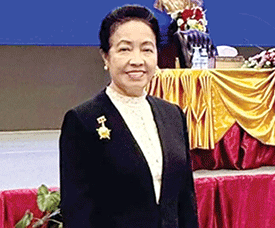 |
| Ambassador Malayvieng Sakonhninhom. |
Ambassador Malayvieng Sakonhninhom, a former ambassador and writer who has worked on books by national leaders, believes the media must make three important shifts to better serve the public and remain relevant in the digital age.
First, it must shift from “announcing” to “explaining”.
Today, people are flooded with information but starved of understanding. Reporters should improve their ability to translate complex national policies, laws, and development plans into simple, human-centred stories. My experience editing Letters to My Grandchildren taught me that people absorb ideas best when they are expressed in clear, meaningful language. Reporters must be educators, not just messengers. When a farmer understands how the Laos-China Railway helps him sell his fruit more quickly and efficiently, then the media has truly served development.
Second, shift from “local only” to being a “bridge to the world”.
To advance national development, the media must improve its international storytelling. During my diplomatic service from 2011 to 2015, I saw how the world often judged Laos through short news clips. We must change this by producing bilingual, digital content that presents the real Laos—our culture, our resilience, and our young entrepreneurs. I translated When He Was Prime Minister into English in 2024 for this reason. The media should do the same every day. In-depth reporting equals strong soft power for Laos.
Third, shift from “chasing speed” to “building trust”.
In the digital age, speed cannot compete with social media platforms such as Facebook, TikTok, and others, but trust can. The most important improvement the media must make is to become the country’s “trust benchmark”. With the rise of AI and fake news, people need a reliable source they can trust to provide verified information. The media industry should invest in fact-checking teams, data journalism, and strong ethical standards. Speed without truth is noise. Truth with responsibility is influence.
For Laos to better prepare for the future, the media should focus on three objectives. First, act as a teacher that educates and empowers citizens; second, become an ambassador that tells Laos’ story to the world; and third, be a guardian that protects the public from false information. If these changes are made, the media will not only survive the digital age but will help lead it.
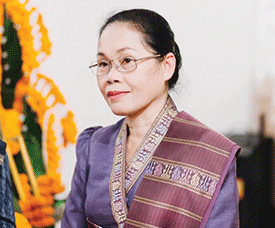 |
| Deputy Minister of Culture and Tourism, Mrs Darany Phommavongs |
Deputy Minister of Culture and Tourism, Mrs Darany Phommavongsa, said “The media plays an important role in supporting Laos’ socio-economic development. In recent years, the media has developed significantly in terms of infrastructure, technology, and content quality.
I believe that, as the world continues to undergo rapid digital transformation, the media must adapt to these changes by embracing modern technologies, including Artificial Intelligence (AI) and data analytics systems, to support media and communication work. This will help improve the efficiency of content production, enhance the speed of information dissemination, and expand access to information for people across the country. At the same time, media organisations must uphold professional ethics, accuracy, and credibility in reporting in order to effectively combat fake news and misinformation, which are among the major challenges facing today’s news consumers.
At the same time, the government and other stakeholders should invest more in the development of media professionals by equipping them with modern knowledge and skills in multimedia production, digital technologies, data journalism, and foreign languages. Such investments will enable reporters to compete and collaborate effectively with their counterparts at both regional and international levels.
Furthermore, the media should play a stronger role in promoting Laos’ strengths, cultural heritage, national identity, and special traditions among the international community. By doing so, the media can build a more positive image of Laos, attracting both tourists and investors, and enhance the country’s visibility and influence on the global stage.
In addition, the media should create innovative digital platforms and strengthen its capacity to engage younger audiences through more appealing communication channels. This will not only ensure the sustainability of the media industry but also support national development goals by fostering a well-informed, connected, and digitally empowered society.
Through these efforts, the media can continue to serve as a key partner in national development, contributing to economic growth, social progress, cultural preservation, and the successful integration of Laos into the regional and global community.
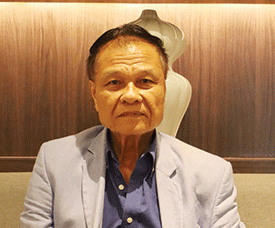 |
| Former Deputy Minister of Information, Culture and Tourism (currently the Ministry of Culture and Tourism), Mr Savankhone Razmountry |
Former Deputy Minister of Information, Culture and Tourism (currently the Ministry of Culture and Tourism), Mr Savankhone Razmountry, said “With the changing media landscape globally and in the digital age I think it’s essential that the Lao media industry embraces digital advances. It’s also necessary to run digital media literacy campaigns among the public, in order to better serve national development and interests.”
President of the Lao Diplomatic Club, Mr Xayakane Sisouvong, said “Today, the media industry is in a much better position to leverage global digital tools (AI, platforms) to serve domestic development goals such as LDC graduation and capacity building, while making greater use of our soft power and placing greater emphasis on our cultural heritage, ethnic diversity, and Mekong identity.”
1. The Dual Landscape:
A. Global Pressures: geopolitical changes, digital disruption; AI revolution, disinformation crisis, regional industrial competition and global soft power race.
B. Domestic Imperatives: LDC Graduation (loss of ODA/trade preferences by 2030); 10th National Socio-Economic Development Plan: with expected an average of 6 percent GDP annual growth, US$3,104 GDP/capita by 2030; new Media Law replacing Resolution No. 36; there are 49 multi-ethnic groups; young digital-native population.
2. Strategic Pivot: Compete on culture, Not Industry:
Laos cannot out-produce China, Thailand or Vietnam. Laos should continue to promote its special features such as ecotourism, high-value crops like premium coffee and tea, and ethnic handicrafts. The media must reframe success:
A. Promote sticky rice/food, Mekong heritage/songs, Lamvong dances; UNESCO sites, traditional medicine, Buddhist spirituality as our global currency.
B. Position Laos as the “green, clean and safe connector” within ASEAN, not just landlocked but land-linked and increasingly connected.
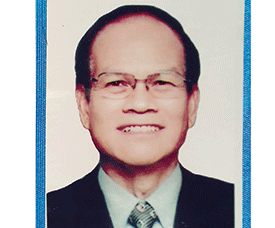 |
| President of the Lao Diplomatic Club, Mr Xayakane Sisouvong |
3. AI: Creative & Constructive, Not Replacement:
A. Constructive (service): AI translation to export Lao content globally in 24 hours; AI verification to combat misinformation and further promotion of culture of farmers in ethnic dialects (weather/prices).
B. Creative (Amplification): AI upscaling of historical archives into “Mekong Memories”. “Lao GPT or DeepSeek” chatbot for tourism and folklore education. AI dubbing/cloning to make documentaries regionally accessible.
4. Inclusive Reach & Regional Economic Integration:
a. Expand multilingual content such as Khmu, Hmong etc. via mobile-first strategies.
b. Engage youth through streaming, gamification, and interactive formats.
c. Strengthen ASEAN media cooperation to support economic integration and build investor confidence through credible reporting.
5. The Bottom Line:
“We don’t make the cheapest goods; we craft the most authentic stories”.
a. Legal--Adopt a new media framework.
b. Technological--Use AI to preserve and amplify our cultura DNA.
c. Philosophical--Redefine development as sustainable, culturally rich, and regionally connected.
Finally: As Laos graduates from LDC status, enable the media to graduate from being merely policy transmitters to architects of national pride and global cultural connection. We should not view the digital age as a threat, but as an amplifier of the messages and image we wish to convey.
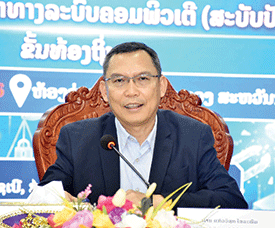 |
| Deputy Minister of the Ministry of Technology and Communications, Mr Keovisouk Solaphom |
Deputy Minister of the Ministry of Technology and Communications, Mr Keovisouk Solaphom, said, Today’s media landscape has shifted to online and social media platforms controlled by AI algorithms, which present both opportunities for fact-checking and challenges from misinformation and deepfakes. To address these issues, Lao media must develop by training journalists in digital skills, fact-checking, and ethical reporting. Additionally, the media should expand into online platforms with engaging multimedia content, adopt new technologies responsibly, and improve news quality while promoting national development and cultural identity in the digital era.
By Phon Thikeo
(Latest Update June 26, 2026)
|

