 |
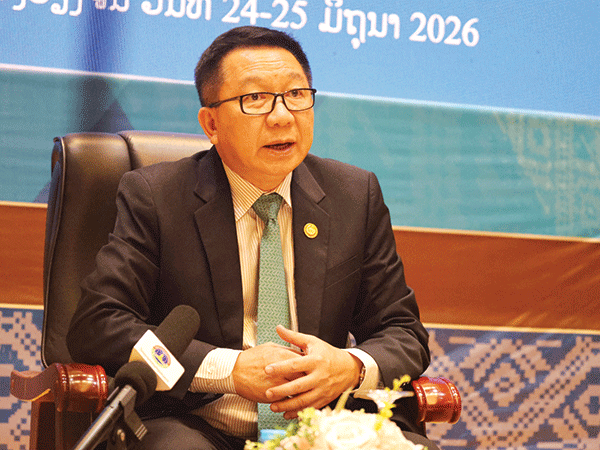
| Dr Linkham Douangsavanh speaks to reporters while attending the first expanded government cabinet meeting of 2026 at the National Convention Centre in Vientiane last Thursday. |
Agriculture ministry boosts exports, targets 4.1 percent growth
The Ministry of Agriculture and Environment is targeting 4.1 percent growth in 2026 for the agriculture sector, which is expected to contribute 20.7 percent to GDP this year and boost efforts to create a more self-reliant economy and ensure sustainable development.
Speaking to reporters during the first expanded government cabinet meeting of 2026 last Thursday, Minister of Agriculture and Environment Dr Linkham Douangsavanh said the target growth figure is being pursued through measures to strengthen food security, expand agricultural exports, improve land and natural resource management, and enhance the sector’s contribution to economic growth.
The agriculture and environment sector has already made notable progress during the first six months of this year, particularly in boosting exports, generating rural employment, and supporting macroeconomic stability, Dr Linkham said.
A key achievement is the expansion of export markets, with Laos securing market access for 84 agricultural and livestock product lines in neighbouring countries. These include 41 product categories approved for export to China, 19 to Vietnam, 17 to Thailand, and seven to Cambodia.
During the first five months of 2026, exports of crops and crop products generated US$752 million, equivalent to 62.6 percent of the 2026 target of US$1.2 billion. Exports mainly comprised bananas, dried cassava, watermelons, cassava starch, and coffee.
Exports of livestock and livestock products grew to US$81.21 million, accounting for 40.6 percent of the 2026 target of US$200 million, while exports of timber, timber products and non-timber forest products totalled US$158.64 million.
To support food security and improve productivity, the ministry encouraged the cultivation of more dry season food and commercial crops, particularly rice, legumes and vegetables, while encouraging the development of agricultural production groups and cooperatives through the adoption of modern technology and clean farming methods.
The ministry also reported progress in land administration, registering 52,887 land parcels during the first half of the year. This figure represents 38 percent of the 2026 target of 140,000 plots of land.
Dr Linkham said efforts are being made to strengthen environmental management and create new opportunities for green growth. The ministry has drafted regulations to support carbon credit trading in the agriculture and environment sectors, and continues to strengthen environmental and social impact assessments of large-scale development projects.
In addition, the ministry is working with international partners to source funding for climate change adaptation and biodiversity conservation, while advancing the use of digital technologies in agricultural land management, forest monitoring, and public service delivery.
A pilot project linking the Lao Land Registration database with the Ministry of Finance’s TaxRis system has been successfully implemented to improve revenue collection and enhance administrative efficiency.
Looking ahead, the ministry will continue implementing seven priority programmes covering food and nutrition security, agricultural and forestry production for trade, forest management and protection, land administration, water resource management, environmental protection, and rural development and poverty reduction.
Priority tasks for the remainder of the year include issuing more land titles, upgrading irrigation, improving plant and animal quarantine facilities along the Laos-China Railway corridor, strengthening forest protection measures, production of more fertiliser and animal feed, and advancing the development of a modern digital land information system.
These efforts are part of the government’s broader strategy to use the country’s potential more effectively, strengthen economic resilience, and promote rapid, green and sustainable development, Dr Linkham said.
Based on lessons learned from the implementation of the previous five-year development plan, the Ministry of Agriculture and Environment aims to achieve 4.6 percent growth in the agriculture sector, with the sector contributing 21.9 percent to GDP. In 2026 alone, the ministry is targeting growth of 4.1 percent and a 20.7 percent contribution to GDP.
The ministry’s strategy is centred on seven programmes involving food and nutrition security; agricultural and forestry production and processing for trade; forest management, protection and utilisation; land allocation and management; water resource management; environmental protection; and rural development and poverty alleviation.
By Bounfaeng Phaymanivong
(Latest Update June 30, 2026)
|

