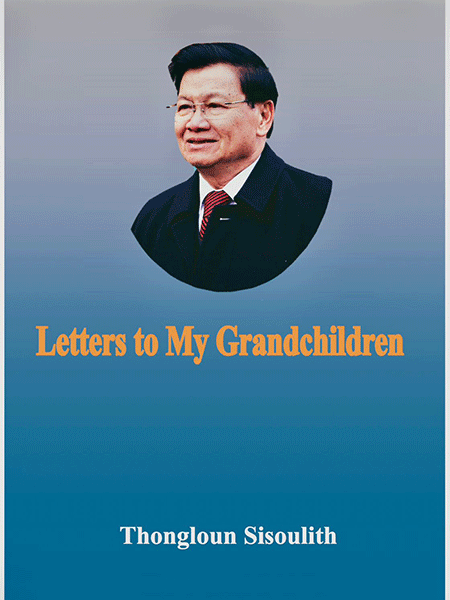
What lessons would a nation’s leader choose to leave for future generations?
Continued from the last issue
In Letters to My Grandchildren, President Thongloun Sisoulith opens a window into his life through a collection of heartfelt letters written during official journeys abroad between 2014 and 2019. More than a family memoir, the book recounts an extraordinary journey from a humble childhood in a remote village in Huaphan province to the highest office in the Lao PDR.
Through vivid recollections of hardship, perseverance, education, and public service, President Thongloun shares the experiences and values that shaped his character and leadership. Readers will encounter the story of a young boy who crossed rivers to attend school, overcame poverty and adversity, and remained steadfast in his pursuit of knowledge and service to the nation.
Rich with personal reflections and life lessons, Letters to My Grandchildren offers a rare and intimate portrait of the man behind the presidency while providing inspiration for young people, parents, and leaders alike. It is a story not only of one individual’s journey but also of resilience, dedication, and the enduring belief that determination can transform even the most modest beginnings into a life of remarkable achievement.
The book comprises 12 chapters, and the Vientiane Times will present each chapter in the newspaper.
 |
| |
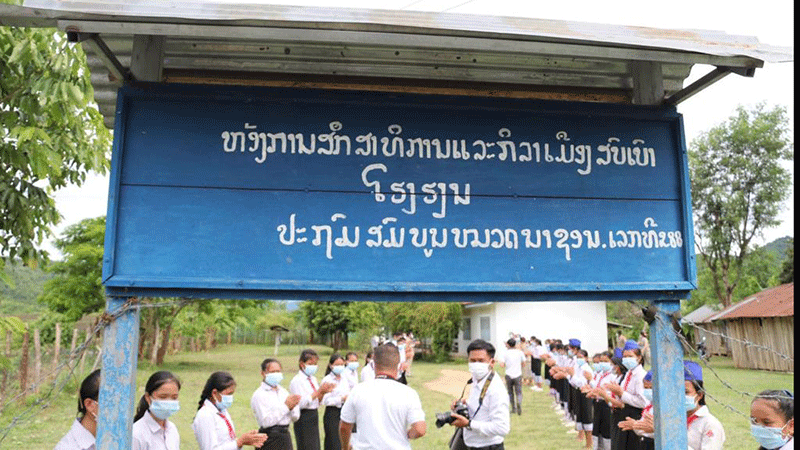
Chapter 2 - The Road to School
As soon as first light showed the path, I set out alone for school every day. The 4–5 kilometres took a little over an hour, but I didn’t feel very tired or lonely walking and at the same time reciting by heart the passages the teacher would test me on kept me company along the way. The most dangerous part was crossing the Ma River to the far bank. Sometimes there was no boat; sometimes the boat was on the opposite side. Afraid of being late, I would take off my clothes, keep my books and clothes on the near bank, swim across to fetch the boat, paddle back for my things, then row over again to make it to class on time. In winter and during the flood season, though, there were times I had to miss school and trudge home, disappointed.
One rainy season, the downpour was heavy and the Ma River was in full flood—water rushing hard with logs sweeping past—so there was no way to cross by boat. I went to my maternalgrandmother’s house and asked to stay the night so I could get to school the next day, waiting until the current subsided enough to return home. Grandma was delighted to have me; she fussed over me like her own beloved grandchild and told me under no circumstances to try crossing the Ma River—it was far too dangerous. “Stay with Grandma and Grandpa,” she said.
“Your parents will worry, of course, but they’ll feel at ease knowing you’re here.” I lasted only two days. On the third, I went to check the river and saw it had dropped a little; there weren’t as many floating logs. I spotted a small boat tied to a tree, but there was no paddle. After school let out, I decided to cut a branch and make a paddle myself, untied the boat, hauled it upstream along the head of the rapids for about 500–600 metrers, then paddled diagonally across the current toward the far shore to get home. I rowed as if my life depended on it, keeping the boat from being sucked into the dangerous rapids. If the boat—and I with it—had been swept into the churning water, there would have been no hope: the tor rent would have hurled the boat against the rocks, smashing it to pieces—and likely taking my life as well.
Continued to the next issue
By Times Reporters
(Latest Update June 30, 2026)
|