 |
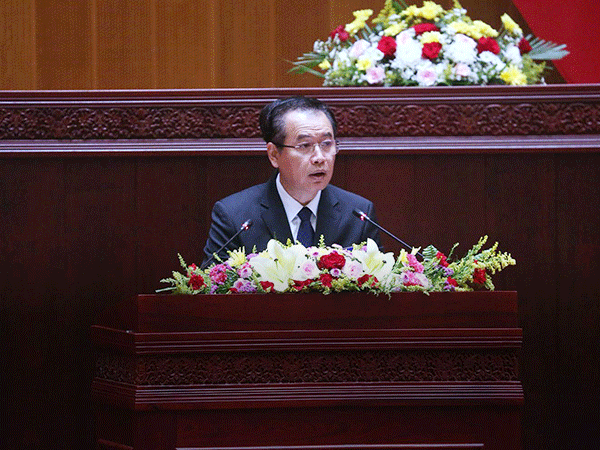
| Mr Malaythong Kommasith addresses an Extraordinary Session of the National Assembly on Tuesday. |
Minister cites “sticky” prices as reason for continuing high costs
Lower fuel prices have yet to bring about a reduction in the cost of most goods and services because businesses still face high costs and economic uncertainty, the National Assembly heard on Tuesday.
Minister of Industry and Commerce, Mr Malaythong Kommasith, said falling fuel prices alone were not enough to bring down the price of consumer goods.
“In economic terms, once prices rise, they tend to be slow and difficult to lower, a phenomenon referred to as sticky prices, as businesses remain concerned about economic uncertainty and risk,” he said.
He explained that businesses are still selling stock purchased at a time when fuel, transport and raw material costs were much higher than at present.
Responding to questions from lawmakers during an Extraordinary Session of the National Assembly this week, Mr Malaythong said several factors are keeping prices high despite a sharp fall in the price of fuel in recent months.
This is because producers, importers and retailers continue to bear the cost of goods bought or produced when fuel prices were at a record high. These costs cannot be recovered by immediately lowering retail prices.
At the same time, businesses continue to be saddled with higher labour, warehouse rental and logistics costs, which have not fallen in line with fuel prices. Economic uncertainty has also made companies reluctant to reduce prices too quickly.
Mr Malaythong acknowledged that controlling prices across the economy remains a major challenge.
Although the monitoring of price structures is an important economic tool, he said it is difficult to apply to every product because of the large number of goods on the market, limited pricing staff, and incomplete cost data. Artificially setting prices below actual costs could also distort market mechanisms, leading to shortages and encouraging informal trade.
Instead, the Ministry of Industry and Commerce is monitoring the price of essential goods such as fuel, sticky rice, pork, chicken, eggs, tilapia and catfish.
To strengthen market oversight, the ministry requires businesses selling controlled goods to submit detailed price structures showing production and purchase costs, transport costs, sale price, and profit margins before prices are approved.
Officials are also stepping up checks of price labels to ensure transparency and prevent unfair pricing.
The ministry is working closely with provincial and district industry and commerce offices to respond quickly to consumer complaints, while opening hotlines so people can report suspected price manipulation.
The government is also taking steps to prevent hoarding and stabilise supplies. Fuel importers have begun submitting stock information through the Digital Trade Operations Platform, allowing officials to monitor fuel reserves more effectively and reduce the risk of supply shortages.
Mr Malaythong said businesses found hoarding goods, failing to display prices, or deliberately manipulating prices would face progressively tougher penalties. These include warnings, fines, suspension or cancellation of business licences, and confiscation of goods in the case of serious or repeated offences.
Despite the recent decline in fuel prices, the government has paid a high fiscal cost to shield consumers from global oil price volatility.
According to figures from the Macroeconomic Research Institute, the government reduced the fuel consumption tax between March 18 and June 30, resulting in forgone tax revenue of about 1,948 billion kip.
This is equal to 2.7 percent of projected tax revenue for 2026, or about 0.5 percent of Gross Domestic Product.
The tax reduction, together with lower global oil prices, helped drive down domestic fuel prices after they reached record levels in April.
Average petrol prices fell from 46,930 kip per litre in April to 26,405 kip in June, a decline of 43.7 percent. Diesel prices dropped from 39,198 kip to 30,799 kip per litre, down 21.4 percent over the same period.
The Macroeconomic Research Institute said the earlier surge in fuel prices had pushed up transport costs and the price of goods and services nationwide, contributing to inflation of 8 percent during the first six months of 2026.
Consumer prices rose by 5.3 percent in April alone, but the Consumer Price Index fell by 0.8 percent by June as fuel prices eased.
Looking ahead, Mr Malaythong said maintaining stable prices would require stronger cooperation across government agencies and greater support for domestic production.
Quoting remarks made by President Kaysone Phomvihane in 1982, he said fair pricing remains “one of the most important yet most complex tasks” facing the country.
He added that the ministry would continue to strengthen price monitoring, improve coordination with other sectors, and encourage higher productivity to help ease prices over the longer term.
By Phonepaseuth Volakhoun
(Latest Update July 9, 2026)
|

