 |
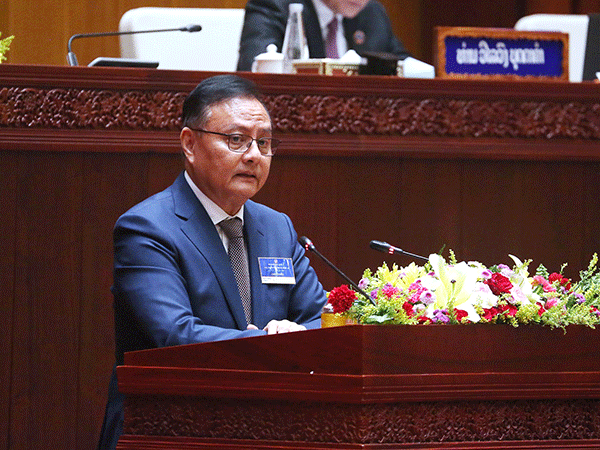
| Deputy Prime Minister and Minister of Finance, Mr Santiphab Phomvihane. |
National Assembly adopts poverty reduction as national agenda, targets 100,000 families by 2030
The National Assembly has approved a National Agenda on Rural Development and Poverty Reduction, making the fight against poverty the government’s top development priority and setting a target to lift 100,000 families out of poverty by 2030.
The four-year agenda (2027-2030), adopted on Wednesday during the first extraordinary session of the National Assembly’s 10th legislature, aims to reduce the national poverty rate from 14.78 percent to 8 percent through sustainable job creation, improved infrastructure and expanded access to essential public services.
Presenting the draft agenda to lawmakers, Deputy Prime Minister and Minister of Finance, Mr Santiphab Phomvihane, said the initiative is designed to tackle the root causes of poverty by creating stable employment and sustainable income opportunities, particularly for disadvantaged rural communities.
He said the government will accelerate infrastructure development and improve access to basic public services, including healthcare, education, clean water and other essential facilities, to raise living standards and improve the wellbeing of poor households.
According to the 2025 national poverty assessment, which surveyed 1,283,251 families in 8,413 villages across 148 districts nationwide, 189,792 families—equivalent to 14.78 percent of all households surveyed—remain below the poverty line.
Through the implementation of the national agenda, the government expects to lower the poverty rate to about 8 percent by the end of 2030.
The strategy also prioritises permanent settlement and sustainable livelihoods for local communities in an effort to reduce unplanned migration and strengthen long-term rural development.
Another key objective is to reinforce grassroots political institutions, enabling local authorities and communities to play a greater role in driving development and implementing poverty reduction initiatives.
To support these goals, the agenda calls for increased investment from both domestic and international sources, alongside stronger legislation and more effective implementation mechanisms.
Priority measures include expanding vocational and livelihood skills training, promoting integrated agricultural production, encouraging commercial farming, strengthening local governance, and improving the legal and institutional framework for rural development.
The poverty assessment identified several major obstacles to poverty reduction, including limited employment opportunities, unstable household incomes, dependence on government assistance, and continued reliance on traditional livelihoods.
Many poor families also face inadequate access to healthcare, education and clean water, while numerous villages remain constrained by poor road connectivity, lack of electricity, and insufficient telecommunications and transport infrastructure.
By Phetphoxay Sengpaseuth
(Latest Update July 9, 2026)
|

