 |
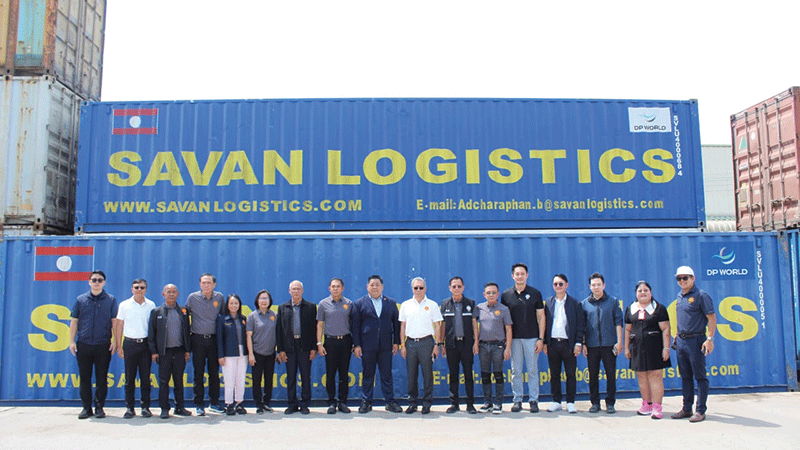
Company representatives join visitors for a group photo to mark the visit of the Thai Senate delegation to the Savannakhey Dry Port and SEZ last week. |
Savannakhet Dry Port to link with Mukdahan rail yard, expanding regional logistics
Savannakhet Dry Port is strengthening its position as a regional multimodal logistics hub by establishing a direct connection with the Mukdahan railway container yard in Thailand. The initiative aims to create a seamless road–rail–dry port network along the East–West Economic Corridor (EWEC).
The proposal was highlighted during a study visit by the Committee on Transport of the Senate of Thailand to Savannakhet on August 14 to examine transport connectivity, border trade, and cross-border logistics between Thailand and Laos.
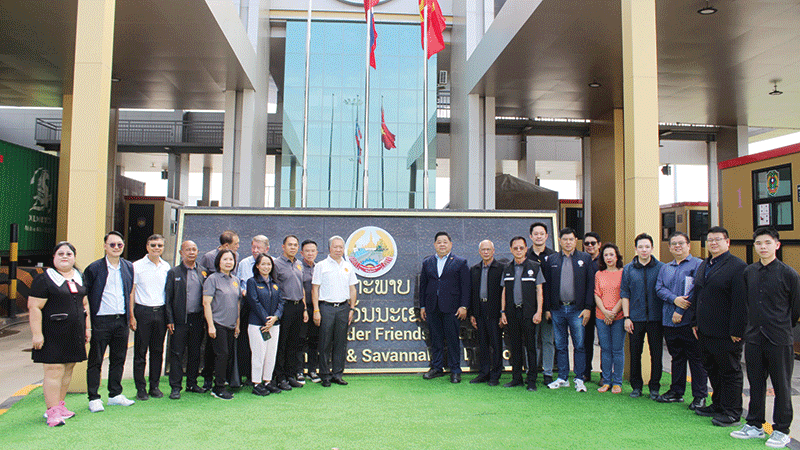 |
Thai Senate delegation joins company representatives for a commemorative photograph during the dry port tour. |
The Thai Senate delegation, led by the Chairman of the Committee on Transport, Mr Wutthichat Kalyanamitr, visited the Savan Park Special Economic Zone (SEZ) and Savannakhet Dry Port. The delegation was briefed on developments within the SEZ, transport infrastructure, and cross-border trade facilities.
The visit comes at an important time as Thailand and Laos seek to improve the efficiency of regional supply chains and make better use of existing transport infrastructure, while also positioning the corridor for extended connectivity towards Vietnam and the China logistics network via northern gateways.
High-level engagement with Savan Logistics and Savan Park SEZ
CEO of Savan Logistics, Mr Jean Pierre Grzelczyk, and Executive Director of the Savan Park SEZ, Mr Tee Chee Seng, received the delegation and presented the long-term development vision for Savannakhet as a regional logistics and industrial hub.
Discussions focused on strengthening multimodal links between Thailand and Laos, with particular emphasis on linking rail infrastructure in Mukdahan with the dry port and industrial zone in Savannakhet, and extending logistics flows further eastward to Vietnam and onward into China’s southern logistics corridors.
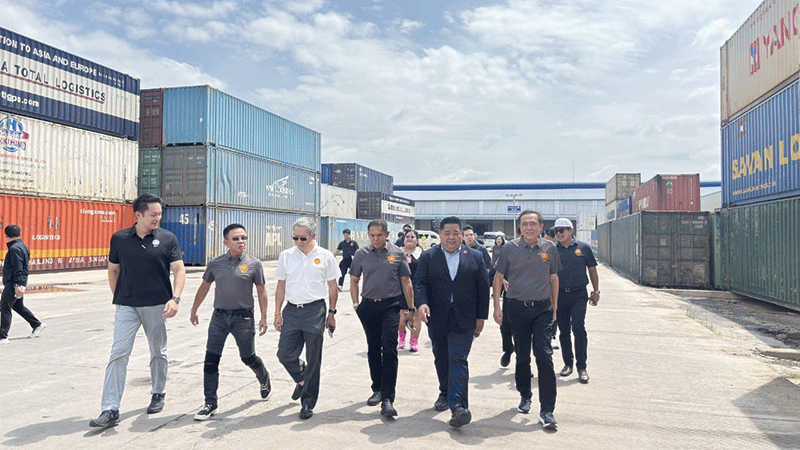 |
The delegation takes a tour to view operations at the dry port. |
Building a road–rail–dry port link
The Executive Director of the Savan Park SEZ and Savannakhet Dry Port said the next stage of development should be to connect the Mukdahan railway container yard with the Savannakhet Dry Port, allowing cargo to move more efficiently between Thailand’s rail network and Laos’ logistics system.
Under the proposed logistics chain, cargo would move sequentially from the Thai rail network through the Mukdahan rail container yard, the Mukdahan border, the 2nd Thai–Lao Friendship Bridge, Savannakhet Dry Port, Savan Park SEZ, Vietnam, and the Chinese border, into the Chinese logistics network.
Savannakhet Dry Port is already positioned as an inland container and logistics facility on the EWEC, connecting Thailand and Vietnam. Its operator, Savan Logistics, describes the facility as an intermodal terminal providing road, ocean, and air cargo-related logistics services and customs clearance.
From border gateway to trans-regional logistics spine
Development of the Mukdahan–Savannakhet link would allow cargo to be consolidated, transferred, and distributed through a coordinated logistics system rather than being handled as separate road and border operations.
The concept is particularly relevant to the EWEC, which links markets across mainland Southeast Asia and provides a strategic east–west trade axis.
With the addition of Vietnam and China links, the corridor evolves from a bilateral trade route into a trans-regional logistics spine linking ASEAN mainland economies with China’s southern supply chain network.
Savan Park SEZ as industrial and export engine
The connection with Mukdahan’s rail infrastructure would also strengthen the relationship between transport infrastructure and industrial production.
Savan Park SEZ provides an industrial and investment platform alongside the Dry Port, creating potential cargo flows in both directions.
Raw materials, components, and machinery could move from Thailand by rail and road into Savannakhet, while manufactured products and export cargo from Laos could move through Savannakhet Dry Port to Vietnam and further onward to China’s border provinces and logistics distribution hubs.
Strategic opportunity: Thailand–Laos–Vietnam–China Corridor
The Thai Senate Committee’s visit reflects growing attention to the need for closer integration of transport networks between Mukdahan and Savannakhet, with a broader regional vision extending beyond ASEAN mainland connectivity.
The key opportunity is to develop the corridor as a multi-country logistics backbone, rather than treating each border segment as an isolated infrastructure node.
For Thailand, the connection provides rail-linked access to Laos, Vietnam, and indirect access to China’s southern logistics system. For Laos, it strengthens its position as a central transit hub between Thailand, Vietnam, and China.
Digital, customs, and cross-border integration
Physical connectivity must be supported by digital logistics systems and harmonised border procedures. Savannakhet Dry Port already provides customs-related services and logistics technology, including electronic seals for bonded cargo transfers, container tracking, and other logistics services.
This would enable a seamless multi-country logistics chain connecting Thailand, Laos, Vietnam and China.
Toward a pan-regional EWEC–China logistics corridor
Savannakhet Dry Port has operated since 2016 and is recognised as an important inland logistics facility in Laos, with DP World completing its acquisition of Savan Logistics in 2024 to strengthen the international logistics platform at Savannakhet (KPL).
The proposed link with Mukdahan’s railway container yard represents a key step in evolving the facility into a pan-regional logistics hub. The long-term vision is to develop Mukdahan–Savannakhet–Vietnam–China as a single integrated trans-Asian multimodal logistics corridor linking the EWEC with China’s southern logistics network.
The initiative supports the broader transformation of Savannakhet from a traditional border transit point into a strategic regional logistics, industrial, and multimodal transport hub within a wider ASEAN–China connectivity framework.
Delivering the core strategic message, representatives said: “The future is not only Thailand-Laos border connectivity. The future is a fully integrated Mukdahan–Savannakhet–Vietnam–China multimodal logistics corridor linking ASEAN with China’s logistics network.”
By Advertorial Desk
(Latest Update August 18, 2026)
|

