 |
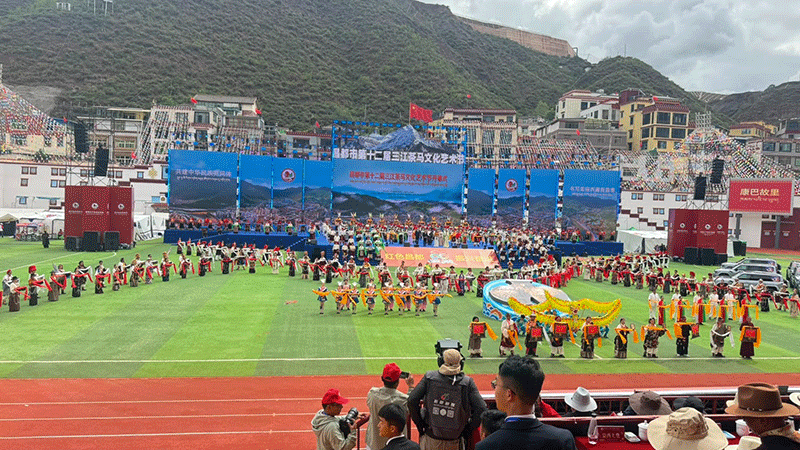
| Dancers perform in Changdu city, China. |
Tea Horse Road festival helps build ties between Laos and China
The ancient Tea Horse Road has become a new bridge for cultural exchange and cooperation between Laos and China, after a Lao delegation visited Changdu last month to attend the 12th Sanjiang Ancient Tea Horse Road Culture and Arts Festival and explore opportunities for closer cooperation in tourism, trade and investment.
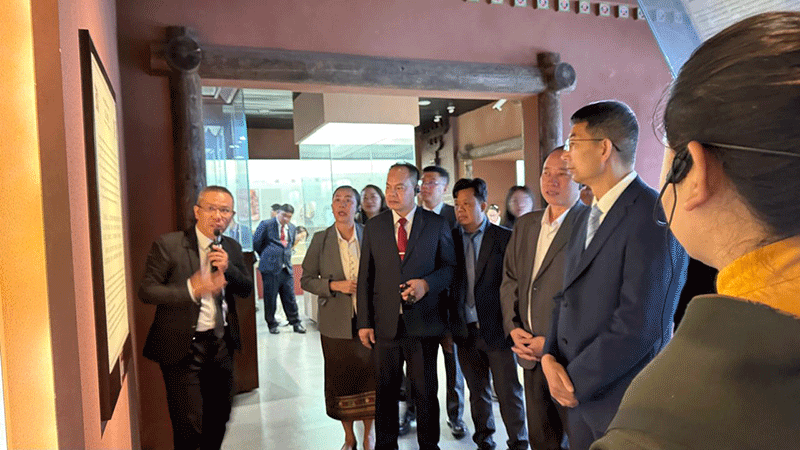 |
| A Lao media delegation views an exhibition in Changdu. |
Held from August 19 to 21, the festival featured traditional music and dance and other cultural activities, while highlighting Changdu’s rich heritage and its historical role as an important hub on the ancient Tea Horse Road.
Organised by the Changdu Municipal Committee and the Changdu Municipal People’s Government, the event used the Tea Horse Road and the Three Rivers region as the central themes for showcasing Changdu’s history, culture and development.
Ms Khaophone Phonepasit, a representative of the Lao National Chamber of Commerce and Industry (LNCCI), who attended the festival, said it gave her a new perspective on Changdu’s culture, tourism, economy and trade.
The experience offered more than an introduction to the culture of the highland city, she said, and was an opportunity to explore similarities and potential areas of cooperation between Changdu and Laos.
“This was my first visit to Changdu City in the Xizang Autonomous Region of China. It was an amazing experience and the performances at the opening ceremony particularly impressed me, as they introduced visitors to the customs, traditions and way of life of different ethnic communities in the region,” she said.
“I gained a better understanding of Changdu’s culture, tourism and economic and trade cooperation, and the event enabled visitors to learn more about Changdu City through dance performances,” she added.
The festival opened on August 19 at the Jin-Chang Sports and Cultural Centre. The programme combined traditional culture with modern forms performances, which were organised around the Tea Horse Road as a historical axis and the Three Rivers, namely the Jinsha, Lancang and Nujiang, as a geographical axis.
The programme featured traditional songs and dances, performances from other parts of China, music, tourism-related activities, a cultural market, and a drone light show.
A spectacular drone display on the evening of August 19 displayed images of the Tea Horse Road and ancient Karuo culture in the night sky above Changdu, linking the city’s historical heritage with modern technology.
Changdu is located in eastern Xizang and is associated with the upper reaches of the Lancang, Jinsha and Nujiang rivers. The city was once an important junction connecting Xizang with Sichuan, Yunnan and Qinghai and was a major trading centre on the Tea Horse Road.
The route not only enabled trade, but built connections between communities, leading to the sharing of cultures, traditions and ideas across the mountains.
Ms Khaophone said she also appreciated the warm welcome from Changdu officials after she and other members of the group arrived at the airport.
“The Vice Mayor of Changdu City personally welcomed us,” she said. “The hospitality of our hosts was very warm and kind. It made me feel as though I was one of the family.”
The hosts also took care of all transportation and accommodation during the group’s visit, she added.
“I would like to express my sincere thanks to the Government of Changdu City, especially the Vice Mayor of Changdu City and all the staff, for providing me with this wonderful opportunity to visit China,” she said.
She also expressed appreciation for the longstanding friendship and cooperation between Laos and China.
For the Vice Mayor of Pakse City, Mr Bounthavy Syhavong, the visit left a similarly strong impression. He said that although it was his first visit to Changdu, the warm reception made him feel closely connected with his hosts.
He was particularly impressed by the way Changdu has preserved its traditional culture while developing modern infrastructure and expanding its economy.
During the visit, the Lao delegation explored cultural and historical sites, giving them a closer insight into the city’s heritage and its links to the Tea Horse Road.
Mr Bounthavy said the visit provided lessons that could be useful for Pakse, particularly in balancing cultural preservation with urban development and tourism.
Representatives from Changdu and Pakse signed a Letter of Intent on establishing friendly-city relations during the Lao delegation’s visit.
Located in eastern Xizang and the southern section of the Hengduan Mountains, Changdu sits in the middle and upper reaches of the Jinsha, Lancang and Nujiang rivers, with an average elevation of 3,500 metres.
Bordering Sichuan, Qinghai and Yunnan provinces, it was a goods distribution centre on the ancient Tea Horse Road, a crucial hub connecting Xizang, Sichuan, Yunnan and Qinghai, and an important gateway from Xizang to the interior.
It boasts world heritage sites such as the “Three Parallel Rivers” (Lancang, Jinsha and Nujiang) and is the source of the Lancang-Mekong River, according to the Changdu Municipal Committee and the Changdu Municipal People’s Government.
By Phetphoxay Sengpaseuth
(Latest Update September 2, 2026)
|

