 |
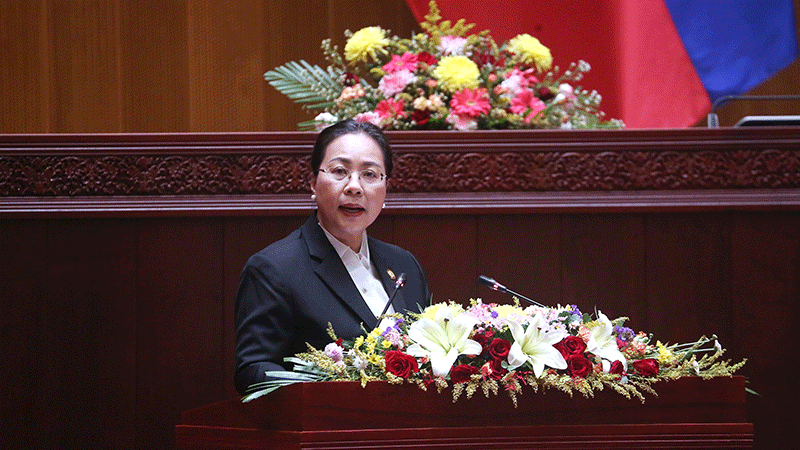
| Mrs Bounkham Vorachit responds to questions raised by National Assembly members at the ongoing second ordinary session of the 10th legislature on Wednesday. -- Photo Sangkhomsay |
BOL takes tougher measures to curb inflation, strengthen kip
The Bank of the Lao PDR (BOL) will step up monetary management, strengthen foreign-exchange controls and encourage wider use of the kip as it seeks to curb inflation and maintain macroeconomic stability, the central bank’s Governor has told the National Assembly (NA).
Responding to questions raised by members on Wednesday, the bank’s Governor, Mrs Bounkham Vorachit, said inflation remained a major concern, averaging 7.9 percent in the first nine months of 2026.
She said BOL studies showed that higher electricity prices were the main factor driving inflation, followed by the high cost of fuel and exchange-rate movements.
Average inflation for the whole of 2026 is expected to remain at 7.9 percent, exceeding the NA-approved target of 5 percent.
Next year, the central bank aims to lower inflation to between 5.5 and 5.8 percent, or no higher than 6 percent, assuming that fuel prices are less volatile than in 2026.
To achieve this, the BOL will continue implementing an integrated monetary policy, including controlling money supply and credit growth, regulating currency exchange rates, and strengthening foreign-exchange market management.
Credit growth will be kept at no more than 16 percent annually, compared with the current rate of 17.6 percent, while measures will also be taken to maintain the stability of the kip.
The BOL will work with the Ministry of Industry and Commerce to oversee imports, particularly fuel, in line with current conditions. It will also provide more credit for agriculture and production aimed at import substitution and export promotion, while encouraging commercial banks with excess liquidity to extend financing to priority sectors.
On strengthening demand for the kip, Mrs Bounkham said the BOL would work to maintain the stability of the kip and ensure that more foreign currency enters the formal financial system.
The central bank aims to increase the proportion of foreign-exchange earnings from exports brought into the country to 75 percent by the end of 2026 and to 85 percent by 2030.
The BOL is also studying a 10-year strategy to ensure the kip is the sole currency used in Laos.
The Governor said the BOL had increased cross-border payment links using QR codes with Thailand, Vietnam, Cambodia and China, while the Laos-China cross-border retail payment service using e-CNY had also been launched.
However, she acknowledged that enforcing wider use of the kip would take time because the economy still has strong demand for foreign currency and people are accustomed to using multiple currencies.
The BOL is also strengthening cooperation with the Ministry of Industry and Commerce and the Ministry of Finance to monitor exports and ensure that foreign-exchange earnings are channelled into the Lao banking system.
The central bank is monitoring export businesses and has introduced measures requiring importers and exporters to use designated foreign-currency accounts through commercial banks.
Regarding credit access, Mrs Bounkham said the BOL would encourage commercial banks to make lending easier while maintaining prudent credit risk management.
The banking system’s non-performing loan ratio stood at 0.95 percent as of September 2026, while banking-sector credit increased by 9.39 percent in the first nine months of 2026 to 257,991.50 billion kip.
Credit provided to micro, small and medium-sized enterprises rose by 13.30 percent to 27,687.19 billion kip, accounting for 10.84 percent of total credit and reaching 36.46 percent of MSMEs nationwide.
The BOL will also continue working with credit guarantee companies to help businesses, particularly MSMEs without sufficient collateral, access financing. It is studying the establishment of venture capital and private equity funds as alternative sources of capital for businesses and producers.
At the same time, the BOL has coordinated with the Ministry of Finance on measures to increase tax payments in kip and reduce foreign-currency tax obligations for businesses without direct foreign-currency income, with the aim of strengthening confidence in the national currency.
Mrs Bounkham said the bank would take note of the NA members’ comments and use them to improve its policies and measures.
By Bounfaeng Phaymanivong
(Latest Update October 8, 2026)
|

