 |
| |
Electric vehicle imports surge 107 percent in Laos
Laos imported 8,330 fully electric vehicles in the first eight months of 2026, up 107 percent compared to 2025, as the government accelerates its shift towards clean energy and reduced reliance on imported fuel.
The surge reflects the transformation of the country’s vehicle market as Laos seeks to use its abundant hydropower while also easing pressure on foreign currency reserves.
Minister of Industry and Commerce Malaythong Kommasith told the National Assembly on Wednesday that 37,475 vehicles were imported during this period, including 2,804 hybrids, up 114 percent from the previous year. New-energy vehicles accounted for 29.7 percent of total vehicle imports.
The government aims for electric vehicles to account for at least 30 percent of the national vehicle fleet by 2030. This would mean about 222,784 four-wheeled electric vehicles and 1,307 public charging stations.
The push is closely linked to Laos’ energy and foreign currency pressures. The country imports all of its fuel, while transport accounts for about 60-70 percent of total fuel consumption. Fuel imports also account for about 16 percent of the total value of imported goods.
“The shift to electric vehicles is not merely an option but a long-term path to survival,” Mr Malaythong said.
He said the shift could reduce foreign currency outflows and allow Laos to make greater use of hydropower and other clean energy sources as part of efforts to build an independent and self-reliant economy.
The government has already taken a major step by temporarily suspending most imports of petrol- and diesel-powered vehicles until the end of this year.
Exemptions apply to certain passenger transport vehicles, machinery, trucks for specific production and development projects, and specialised vehicles.
To make electric vehicles more accessible, the Ministry of Industry and Commerce is preparing measures relating to vehicle prices, taxation, finance, charging infrastructure, and after-sales service.
Fully electric vehicles valued below US$50,000 are exempt from excise tax under current measures.
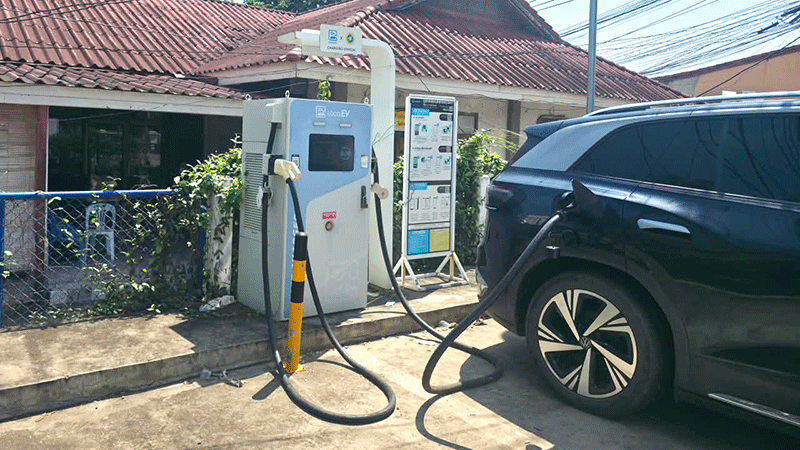
Charging infrastructure is also expanding, although gaps remain. The ministry has licensed 43 charging operators, with about 200 charging stations operating across all 17 provinces and the capital Vientiane.
The Lao EV charging app has also been launched to help motorists locate charging points.
Electricité du Laos has considered an average 10 percent reduction in electricity rates for charging stations, as well as lower rates during off-peak periods.
The government also plans to encourage commercial banks to offer EV loans with lower interest rates and longer repayment periods.
The Bank of the Lao PDR is encouraging vehicle purchases and payments through the banking system and has completed a green bond to raise funds for EV infrastructure, according to Mr Malaythong.
But the rapid growth has exposed several challenges. Vehicle prices remain high, access to credit is limited, and a second-hand EV market has yet to develop.
Consumers also remain concerned about battery safety and vehicle reliability.
The market has limited choices for commercial electric vehicles, while Laos lacks sufficient specialised mechanics.
All spare parts must be imported and there is no organised system for the reuse of old batteries.
There are also problems around charging infrastructure. Different connector systems, including GB/T and CCS2, are in use, while fast chargers for heavy trucks remain limited. Local electricity networks could also be overburdened if many vehicle batteries are charged at the same time.
The government is revising the rules for EV importers and distributors, requiring authorised dealerships, after-sales service centres, adequate spare parts, and proper management of used batteries.
The 2030 target represents a broader effort to strengthen energy security, reduce dependence on imported fuel, and make better use of Laos’ electricity resources.
By Phonepaseuth Volakhoun
(Latest Update October 8, 2026)
|

