 |
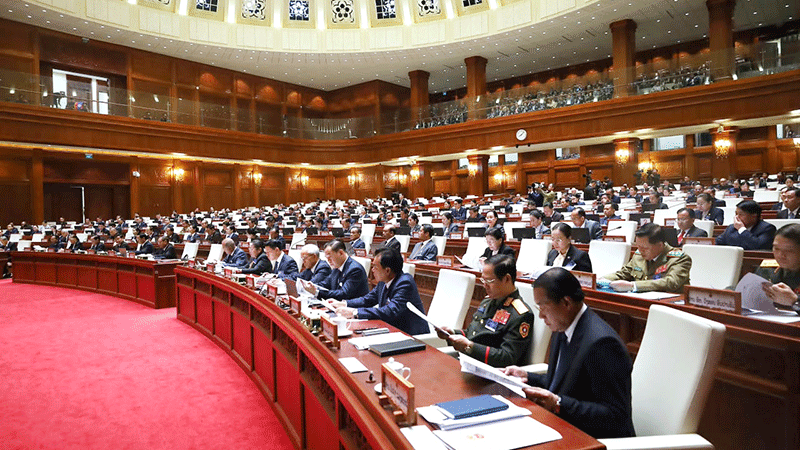
| The ongoing second Ordinary Session of the 10th National Assembly. --Photo Po |
Roads at the heart of Laos’ development: Lawmakers urge faster action
For many people, a road is simply a way to get from one place to another. But in a country like Laos, roads are much more than stretches of asphalt and concrete – they are lifelines connecting communities, markets, businesses and borders, and opening the door to trade, investment and tourism.
That is why improving the country’s road network has again become a major concern for lawmakers, who are urging the government to accelerate action to address infrastructure problems and ensure that key roads are built, repaired and properly maintained.
The issue was highlighted during the ongoing second Ordinary Session of the 10th National Assembly (NA) on October 6, when lawmakers discussed the implementation of the 2026 socio-economic development plan, state budget and monetary plan, and development priorities for 2027.
Among the issues raised was the need to make better use of investments and ensure that major roads receive appropriate funding and attention.
NA member Phoykham Houngbounyuang of Xaysomboun province proposed that roads considered economically important should, where possible, be developed through investment models involving other economic sectors. Under a build-and-recover-investment approach, investors can help develop major economically viable roads, allowing the government to focus its limited resources on routes that are less commercially attractive but essential to communities.
The proposal reflects a broader challenge facing Laos – how to expand infrastructure while managing limited public resources.
For lawmakers from provinces located along important transport corridors, the condition and construction of roads are not simply policy issues. They directly affect everyday life.
The NA member for Khammuan province, Phaymany Phommasan, spoke about National Road 12. About 30 percent of the project has been completed so far, and he suggested future construction can be divided into multiple contracts to speed up implementation and prevent delays.
In Khammuan, local infrastructure has come under increasing pressure from the heavy transportation of minerals. Thirteen companies involved in iron mining projects transport minerals through the province, particularly Bualapha district. The heavy traffic has affected roads and created difficulties for local residents.
Lawmakers called on relevant authorities to visit affected areas, assess conditions on the ground and take practical steps to address problems.
Another issue involves the equipment used to control the weight of vehicles at international checkpoints. Khammuan has three weighbridges along National Roads 12 and 13, but they are reportedly not operational. Though provincial authorities have raised the matter with relevant ministries, the problem is yet to be resolved.
As a result, some vehicles pass through without being properly weighed, and drivers park outside the checkpoint and enter only to complete documentation. Such practices raise concerns about effective control of heavy vehicles and the additional pressure they put on roads.
Prime Minister Saleumxay Kommasith presented the government’s proposed 2027 National Socio-Economic Development Plan to the second Ordinary Session of the 10th NA on October 5. The session is chaired by the President of the National Assembly, Dr Sonexay Siphandone.
Prime Minister Saleumxay told the NA that the government will continue building and repairing transport infrastructure across the country, including roads, railways, waterways and air transport facilities.
The plan will focus on major economic corridors, national highways, provincial and district roads, and routes linking communities with production and service centres.
Among the key routes identified are the Vientiane capital-Hanoi expressway, Route 13 North, Route 13 South, Route 8, Route 9 and Route 12.
The goal is not simply to make journeys smoother. Better roads will reduce transport difficulties, strengthen trade, encourage investment and support tourism, while improving access to markets and essential services.
For farmers, better roads can mean getting agricultural products to markets faster and at lower cost. For businesses, reliable transport links can make investments more attractive. For tourists, safer and better maintained roads can make more destinations accessible. And for communities along major routes, improved infrastructure can bring new economic opportunities.
Yet building roads is only one part of the challenge. Keeping them in good condition, controlling overloaded vehicles and ensuring that infrastructure investments are completed efficiently are equally important.
The concerns raised by NA members send a clear message: Laos needs a transport network that supports economic ambitions and improves people’s daily lives.
As Laos looks towards 2027, the road ahead may still be challenging. But with faster implementation, better investment and stronger coordination among authorities, the country’s roads can become powerful foundations for growth, connectivity and opportunity.
By Times Reporters
(Latest Update October 8, 2026)
|

