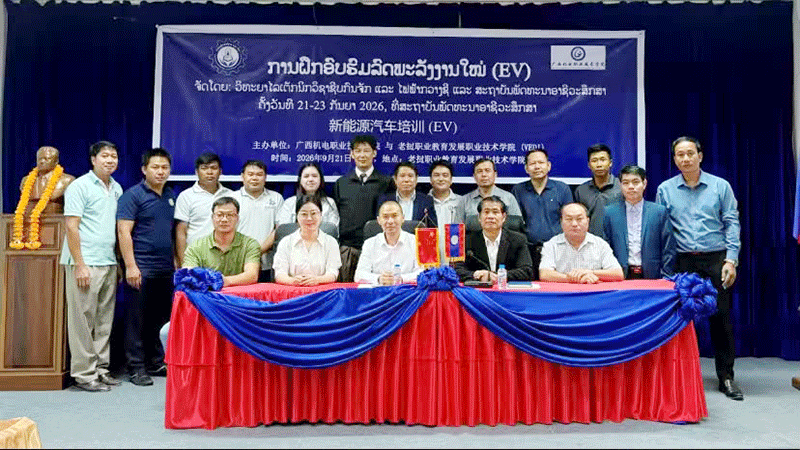
China–Laos EV training helps address skills shortage, supports green transport drive
A China–Laos electric vehicle (EV) technology training programme is helping address a shortage of specialised mechanics, a key challenge facing the Lao government’s efforts to accelerate EV adoption, reduce dependence on imported fuel and promote green growth.
The training, held from September 21-23, was jointly organised by Guangxi Technological College of Machinery and Electricity and Laos’ Vocational Education Development Institute (VEDI) to strengthen local technical skills in EV maintenance and repair, according to a news release issued by the Chinese college.
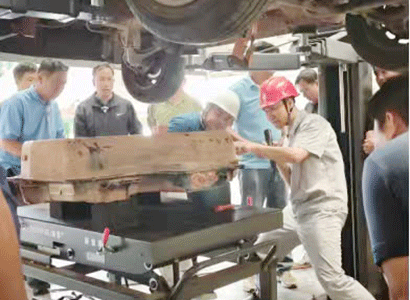 |
Participants receive hands-on training in electric vehicle maintenance and repair.
|
The initiative comes as Laos experiences a sharp increase in EV imports, creating greater demand for qualified technicians.
According to figures presented to the National Assembly recently by Minister of Industry and Commerce Malaithong Kommasith, Laos imported 8,330 fully electric vehicles during the first eight months of 2026, an increase of 107 percent year-on-year.
The government aims for EVs to account for at least 30 percent of the national vehicle fleet by 2030, supported by 1,307 public charging stations.
However, the rapid expansion of the EV market has exposed several challenges, particularly the shortage of specialised mechanics, limited after-sales services and concerns over battery safety and reliability.
Against this backdrop, the China–Laos training programme represents a practical step towards developing the skilled workforce needed to support the country’s transition to electric transport.
The training programme brought together teachers from four Lao vocational colleges and non-commissioned officers from the Lao armed forces.
Led by instructor Liu Gang, assisted by Li Yongfu and Luo Tingjie, the Chinese teaching team delivered classroom instruction and practical training at VEDI’s facility, using a Baojun E100 electric vehicle.
The training covered high-voltage systems, traction battery maintenance, fault diagnosis, battery disassembly and reassembly, and battery balancing. Through practical exercises based on real-world fault cases, participants developed skills in vehicle inspection, battery fault-code interpretation, maintenance, and systematic troubleshooting.
All participants passed the final assessment and received certificates of completion.
The Chinese college also provided VEDI with updated bilingual textbooks and teaching materials to strengthen vocational education and enable instructors to transfer their knowledge to future technicians.
Director of VEDI, Dr Bounseng Khammounty, praised the initiative and expressed hope for continued cooperation in technical training and skills development.
The programme could help improve local EV maintenance services, strengthen consumer confidence and support the government’s efforts to expand electric transport.
The shift towards EVs is central to Laos’ efforts to strengthen energy security and reduce pressure on foreign currency reserves.
With transport accounting for an estimated 60–70 percent of the country’s fuel consumption, greater EV adoption would help reduce reliance on imported petroleum while making better use of Laos’ abundant hydropower resources.
Continued China–Laos cooperation in vocational training could therefore play an important role in developing technical talent and supporting the country’s long-term green growth ambitions.
By Times Reporters
(Latest Update October 13, 2026)
|