 |
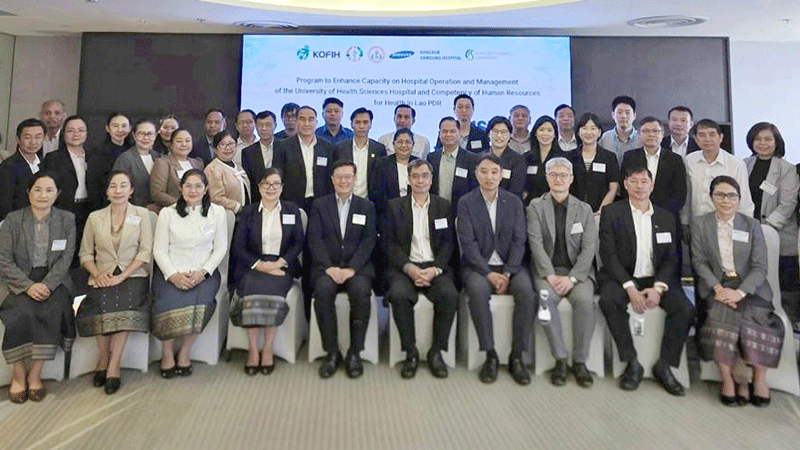
| Lao and Korean healthcare professionals during the UHS PMU consultation on hospital operational readiness. |
Korean partnership strengthens preparations for Laos’ first academic teaching hospital
The Korea Foundation for International Healthcare (KOFIH), in partnership with leading Korean medical institutions, is stepping up support for Laos’ first academic teaching hospital, scheduled to open in 2028, with a focus on strengthening hospital management, medical workforce capacity and sustainable healthcare services.
The initiative, implemented in cooperation with Kangbuk Samsung Hospital and Sungkyunkwan University School of Medicine, aims to equip Laos’ University of Health Sciences (UHS) with the expertise, management systems and skilled personnel needed to operate the new hospital effectively, according to KOFTH.
As part of these efforts, KOFIH and its Korean partners organised a three-day workshop from October 19–21 at the Amari Hotel in Vientiane, bringing together Lao and Korean healthcare professionals to advance preparations for the hospital’s opening.
The workshop formed part of the second phase of the Hospital Operation and Management Capacity-building Programme (HOMCP), which is shifting its focus from developing hospital regulations and management tools to putting them into practice.
Participants emphasised that establishing a successful teaching hospital requires more than modern infrastructure and medical equipment. Equally important are qualified healthcare professionals, clearly defined responsibilities, effective operating procedures and continuous professional development.
Representatives from UHS, the Ministry of Health and central hospitals discussed key aspects of hospital operations, including management autonomy, workforce planning, phased introduction of clinical services and sustainable financing.
The discussions also explored ways to improve healthcare quality and strengthen public confidence in medical services, drawing on Laos’ Five Goods, One Satisfaction (5G1S) quality policy.
Particular attention was given to practical measures that could support the hospital’s long-term financial sustainability, including health check-up services, hospital information systems, integration with health insurance schemes and more efficient medicine procurement.
Korean medical experts shared their experience in hospital management, clinical research, clinical trials and effective resource management. They also stressed the importance of adapting international best practices to the specific needs and circumstances of Laos rather than directly replicating Korean hospital management models.
Another key component of the workshop focused on infection prevention and control (IPC), an essential element in ensuring patient safety and maintaining healthcare quality.
UHS personnel worked on strengthening infection prevention procedures in line with the 5G1S policy, building on hospital operation regulations developed during the programme’s first phase.
In parallel, medical education sessions addressed clinical training and assessment methods, including the Objective Structured Clinical Examination (OSCE) and the UHS E-Portfolio system.
These initiatives are intended to strengthen the university’s capacity to train future healthcare professionals while supporting the delivery of safe and reliable medical services.
The cooperation will continue in November through a Joint Seminar under the theme “Toward Autonomous Hospital Operations at UHS”. During the seminar, UHS representatives will present draft standard operating procedures and updates on preparations for the hospital’s opening, while Korean specialists will provide technical advice and recommendations.
A parallel Faculty Capacity-Building Seminar will focus on further improving medical education and strengthening the teaching capacity of UHS personnel.
Through its continued partnership with UHS and Korean medical institutions, KOFIH aims to help establish the workforce, management systems and operational capacity needed to ensure the new teaching hospital delivers safe, trusted and sustainable healthcare services to the people of Laos.
By Times Reporters
(Latest Update October 22, 2026)
|

