 |
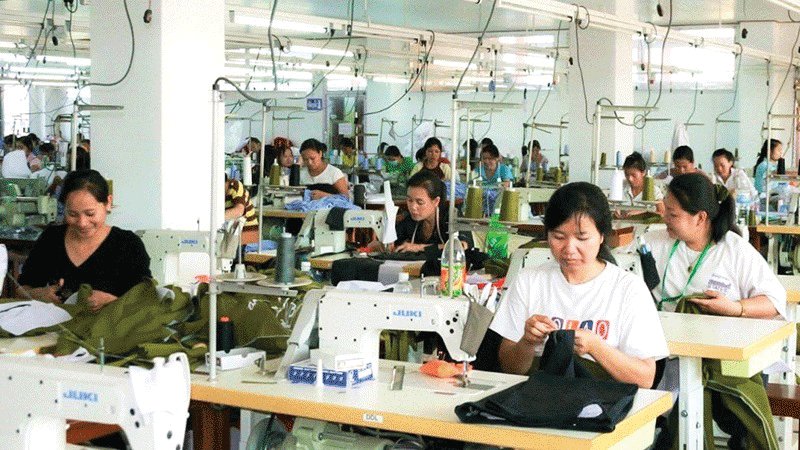
Women at work in a Vientiane garment factory. (File photo Vientiane Times)
|
Govt to raise private-sector minimum wage to 3.4 million kip
The government will increase the minimum monthly wage for private-sector workers to 3.4 million kip from January 2027, up from the current 2.5 million kip, to help keep pace with spiralling living costs.
The wage rise was decided on at a meeting of the Prime Minister and Deputy Prime Ministers on October 19, according to a notice issued by the Office of the Prime Minister on October 21.
Under the new arrangement, the basic monthly wage will rise from 1.6 million kip to 2 million kip, while the cost-of-living allowance will increase from 900,000 kip to 1.4 million kip. Together, these payments will bring the total monthly minimum wage to 3.4 million kip for workers in production, business and service establishments.
The minimum wage was last increased in 2023 but many people continue to face financial hardship as living costs rise and the value of the kip weakens.
Speaking at the National Assembly earlier this month, Minister of Labour and Social Welfare Mr Phosay Sayasone said 76,604 people registered as job seekers during the first nine months of 2026.
Of these, only 5,259 people, or 6.8 percent, sought employment in Laos, while 71,345 requested jobs abroad.
The figures highlight the challenge facing Lao employers, including factories and industrial estates, as workers continue to seek better-paying opportunities in other countries, particularly in Thailand and the Republic of Korea.
From 2016 to 2026, a total of 708,751 Lao workers took up employment abroad. Of these, 672,936 went to Thailand, 32,089 to the Republic of Korea and 3,257 to Japan, according to ministry figures.
Alongside the wage hike, the government is promoting vocational training and self-employment to expand employment opportunities, particularly for disadvantaged people and those living in rural areas.
During the first nine months of 2026, 126,392 people received skills training, reaching 97.22 percent of the full-year target of 130,000.
Training programmes cover modern farming techniques, mushroom cultivation, cattle raising, weaving and agricultural product processing, as well as marketing, entrepreneurship and business planning.
From 2027 to 2030, the ministry plans to support 750 people through rural employment and self-employment programmes, including providing equipment to help 323 people establish their own livelihoods.
By Phonepaseuth Volakhoun
(Latest Update October 29, 2026)
|

