 |
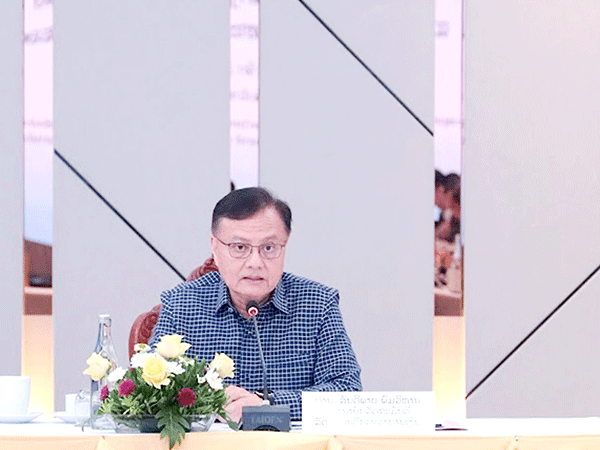
Deputy Prime Minister and Minister of Finance Mr Santiphab Phomvihane chairs a high-level meeting last week.
--Photo Ministry of Finance
|
Govt charts long-term reforms to spur economic self-reliance
The government is moving to strengthen Laos’ financial foundations and economic self-reliance through a long-term strategy focused on increased domestically-generated revenue, sustainable management of public debt, and expansion of productivity, as Laos prepares to graduate from Least Developed Country (LDC) status.
To this end, the Ministry of Finance held a high-level meeting on November 6 to discuss the draft Vision to 2040 and State Financial Development Strategy to 2035.
The meeting was chaired by Deputy Prime Minister and Minister of Finance, Mr Santiphab Phomvihane, and attended by deputy ministers, department directors-general and deputy directors-general, and representatives from various ministries and equivalent organisations.
Mr Santiphab said state finance was the main artery of the national economic system and played a crucial role in supporting economic stability and development.
Given Laos’ challenging economic and financial situation, he said the government was developing a long-term vision and strategy in line with its goal to build an independent and self-reliant economy.
He called for a thorough assessment of the 10 strategies implemented under the previous development framework, with greater attention given to priority tasks and measurable results.
Key areas include strengthening revenue collection, improving budget expenditure management, controlling public debt, and modernising public finance administration through closer coordination between government agencies.
Mr Santiphab urged meeting participants to provide frank and constructive comments on the draft documents to further refine them before submission to the government for consideration and approval.
The meeting reviewed achievements and lessons learnt from the Vision to 2030 and State Financial Development Strategy to 2025, including efforts to maintain macroeconomic stability, broaden the state revenue base, and modernise public finance management.
Participants also discussed continuing economic and financial challenges, particularly inflation, exchange-rate fluctuations, budget deficits and public debt, and considered how the new strategy should respond to changing economic conditions.
Beyond improving public finance management, achieving greater economic self-reliance will require a stronger domestic production base capable of generating income, employment, exports and government revenue. This includes increased agricultural production, expansion of agro-processing and manufacturing, development of tourism and other services, and more domestic and private-sector investment.
Improving the business environment, employee skills, modernising financial administration and strengthening transparency and accountability will also be important in building a more resilient economy and reducing reliance on external financing.
The draft strategy also reflects the Ministry of Finance’s expanded responsibilities and organisational structure following the merger of the former Ministry of Planning and Investment into the ministry. It takes into account Laos’ preparations for graduation from LDC status and the need to strengthen its capacity to sustain development beyond that transition.
The draft Vision to 2040 and State Financial Development Strategy to 2035 were developed through nationwide consultations, government-level meetings and discussions with development partners.
Containing 12 strategies and clearly defined macro-level targets, the framework is intended to guide Laos’ public financial development over the coming years.
The meeting saw senior officials consolidate their views and reach consensus on the key elements of the draft, with the aim of submitting a final report to the government for consideration and approval by the end of this year.
By Phetphoxay Sengpaseuth
(Latest Update November 10, 2026)
|

