 |
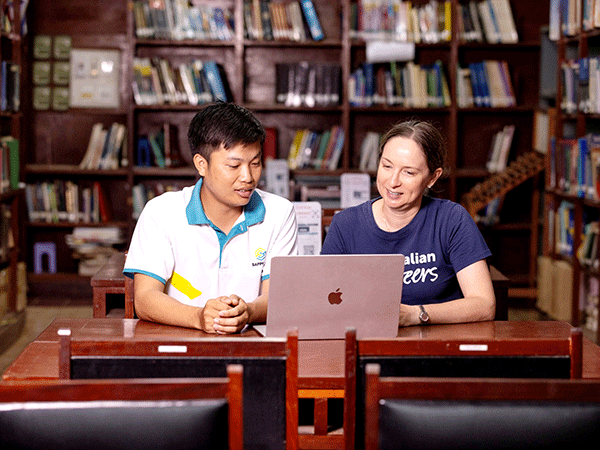
| Katy is currently serving as a Clinical Mentor at the University of Health Sciences’ Institute of Research and Education Development (IRED) through the Australian Volunteer Programme. |
A journey comes full circle as Australian volunteer returns to Laos to mentor young clinicians
The Vientiane Times publishes this impactful and insightful feature to honour the dedication and contributions of volunteers worldwide,
marking International Volunteer Day on December 5.
When Katy walks into the University of Health Sciences each morning, she carries more than her notebook and lesson plans. She carries memories — of a childhood spent in Laos, of watching her mother work as a nurse, and of the first sparks of inspiration that would one day guide her into a career in healthcare.
Now, decades later, she has returned to the country that shaped her earliest years, this time as a Clinical Mentor with the Australian Volunteer Programme, supporting the University of Health Sciences’ Institute of Research and Education Development (IRED) and several hospitals in Vientiane.
Katy is one of more than 650 Australians who have supported hundreds of partner organisations in Laos at both central and provincial levels under the AVP program since 1996.
Through this program, the Australian Government helps Laos achieve its sustainable development goals by deploying skilled Australian volunteers to assist across key sectors such as education, health, agriculture, and energy.
Katy has been in Laos since February and often reflects on how quickly the months have passed. Her days are full, moving between case presentations, bedside teaching, research support sessions, and English lessons.
But for her, the real substance of the work lies in the people she works alongside — the staff at the university, the paediatricians at Mahosot, the Children’s Hospital, and Setthathirath Hospital, and the junior doctors eager to learn and grow.
Her connection to Laos began long before this assignment. Over a couple of decades ago, she lived in Vientiane as a child while her mother worked with the embassy as a nurse.
Those years left an impression deeper than she realised at the time. She remembers following her mother to clinics, observing the care and calm confidence she brought to her work.
“It was my time in Laos that helped inspire my career in the health field,” Katy says, recalling the early seeds of her interest in medicine. Returning now feels like stepping back into a familiar rhythm, one that she carries not just in memory but in purpose.
This sense of purpose is part of what guided her decision to volunteer. Throughout her career in Australia, Katy was fortunate to have strong mentors; people who guided her, shared their knowledge, and encouraged her when the path felt difficult.
These mentors shaped her professionally and personally, and she wanted to offer the same kind of support to the next generation of clinicians. Volunteering in Laos, a place that holds such personal meaning, seemed like a natural step. “I wanted to help other people and share what I’ve learned,” she says. “I’ve benefited from good mentors, and I wanted to pay that forward.”
At IRED, Katy works closely with academic staff to write and develop scientific articles. Supporting research is one of the roles she values most, because it strengthens the visibility and impact of Lao-led studies in the broader medical community. She enjoys sitting with researchers, discussing their data, refining drafts, and helping them shape work that can be shared internationally.
Seeing their papers come together, and knowing that Lao research is contributing to regional health knowledge, is deeply rewarding.
Her hospital work is equally meaningful. Ward rounds with paediatricians, clinical teaching with junior doctors, and daily training sessions bring her back to the heart of medicine: providing care, learning together, and supporting each other through the challenges of clinical work.
She finds joy in the sense of teamwork that emerges naturally in these environments. “What I enjoy most is working with other people,” she says. “There’s so much mutual learning.”
That mutual learning has had a profound impact on her own practice. “I’ve gained an appreciation of the differences in medical care in Laos and Australia,” she reflects.
“Resources may be more available in Australia, but the quality of care here is so strong. I’ve been reminded of the importance of communication, and the need to really listen to patients.” It is this blend of clinical knowledge and human connection that she values most in her work.
Her assignment carries both short-term and long-term goals. In the short term, she focuses on day-to-day teaching, clinical skill development, and supporting students and young doctors in their academic work. Over the longer term, she hopes to help build sustainable systems for training and education, collaborating with the university and other Australian volunteers to strengthen local capacity.
She emphasises that this kind of work is never about one person; it is about contributing to something that will continue long after her assignment ends.
For Katy, returning to Laos has been more than a professional decision; it has been a meaningful personal journey.
The country that nurtured her early childhood is now a place where she can give back, share her experience, and support others in the same field that her mother introduced her to all those years ago.
“Laos holds a special place in my heart,” she says. “Coming back feels like everything has come full circle.”
In the busy halls of the university and the warm, bustling wards of Vientiane’s hospitals, Katy has found not only a place to teach but a place to grow, connect, and rediscover the roots of her passion for healthcare.
And as she supports the next generation of Lao clinicians and researchers, she carries with her the quiet sense that the story that began here long ago has found its way home.
Katy will end her assignment in Laos in February and will carry home countless memories such as the spiciness of papaya salad, larb kai (minced chicken salad), and other Lao dishes that will forever remain among her favourites.
As she returns home, she leaves with deep affection for the people, culture, and flavours that have shaped her journey, knowing that Laos will always hold a special place in her heart.
By Bounfaeng Phaymanivong
(Latest Update December 5, 2025)
|

