 |
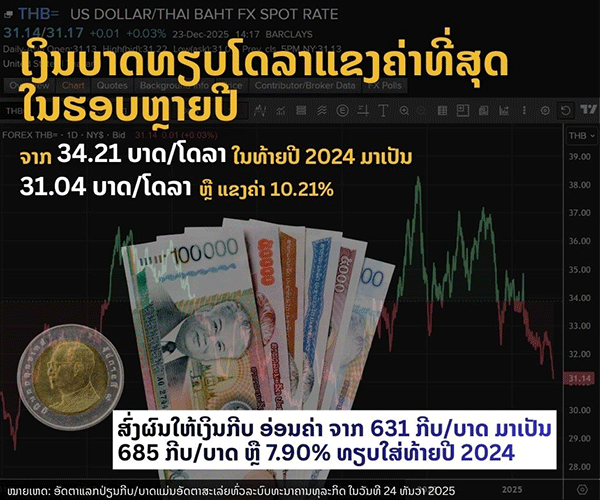
Image reproduced from BOL’s Facebook page on currency exchange rates, which contains figures concerning the Thai baht vis-à-vis the US dollar and the depreciation of the kip against the Thai baht at the end of 2024. --Photo BOL.
|
Central bank issues update on fluctuations in regional currencies
The Bank of the Lao PDR (BOL), has reported recent movements in regional currencies, highlighting significant shifts in the Thai baht (THB) against the US dollar (US$) and their subsequent impact on the Lao kip (LAK).
According to the central bank’s Facebook post last Friday, the baht has strengthened markedly against the US dollar, reaching its highest level in several years.
The exchange rate moved from 34.21 THB per US dollar at the end of 2024 to 31.14 THB per US dollar, representing an appreciation of about 10 percent.
As of the latest monthly update by the Bank of the Lao PDR (BOL) on December 30, the bank buys the US dollar (US$) at 21,503 kip and sells it at 21,713 kip, while the yearly update has not yet been unveiled.
The BOL attributed this to two main factors. First, the US dollar weakened following the US Federal Reserve’s decision to cut its policy interest rate by 0.25 percentage points, bringing the target range to between 3.50 and 3.75 percent.
Second, domestic factors in Thailand played a significant role, particularly an unprecedented increase in gold trading, which contributed to stronger demand for the Thai currency.
As stated in the monthly update, the baht’s appreciation in value against the US dollar has resulted in a depreciation of the kip against the baht.
The exchange rate between the two currencies shifted from 631 LAK per THB at the end of 2024 to around 685 LAK per THB, reflecting a depreciation rate of 7.9 percent.
The BOL noted that movements in regional and international currencies continue to have a direct influence on the kip, especially given the close economic and trade links between Laos and neighbouring countries.
Changes in major currencies such as the US dollar and Thai baht can therefore affect import costs, cross-border trade, and domestic price dynamics.
The central bank reaffirmed in its monthly report that it is closely monitoring developments in global financial markets and regional exchange rates, adding that the current environment presents increasing challenges for monetary authorities.
These include managing exchange rate volatility, containing imported inflation pressures, safeguarding foreign currency reserves, and closely tracking capital flows linked to regional trade and financial movements.
To address the unprecedented currency exchange rate fluctuations, the BOL has introduced a range of measures. These include active liquidity management in both local and foreign currencies, prudent management of foreign exchange reserves, and closer supervision of commercial banks and foreign exchange operators.
The central bank continues to promote the use of the kip in domestic transactions, strengthen foreign currency regulations, and enhance data monitoring systems to enable timely and appropriate policy responses to sudden market movements.
The BOL said these measures are part of its broader strategy to maintain macroeconomic stability, support confidence in the financial system, and mitigate risks arising from external economic shocks amid ongoing uncertainty in global and regional markets.
By Advertorial Desk
(Latest Update December 30, 2025)
|

