 |
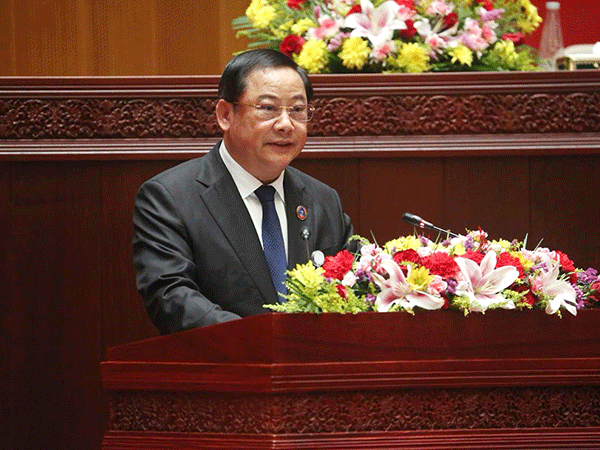
| Prime Minister Sonexay Siphandone presents the government’s National Socio-Economic Development Plan for 2026-2030 at the inaugural session of the 10th National Assembly on Monday. |
Govt sets 6 percent growth target, pushes for self-reliant economy
The government has set a growth target of at least 6 percent over the next five years, while aiming to stabilise the economy, reduce public debt, and strengthen financial security.
The 6 percent figure represents an increase from the 4.24 percent growth rate achieved during the course of the previous five-year development plan.
The Prime Minister, Dr Sonexay Siphandone, presented the government’s 10th National Socio-Economic Development Plan for 2026-2030 at the inaugural session of the 10th National Assembly on Monday, chaired by National Assembly President Dr Xaysomphone Phomvihane, following his re-election for another term.
The plan was endorsed during the session, shaping Laos’ economic trajectory for the next five years at a time when the country continues to face financial pressures and global economic uncertainty.
The Prime Minister said “In the years ahead, the global and regional situation is expected to continue changing rapidly and unpredictably.” This will bring both opportunities and challenges, he added.
His address outlined the direction of the National Socio-Economic Development Plan for 2026-2030, which places economic recovery and stability at the centre of national policy.
The government aims to reduce public debt to below 70 percent of Gross Domestic Product (GDP) while keeping inflation at around 5 percent to rein in the spiralling cost of living. Foreign currency reserves will be maintained at a level sufficient to cover at least five months of imports, helping to strengthen financial security.
At the same time, the plan targets steady income growth, with per capita GDP expected to reach US$3,104 by 2030 and gross national income per capita projected at US$2,914.
The Prime Minister stressed the need for stronger financial discipline and careful economic management in line with market principles under state oversight. Laos must gradually reduce reliance on borrowing while improving the efficiency of public spending, he said.
Revenue earned by the State is targeted at 554,400 billion kip, or about 20.95 percent of GDP, while expenditure is set at 528,400 billion kip. This would create a modest budget surplus of about 26,000 billion kip.
To support growth, the government plans to source investment worth 636,178 billion kip, equivalent to about 24 percent of GDP, with greater contributions from both domestic and foreign entities.
Three key sectors are expected to fuel economic growth. In agriculture, the government is targeting an annual rice yield of 4 million tonnes and US$1.9 billion annually in income earned from agricultural and forestry exports.
Tourism is also set to play a major role. The goal is for 22 million visitors to take holidays in Laos over the next five years, generating about US$8 billion in revenue, supporting jobs and small businesses across the country.
In the energy sector, electricity generation is projected to exceed 333,000 million kilowatt-hours, reinforcing Laos’ position as a regional power supplier, while mineral processing is also expected to grow.
Alongside economic targets, the Prime Minister highlighted the importance of building a more self-reliant economy, improving governance, and ensuring that growth remains stable and sustainable.
By Phonepaseuth Volakhoun
(Latest Update March 24, 2026 )
|

