 |
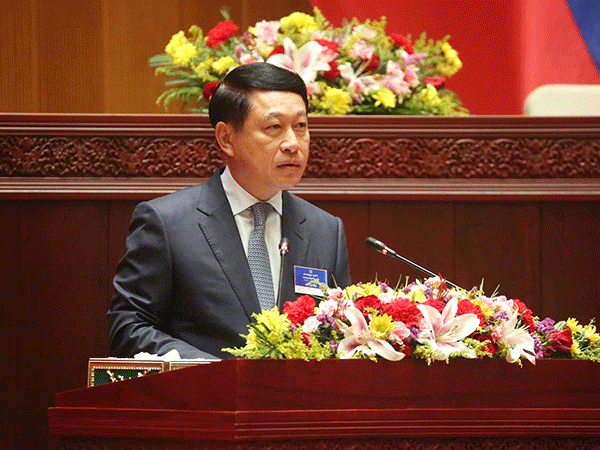
| Standing Deputy Prime Minister, Mr Saleumxay Kommasith, addresses the National Assembly on Tuesday. |
Govt pushes Laos-Vietnam rail link to access sea trade routes
The government has given the National Assembly a detailed description of the plan to build a railway linking Laos and Vietnam, aiming to give Laos direct sea access and boost regional connectivity.
Standing Deputy Prime Minister, Mr Saleumxay Kommasith, outlined the progress made on the project when addressing the inaugural session of the 10th Legislature on Tuesday.
The railway is a key pillar of the government’s National Socio-Economic Development Plan for 2026-2030 and would help turn Laos into a land-linked hub along the East-West Economic Corridor.
The planned railway will cover a distance of 562 kilometres between Vientiane and the Vung Ang deep water port on the coast of Vietnam. It will be built in three phases.
Phase 1A, which was outlined to the Assembly, will run for 147 kilometres from Thakhaek district in Khammuan province to Mu Gia on the Laos-Vietnam border.
Vice President of the National Assembly, Dr Vilayvong Bouddakham, said the railway could be an economic lifeline that would raise Laos’ profile in the region.
The railway would provide Laos with its closest access to the sea through Vung Ang port and open up a new route for trade with global markets.
It is planned that the track will be built to the 1.435-metre standard gauge, the same as the Laos-China Railway, allowing for a smooth connection. Passenger trains are expected to run at 150km/h, while freight trains will operate at 80km/h.
According to a feasibility study, the project has an internal rate of return of 7.1 percent and is expected to recoup the investment cost within 14 years.
The railway will be built by the Petroleum Trading Lao Public Company under a build-operate-transfer model, with an investment of US$1.339 billion and a concession period of 50 years.
The government estimates the railway will generate a return of about US$76.33 billion, including US$21.99 billion added to gross domestic product and US$32.60 billion in transport revenue.
According to the report delivered by the deputy prime minister, freight volumes could increase from 5,079 tonnes to as much as 47,133 tonnes a day, benefitting from reductions in time and cost.
Despite strong support, some National Assembly members raised concerns over the length of the concession period.
National Assembly member for Xayabouly province, Dr Khamsene Sisavong, said a 50-year concession may be too long compared to the 14-year payback period.
He suggested reducing the concession agreement to between 35 and 40 years to protect national interests.
“If the concession covers a long period of time, the repayment period should be extended to 20 or 25 years,” he said.
He warned that a short repayment period could lead investors to cut spending on maintenance and social support to reduce costs.
National Assembly member for Xekong province, Mr Chanthaboun Soukaloun, raised concerns about currency risks, noting that the project will be paid for in US dollars while revenue will be collected in kip.
He urged the government to use Lao-made materials such as cement and steel, to reduce imports and support local manufacturers.
“If this is not clearly stated, contractors may import everything, causing considerable currency outflow and limiting the benefits for the Lao people,” he said.
He also proposed a two-stage revenue system, with tax relief during the repayment period and increased state revenue once the project becomes profitable.
The railway will be built on land currently occupied by 2,210 families in four districts of Khammuan province.
Further planned sections of the railway include Phase 1B from the Lao border to Vung Ang Port in Vietnam, and Phase 2 linking Vientiane to Thakhaek, which are still under study.
By Times Reporters
(Latest Update March 25, 2026 )
|

