The Lao New Year Legend
The fascinating story behind Pi Mai Lao explains some of the traditions we joyfully practise every year
This is an appropriate time to recount the legend behind Lao New Year, as April marks the transition from the old year to the new.
Pi Mai Lao, celebrated annually in mid-April, is not only a time for merry-making but is deeply rooted in ancient folklore, especially concerning the ubiquitous use of water during the festivities and hallowed rituals.
According to the legend, there once lived the son of a wealthy man named Thammabarnkoummarn. He was a gifted scholar who studied Taiphet—an ancient discipline encompassing astrology, linguistics and pedagogy. Renowned for his intelligence, he possessed knowledge far beyond that of ordinary people and could even understand the languages of animals and birds.
Whenever people sought answers to complex worldly or spiritual questions, Thammabarnkoummarn would provide wise and thoughtful responses. His reputation grew steadily, and it was said that even the gods in heaven knew of his intellectual powers.
One such deity, Phayakabinlaphom, who was believed to govern Earth and the celestial beings, became intrigued. Curious to test the young man’s intellect, the god descended to earth and met Thammabarnkoummarn at his home--the Castle of Seven Storeys.
Phayakabinlaphom posed a challenging question: “What is the most important part of the body, known as ‘sili’, in the morning, at noon, and in the evening?”
He gave Thammabarnkoummarn seven days to come up with the answer, but added a severe condition: if the young man failed, he would be beheaded. However, if he succeeded, the god himself would accept the same fate.
 |
After the god departed, Thammabarnkoummarn began to ponder the question. Despite his vast knowledge, he could not find a clear answer. Days passed, and as the deadline approached, he grew increasingly anxious. By the sixth day, exhausted from sleeplessness and lack of food, he realised he might not survive the challenge.
Determined not to lose his honour, he left his castle and wandered into the forest. Weak and resigned to his fate, he sat beneath a tree and eventually fell asleep.
Late that night, he was awakened by voices above him. Two vultures perched in the tree were discussing their plans for the next day. The female vulture asked what they would eat, and the male replied that they would soon feast on human flesh—specifically that of Thammabarnkoummarn, who was to be beheaded by the god.
Curious, the female vulture asked why such a wise man would face death. The male explained that he had failed to answer the god’s question. When she pressed further, asking what the question was, he repeated it.
The female then challenged him: did he know the answer?
With confidence, the male vulture replied that the answer was simple. At first, he hesitated to explain, saying it was too late. But after persistent urging, he finally revealed the solution.
“In the morning,” he said, “the sili is in the face. That is why people wash their faces upon waking. At noon, the sili is in the chest, which is why people sprinkle water on their bodies to cool themselves. In the evening, the sili is in the feet, and people wash their feet before going to bed.”
Thammabarnkoummarn, who understood the language of birds, listened carefully. Overjoyed at discovering the answer, he immediately returned to his castle.
The next morning, on the seventh day, Phayakabinlaphom returned. When asked the question again, Thammabarnkoummarn confidently provided the correct answer. The god was astonished and acknowledged his defeat.
However, according to their agreement, this meant that the god must now be beheaded.
Phayakabinlaphom possessed immense power, and his death posed a grave danger to the world. It was believed that if his head touched the earth, flames would engulf the planet. If it rose into the air, all living beings would suffocate. If it fell into water, rivers and oceans would dry up.
To prevent such a catastrophe, the god summoned his seven daughters, each representing a day of the week. He instructed them to take good care of his head following his execution.
Each daughter is associated with a specific day and rides a symbolic animal. Thoungsathevi represents Sunday and rides a mythical bird. Kholakhathevi, representing Monday, rides a tiger. Haksathevi of Tuesday rides a wild boar, while Monthathevi of Wednesday rides a donkey. Kilinithevi, representing Thursday, rides an elephant. Kimithathevi of Friday rides a water buffalo, and Mahothonthevi of Saturday rides a peacock.
Phayakabinlaphom instructed his daughters to place his head on a golden tray and ensure that not a single drop of blood touched the ground. The head was then to be kept in a sacred cave known as Khauwsoumenkailath.
He further instructed that each year, during Pi Mai Lao, the daughter representing the first day of the New Year would carry the head in a ceremonial procession. She would cleanse it with perfumed water mixed with fragrant flowers. At the end of the celebrations, the daughters would return the head to the cave.
This ritual is the symbolic foundation of today’s Lao New Year celebrations.
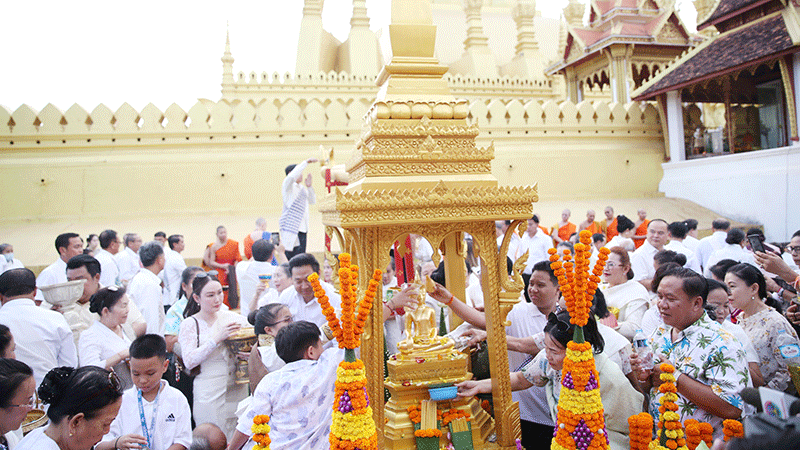
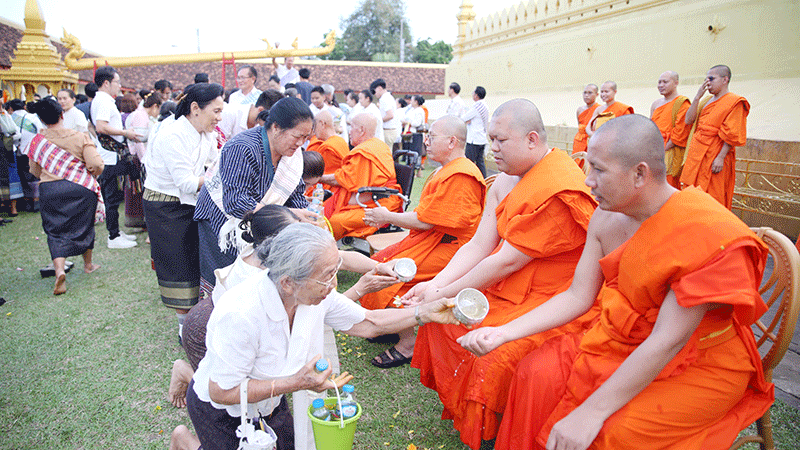
During Pi Mai Lao, people visit temples to gently pour scented water over Buddha images as a sign of respect and purification. They also pour water over the hands of their elders, other family members, and respected figures to express gratitude and wish them good health, happiness and longevity.
Thus, the water-splashing tradition that largely defines Lao New Year is not merely a fun activity, but carries deep cultural and spiritual meaning rooted in ancient legend.
As Lao New Year approaches each April, this enduring story continues to remind people of the wisdom, humility, and the importance of tradition—values that remain at the heart of Lao culture today.
This is an appropriate moment to wish all readers a joyful Lao New Year and to encourage everyone to enjoy the holiday wisely and safely.
By Phon Thikeo
(Latest UpdateApril 9, 2026)
|