 |
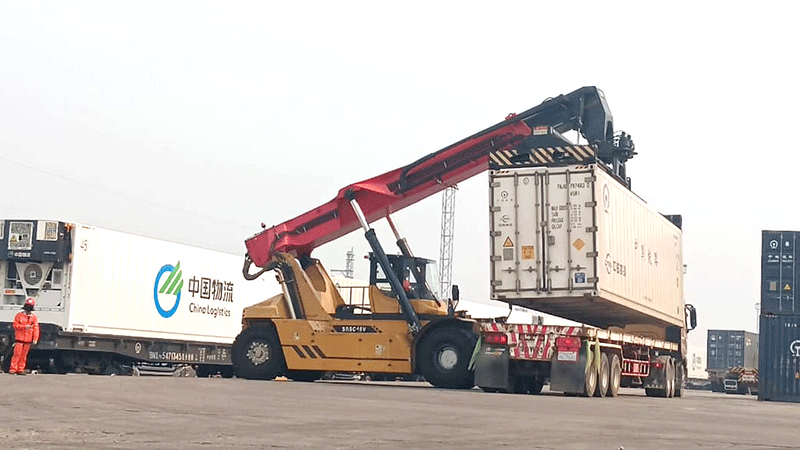
| A forklift truck handles a container at the Vientiane South Station on April 17. |
Laos-China Railway emerges as “green corridor” driving regional trade
The Laos-China Railway is rapidly transforming regional trade, emerging as a high-efficiency “green corridor” that is streamlining logistics and accelerating the flow of goods across Southeast Asia.
New energy vehicles (NEVs) manufactured in Chongqing, China, can now reach Vientiane in as little as five days via the railway—down from 20 to 30 days previously—cutting logistics costs by an estimated 30-50 percent and significantly improving supply chain efficiency.
The railway’s impact is reflected in its rapid expansion. Daily cross-border freight services have increased more than tenfold, from just two trains at the outset to 23 trains per day.
Over the past four years, the railway has handled a cumulative 81.5 million tonnes of cargo, while the range of goods transported has surged from around 10 categories to more than 3,800, covering markets across ASEAN.
At logistics hubs along the route, activity has intensified in step with rising demand. During a recent site visit to Vientiane South Station organised by the Laos-China Railway Company (LCR), Lao and Chinese media personnel observed operations and spoke with frontline staff overseeing cargo movement.
One of the company’s employees, Ms Nilavanh Chaleunsouk, who is responsible for inspecting containers and verifying export documentation, said her work is crucial to ensuring cargo safety and the timely delivery of goods to China.
She noted that a large share of cargo transiting through the station consists of Thai fruit, particularly durian, while exports from Laos mainly comprise minerals, tapioca, rubber, and other commodities—highlighting the railway’s growing role in facilitating both transit trade and export.
The corridor’s rising significance also aligns with broader regional shifts towards the use of electric vehicles. As Thailand, Indonesia, and Malaysia roll out policies to promote NEV adoption, Laos—despite being the only landlocked country in ASEAN—is positioning itself as a distribution hub for electric vehicles in the Indochina subregion.
This shift is already visible in Chongqing’s trade performance, with automotive exports surging by 89.3 percent in the first two months of 2026, supported in part by improved rail connectivity.
With faster transit times, lower costs, and expanding cargo volumes, the Laos-China Railway is set to play an increasingly central role in linking China with ASEAN, strengthening regional supply chains and driving sustainable trade.
By Bounfaeng Phaymanivong
(Latest UpdateApril 21, 2026)
|

