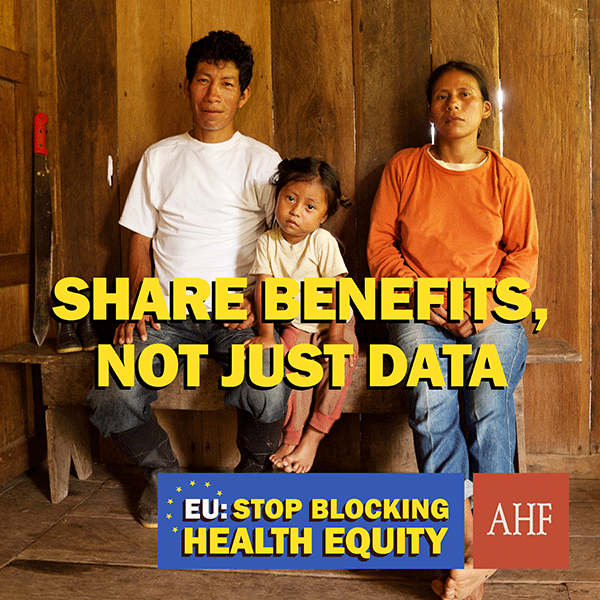
AHF calls for equity during WHO Pandemic Accord talks
The AIDS Healthcare Foundation (AHF) has issued a call to support and reiterate the importance of advancing the cause of equity during the final stages of the World Health Organisation (WHO) Pandemic Accord negotiations.
The foundation stresses that the agreement must be more than just words on paper; it must consist of binding commitments to address the deep-seated inequities and disparities within the global health system.
During the COVID-19 pandemic, the hoarding of vaccines alone is estimated to have caused more than 1.3 million deaths, with a disproportionate effect felt across the Global South.
While countries such as Canada, the United Kingdom, and various Western European nations had double-vaccinated over 70 percent of their entire populations by February 2022, 85 percent of nations in Africa were unable to provide even a single dose to their people. AHF asserts that such a failure of global solidarity cannot be allowed to happen again.
 |
 |
| |
|
Equity demands that this Accord establishes concrete mechanisms for the regional production of vaccines, diagnostics, therapeutics, and other pandemic technologies within Global South countries. This requires not only adequate financing but, more importantly, a clear and enforceable roadmap for the transfer of knowledge, know-how, and technology.
While provisions for the establishment of a WHO Pathogen Access and Benefits Sharing (PABS) system have been among the most contentious in these negotiations, AHF suggests that the proposal to set aside 20 percent of production by manufacturers should be considered the floor, not the ceiling.
The foundation argues that setting aside only 20 percent of production for 80 percent of the world’s population is not only inequitable but also unlikely to alleviate the demand for life-saving countermeasures during future global health emergencies.
To truly meet global demand during a Public Health Emergency of International Concern (PHEIC) or a future pandemic, PABS must include provisions for technology transfer in addition to annual financial contributions and a percentage of pandemic-health products set aside as benefits to be shared.
These measures are essential to scaling up production across all regions.
One practical approach suggested by AHF could be to require participants in PABS to issue temporary licences under pre-established terms, ensuring that every region has the capability to produce life-saving countermeasures when they are needed most.
While Global North countries have frequently stated that “no one is safe until everyone is safe”, their actions have not always aligned with these words.
As the final stages of these negotiations approach, AHF reminds these nations that a global agreement must ensure true equity through binding commitments that can protect peoples of all nations.
The AIDS Healthcare Foundation is a global non-profit organisation providing cutting-edge medicine and advocacy to more than 2.8 million people in 50 countries worldwide, spanning Africa, the Americas, the Asia/Pacific Region, and Europe.
It is currently the largest non-profit provider of HIV/AIDS medical care in the world. To learn more about AHF, please visit www.aidshealth.org, find them on Facebook at www.facebook.com/aidshealth, or follow @aidshealthcare on Twitter and Instagram.
By Advertorial Desk
(Latest UpdateApril 22, 2026)
|