 |
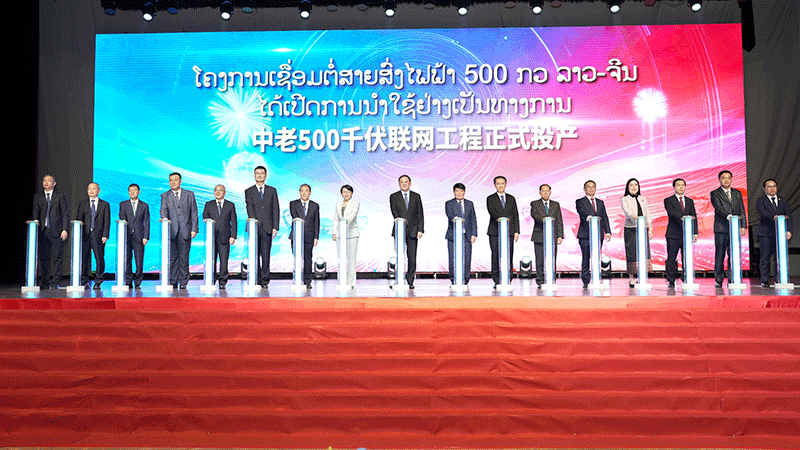
| Lao and Chinese leaders officially open the 500kV Laos-China power line on April 20. |
Laos-China 500 kV transmission line becomes operational
High-ranking government officials from Laos and China on April 20 officially opened a 500 kilovolt power line in a significant boost to cross-border electricity trade and clean energy growth.
The new link raises power exchange capacity from 50 megawatts to 1,500MW, a 30-fold increase. It will transmit about 3 billion kilowatt-hours of electricity each year, cutting around 2.5 million tonnes of carbon dioxide emissions.
Prime Minister Sonexay Siphandone attended the launch alongside Lao and Chinese leaders and partners.
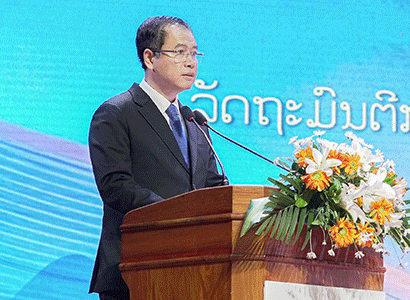 |
| Minister of Industry and Commerce Malaythong Kommasith. |
Minister of Industry and Commerce Malaythong Kommasith said the project removes limits to electricity transmission and strengthens the economy.
“If the Laos-China Railway is the backbone of transport, this project is the main artery powering economic growth,” he said.
“The utilisation of modern technology from China through this project will help the Lao power grid achieve stability, modernisation, and competitiveness on both the regional and international stages,” he added.
The power transmission line runs for 177.5km, linking Yunnan province in China with Oudomxay and Luang Namtha provinces in Laos. Of this, 145km of the line lies in China and 32.5km in Laos. A new 500kV substation and two 230kV lines have been added in Laos to connect with the northern grid.
China Southern Power Grid operates the Chinese section, while Electricite du Laos Transmission (EDL-T) manages the Lao section.
The project supports the Lao government’s ambition to expand the use of clean energy and strengthen its role as a regional power supplier. It also helps distribute electricity more efficiently across the Laos-China border.
The two operators applied environmental and social standards during the construction of the transmission line. The route avoided protected areas and residential zones, saving about 170 hectares of woodland. During construction, drones and helicopters moved more than 5,000 tonnes of materials, reducing the environmental impact by over 90 percent.
Smart technology also improved safety and efficiency. Engineers used digital systems to monitor work in real time, while drones and robotic devices carried out inspections.
Construction of the transmission line created jobs for Lao workers and enhanced skills in the power sector. More than 500 Lao workers took part, and over 1,600 training sessions were provided.
Project operators also funded a new primary school in Namor Tai village and set up five reading rooms at schools in Namor district and Vientiane. They also improved drainage systems in some areas to reduce the risk of flooding.
In addition, Laos launched its first sign language television programme with support from the project operators, helping about 80,000 hearing-impaired people to access information.
The new power link also opens the door to cross-border electricity trading. Clean energy from northern Laos can now be traded through China’s southern power market, marking a first step towards a regional power market.
This latest development serves to mark 65 years of diplomatic relations between Laos and China and builds on cooperation under China’s Belt and Road framework.
Officials from both countries say they will use the project as a base to further upgrade Laos’ power grid and expand regional energy links.
By Times Reporters
(Latest UpdateApril 22, 2026)
|

