 |
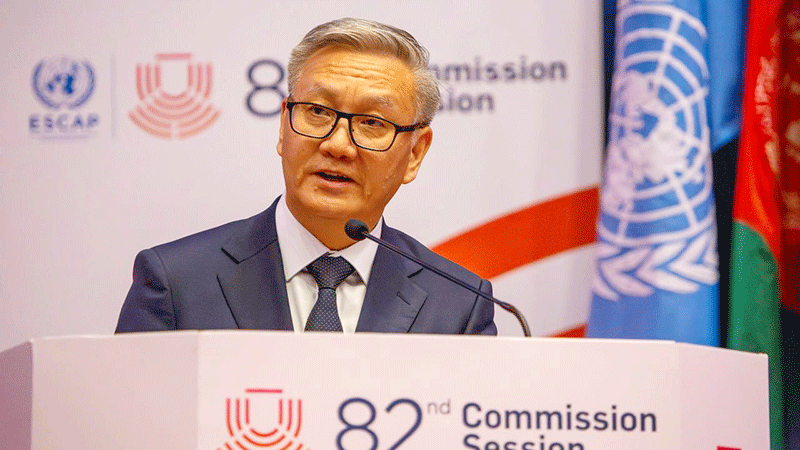
| Deputy Prime Minister and Minister of Foreign Affairs, Mr Thongsavanh Phomvihane, gives an address at the 82nd session of the United Nations Economic and Social Commission for Asia and the Pacific. |
Laos reaffirms development goals, calls for stronger int’l support at UNESCAP meeting
The Lao government reaffirms its commitment to sustainable development and calls for stronger international cooperation as it progresses on the path to graduation from Least Developed Country status, despite global economic challenges.
Deputy Prime Minister and Minister of Foreign Affairs, Mr Thongsavanh Phomvihane, delivered this message at the 82nd session of the United Nations Economic and Social Commission for Asia and the Pacific (UNESCAP), taking place from April 20-24 at the United Nations Conference Centre in Bangkok.
The meeting brings together ministers and other stakeholders from across the region to discuss opportunities and solutions for a sustainable future.
In his address at the opening ceremony on Monday, the deputy prime minister spoke of the mounting socio-economic challenges facing the Asia-Pacific region, including economic downturns, rising public debt, climate change, inequality, and prolonged geopolitical tensions affecting energy and food security.
He stressed the importance of strengthening regional and international cooperation, underlining the role of multilateralism in addressing shared challenges.
During the general debate, Mr Thongsavanh outlined the government’s efforts to advance the Sustainable Development Goals (SDGs), including through implementation of the 10th National Socio-Economic Development Plan.
Approved by the National Assembly, the plan is considered a key pathway towards Laos’ planned graduation from Least Developed Country status by the end of this year.
The plan targets average annual economic growth of at least 6 percent and aims to raise GDP per capita to US$3,055 by 2030.
It also aims to build a more independent and self-reliant economy, focusing on clean energy, agriculture and processing, tourism, transport, and development of a digital economy.
The session, held under the theme “Leaving no one behind: advancing a society for all ages in Asia and the Pacific”, also addresses demographic change, including ageing populations, youth employment, women’s economic empowerment, and the future of care.
Asia and the Pacific, home to more than 60 percent of the world’s population, is undergoing a major demographic transition, posing challenges around jobs, productivity and inclusive growth amid climate change, digitalisation, and artificial intelligence.
On the sidelines of the meeting, Mr Thongsavanh met with the Executive Secretary of UNESCAP, Ms Armida Salsiah Alisjahbana, to discuss cooperation under the Commission’s frameworks. He also held talks with the Minister of Foreign Affairs of Azerbaijan, Mr Jeyhun Bayramov, on bilateral relations between Laos and Azerbaijan.
The session is expected to adopt six resolutions and 25 decisions aimed at accelerating SDG implementation for least developed, landlocked developing, and small island developing countries over 2026–2027.
The Lao delegation is also participating in side events to share experiences and best practices on inclusive and sustainable development across all age groups.
By Times Reporters
(Latest UpdateApril 22, 2026)
|

