 |
| |
Walking together for women’s and adolescents’ health in Laos
When looking back on the journey of women’s, mothers’, newborns’, children’s and adolescents’ health in Laos, what stands out is not only progress in policies, or systems. It is the people, their energy, perseverance and belief.
This is a story of commitment over time. A story of health providers who kept serving, of midwives who remained beside women and families at the moments that matter most, of ethnic health staff who returned to serve their own communities, and of young people whose trust, courage and participation helped shape a more responsive health system. It is also a story of continuity, carried in different ways through the years by the UNFPA SRH Coordinator, Ms Sally Sakulku, former Minister of Health, Dr Bounfeng Phoummalaysith and Chargé d’Affaires to the Embassy of Luxembourg, Mr Thomas Lammar, whose paths remained connected to the same broader purpose: advancing health, dignity and rights in Laos.
What makes this shared journey meaningful is not only who they are, but what their connection represents. Long before the results became visible, there were years of planning, coordination, advocacy, technical work and partnership-building behind them. Through the Joint Programme supported by Luxembourg and implemented with the Ministry of Health, UNICEF, UNFPA and WHO for two decades, Laos didn’t build a project or a one time activity, but a longer road of reform in reproductive, maternal, newborn, child and adolescent health. That work moved from policy to practice, from national strategy to provincial implementation, from training institutions to health centres, from supply systems to counselling rooms, and from leadership tables to the bedside of a woman in labour.
The strength of this journey is that it was never reduced to one intervention, one team or one level of the system. It rested on government leadership, technical guidance, sustained investment and, equally importantly, human trust. Over time, one of the most important shifts in Laos was the recognition that access alone was not enough. It was not enough for a service to exist on paper if a woman arrived and the provider was not fully prepared. It was not enough for a building to stand if the facility lacked the equipment, referral systems or standards needed to manage complications. It was not enough for adolescents to be told that services were available if they still feared judgment, silence or embarrassment. The deeper question became not only whether care existed, but whether it was good, respectful and worthy of trust, and would thus contribute to fulfilling their sexual and reproductive health and rights. That shift helped shape some of the most important improvements in the health sector, especially in the areas of midwifery, facility readiness, family planning and counselling.
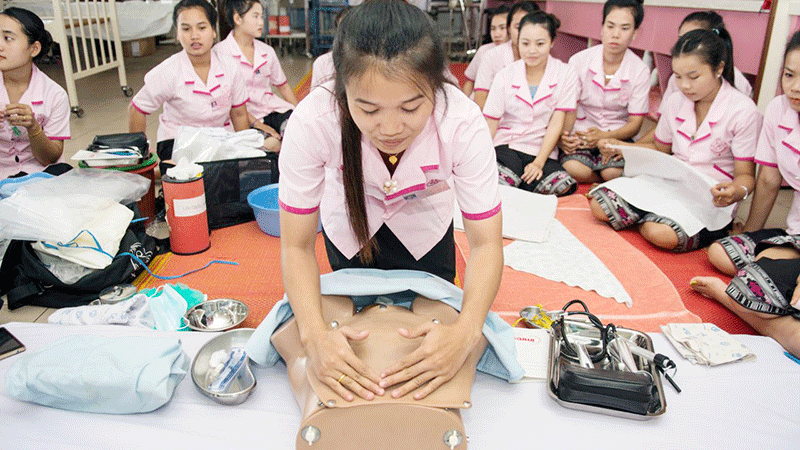
One of the clearest examples of this long-term vision is the investment in midwives. Well-trained midwives can prevent up to two-thirds of all maternal and neonatal deaths. Their care lowers unnecessary medical interventions like C-sections, improving safety. In Laos, strengthening midwifery was never simply about adding more personnel. It was about building a profession strong enough to save lives. Earlier assessments and plans highlighted the need to develop midwifery education pathways, improve teaching capacity, expand clinical training opportunities, and strengthen the competencies required for skilled birth attendance and emergency obstetric and newborn care. Over time, this evolved into stronger standards, clearer competency frameworks and accreditation requirements aimed at improving the quality and consistency of training. A better-trained midwife means safer childbirth, better counselling, earlier identification of danger and greater confidence for women and families at one of the most vulnerable moments of life.
There is something deeply human in that kind of investment. It says that women in remote districts deserve the same seriousness of care as anyone else. It says that standards matter, that training cannot be rushed, and that the person standing beside a mother in labour must be equipped not only with compassion, but with the right skills. It is also a tribute to the many midwives who stayed in the profession, who kept serving through the years, and who carried this responsibility with quiet strength. Much of this story belongs to them.
The same long-term commitment can be seen in efforts to strengthen health facilities and service delivery. A skilled provider also needs a functioning environment in which to work. Over the years, the partnership supported stronger service delivery, subnational capacity and infrastructure, including equipment and systems that improved the ability of facilities to respond. Retraining and deployment of community midwives and skilled attendants, including ethnic staff who understood local languages, helped transform the use of health centres. Facilities that once saw very few deliveries began handling many more, not by chance, but because women gradually had more reason to trust that care would be available and meaningful. This is why the contribution of health providers across the country deserves real recognition: they helped turn policy into care, and care into confidence.
Another powerful part of this journey is the effort to make reproductive health services more relational and respectful. The couples’ counselling initiative supported in Laos reflects a more human way of thinking about health. It promotes user-friendly, non-discriminatory and confidential approaches to support couples’ wellbeing. Reproductive health is no longer reduced to instructions handed down in a rushed encounter. It becomes a conversation, a space where partners can ask questions, discuss contraception, understand reproductive choices and make decisions together with more confidence. That kind of care is not only technically sound; it is dignified.
The same spirit extends to adolescent- and youth-friendly care. Laos’ health journey has increasingly recognised that young people need more than information campaigns. They need services designed around their realities, spaces where confidentiality is respected, questions are welcomed, and providers know how to engage without judgment. These approaches matter because they influence whether a young person delays a risky pregnancy, seeks help early, feels safe enough to ask for advice, or simply learns that the health system can be a place of support rather than fear. When health becomes more youth-friendly, it becomes more just. And in that sense, young people are not only beneficiaries of progress. They are part of the reason progress had to become more responsive and more humane.
What makes the connection between Ms Sally, Dr Bounfeng and Mr Thomas so meaningful is that none of them remained fixed in one role, yet the thread between them did not break. One remained closely tied to technical coordination and reproductive health. One rose through national health leadership. One moved from the UN to represent a partner country whose support remained steady across the years. Their story helps reflect the contribution of many others whose names may be less visible, but whose role was essential: the midwives standing at the centre of services, the providers continuing to serve across the country, the ethnic health staff returning to their communities, and the young people who reminded the system to listen better.
On this World Health Day, this shared journey reminds us that health progress is not built only by brilliant moments. More often, it is built by people who refuse to let the work fade when the spotlight moves elsewhere. It is built with patience, trust and respect for the people it is meant to serve. And in the lives of women seeking safer childbirth, adolescents seeking guidance without shame, and communities placing greater confidence in care, the impact of such commitment becomes real.
Source: UNFPA
By Times Reporters
(Latest UpdateApril 22, 2026)
|

