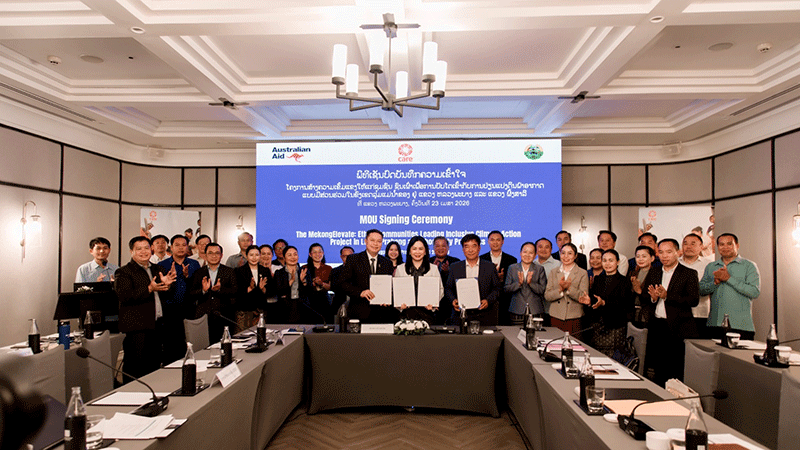
Luang Prabang, Phongsaly, CARE International ink MoU to launch MekongElevate project
The Ministry of Agriculture and Environment, represented by the provincial Agriculture and Environment Offices of Luang Prabang and Phongsaly, and CARE International in the Lao PDR, signed a Memorandum of Understanding in Vientiane on April 23 to launch the “MekongElevate: Ethnic Communities Leading Inclusive Climate Action Project”.
 |
MekongElevate is funded by the Australian government through the Mekong-Australia Partnership (MAP) and is implemented by CARE and local partners. The initiative is scheduled to run from now until May 31, 2029.
Australian Ambassador to Laos, Megan Jones, said “Our Mekong-Australia Partnership supports local responses to shared regional challenges. Australia is proud to partner with Laos to support a more inclusive and resilient Mekong subregion. The MekongElevate project addresses our shared priorities of climate resilience, gender equality, and inclusion. It will invest in people – particularly women, people with disability, and marginalised groups – providing them with skills and opportunities to lead and shape their own paths in the green transition.”
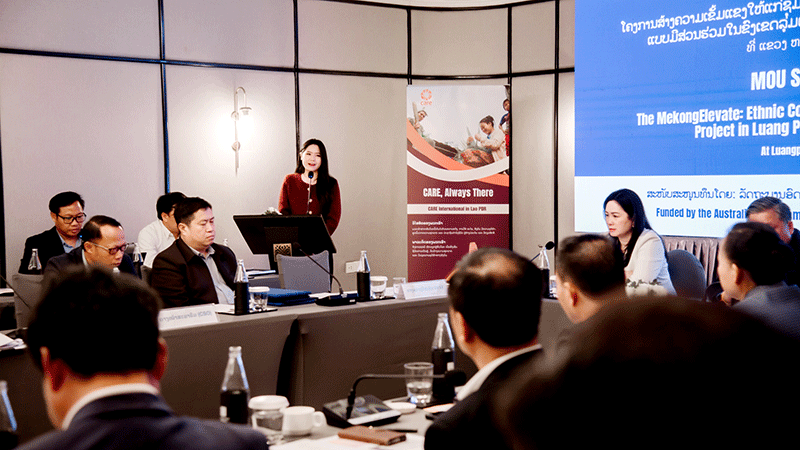
Representative/Officer in Charge of CARE International in the Lao PDR, Ms Keopalina Vongphosy, said “Supported by the Australian government (DFAT), the MekongElevate project empowers ethnic women, youth, and people with disabilities in Luang Prabang and Phongsaly to lead climate action.”
“By combining Village Saving and Loan Associations with Climate-Smart Agriculture, CARE International and the Lao government are building financial independence and environmental resilience across the Mekong sub-region.”
Alternate Member of the Party Central Committee and Vice Chairman of the Luang Prabang Provincial Administration Committee, Mr Chindavong Phosykham, added: “This MoU signing marks a milestone in collaborating to build climate resilience for ethnic communities in Phongsaly and Luang Prabang.”
The Vice Chairman noted that the project aims to improve rural livelihoods through sustainable agriculture and community-led planning to reduce poverty. He thanked the Australian government and CARE International for the financial and technical support vital to Laos’ sustainable development.
In Laos, the project works in partnership with the National Agriculture and Forestry Research Institute (NAFRI) and key civil society partners ARMI and SAEDA.
About the MekongElevate project
MekongElevate aims to strengthen the climate resilience of upland communities in Vietnam, Laos, and Cambodia. It aims to support ethnic groups, including women, youth, and people with disabilities from ethnic backgrounds in six border provinces of the three countries.
The project addresses critical challenges in remote upland communities of Laos, where populations rely heavily on agriculture and face severe impacts from climate change.
High-altitude ethnic communities—including the Hmong, Khmu, and Akha groups—are highly vulnerable to changing climate conditions, which threaten food security and livelihoods, and can lead to a continuous cycle of environmental degradation.
In Laos, the project will be rolled out across 20 villages in two districts of Luang Prabang and Phongsaly provinces. These communities represent a diverse population of nearly 7,000 individuals, primarily female farmers, who will benefit from improved adaptive capacities and socio-economic stability.
CARE works globally to end poverty and achieve social justice. In Laos, CARE partners with communities, government agencies, and civil society to empower vulnerable populations, especially women and girls, through inclusive development and resilience-building.
MekongElevate pursues three main objectives:
•Promoting Climate-Smart Agriculture: Assisting people in adopting sustainable farming techniques and innovations to protect their livelihoods against climate change.
•Strengthening Safety Nets: Supporting communities in accessing recovery mechanisms and risk contingencies to minimise loss and damage caused by natural disasters and extreme weather.
•Empowering Leadership: Enhancing the voices and roles of ethnic women, youth, and people with disabilities in climate-related governance and decision-making processes, from the local to the regional level.
About CARE International in Laos
CARE International, a global NGO dedicated to eradicating poverty and advancing social justice, focuses on empowering vulnerable populations, particularly women and girls who face profound marginalisation. In 2024, CARE’s reach extended to over 100 countries, providing support to 200 million individuals striving to overcome poverty and inequality. To date, their efforts have positively impacted over 52 million participants, aligning with the United Nations Sustainable Development Goals.
In Laos, CARE International has been active since 1992, concentrating on improving the lives of vulnerable groups, especially ethnic minority communities in both rural and urban settings.
Working in collaboration with community members, government entities, civil society organisations, and the private sector, CARE currently implements projects in Vientiane and the provinces of Phongsaly, Luang Namtha, Luang Prabang, Salavan, Champasak, and Xekong. The CARE Laos “Marginalised Women and Girls” programme utilises integrated initiatives focused on women’s health, economic empowerment, and climate resilience to foster sustainable socio-economic justice, with a strong commitment to local capacity building.
About the Mekong-Australia partnership
The Mekong-Australia Partnership, launched in 2020, is an Australian government initiative that responds to shared regional and transboundary challenges to support a peaceful, stable and prosperous Mekong subregion. Australia engages pragmatically and flexibly in support of the subregion’s priorities and where Australia can add value.
Australia works with Mekong partners in Vietnam, Thailand, Cambodia, Laos and Myanmar to improve water security and climate change resilience; counter and disrupt transnational crime; enhance economic resilience and subregional integration; build leadership and skills through scholarships and short courses; and support inclusive development, including gender quality and disability equity.
By Advertorial Desk
(Latest UpdateApril 24, 2026)
|