 |
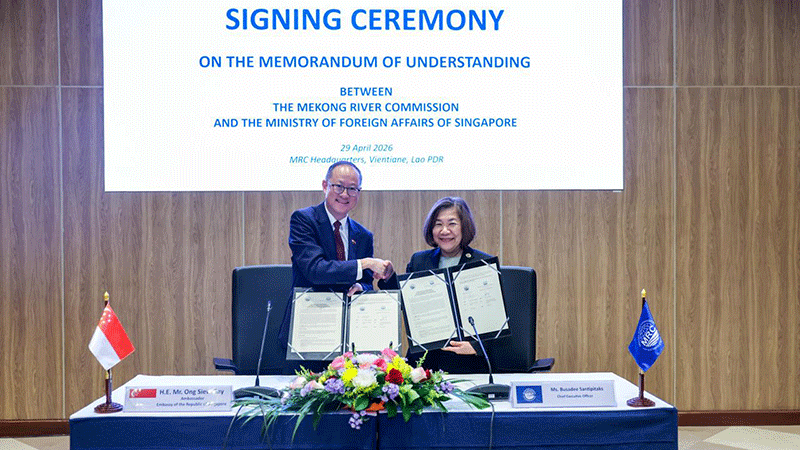
| Mr Ong Siew Gay and Ms Busadee Santipitaks display the cooperation agreement. –Photo Mekong River Commission |
Mekong body strengthens river regulation through partnership with Singapore
The Mekong River Commission has strengthened regional water cooperation with the signing of a partnership agreement with Singapore last week, to address rising climate and water challenges.
The agreement, signed in Vientiane with Singapore’s Ministry of Foreign Affairs, aims to improve water security, climate resilience, and sustainable development across the Mekong region.
Under the agreement, the two sides will focus on three main areas.
First, they will use satellite and geospatial technology to track weather and water levels, to support agriculture and economic resilience.
The agreement will strengthen water governance and urban water management. Singapore will share its experience in wastewater treatment, water quality control and recycling, which could support growing cities in Laos.
Training programmes will also be provided through Singaporean institutions to build skills among officials and technical staff in the region.
The Ambassador of Singapore to Laos, Mr Ong Siew Gay, said the Mekong River Basin has wider regional impacts despite Singapore not being a river country.
He added that countries must strengthen cooperation as global challenges become more complex.
CEO of the Mekong River Commission (MRC) Secretariat, Ms Busadee Santipitaks, stressed that cooperation across borders is essential because the Mekong’s challenges affect all countries along the river.
She noted that the partnership with Singapore brings new technical expertise and fresh perspectives, which can help strengthen water management and build more resilient systems for the future of the Mekong region.
The agreement will run for five years and aligns with the Mekong River Commission’s Strategic Plan for 2026–2030, which prioritises climate resilience and sustainable water use.
This cooperation builds on earlier work between both sides, including a 2025 initiative on satellite-based flood monitoring. Singapore has also trained more than 57,000 officials from Laos, Cambodia, and Vietnam under its cooperation programme.
The partnership comes at a time when Laos and its neighbours navigate the triple threat of climate change, fluctuating water demands, and persistent arsenic levels in river water and sediment.
Recent findings by the MRC show that arsenic contamination remains a localised but ongoing concern, with higher risks found in river sediment than in the water itself.
According to the report, arsenic levels in the water are slightly above the safety threshold of 0.01 mg/litre, but most other heavy metals, including mercury, cadmium, lead and zinc, remain within safe limits.
The main concern lies in sediment along parts of the river, where arsenic concentrations exceed safety guidelines. These levels can change with the seasons, especially during heavy rainfall and shifts in river flow, which move contaminated sediment downstream.
The MRC reported that arsenic contamination remains limited to specific upstream areas and has not spread across the wider lower Mekong basin.
The most affected areas are in northern Thailand, particularly in the Kok, Sai and Ruak rivers, as well as several monitoring points along the Mekong River in Chiang Rai, where sediment shows elevated arsenic levels.
In Laos, monitoring recorded a brief rise in arsenic levels in Bokeo province on February 6, 2026, but follow-up tests in February and March showed levels quickly returned to safe limits.
Further downstream in Luang Prabang province, arsenic levels have remained consistently below the 0.01 mg/L safety threshold, indicating that contamination has not moved beyond upstream areas.
By Times Reporters
(Latest Update May 5, 2026)
|

