 |
Progress towards schistosomiasis elimination in Laos
Around the world, communicable diseases remain a burden for many – but one by one, these diseases are being eliminated. Laos eliminated trachoma in 2017 and lymphatic filariasis in2023. Malaria cases have fallen from hundreds of thousands in the 1990s to 272 in 2025.
Laos is now closing the gap on eliminating another debilitating disease – schistosomiasis – after decades of efforts by national and provincial officials, frontline healthcare workers, and development partners.
“Transmitted by parasitic worm-infected snails living in contaminated water, the disease remains a significant public health concern in specific parts of Laos alongside the Mekong River where the disease-transmitting snails can thrive,” said Director of Center for Malaria Parasitology and Entomology, Dr Virasack Banouvong.
“The disease persists in southern Champasack Province, where an estimated 120,000 people reside in 202 high-risk villages across Khong and Mounlapamok districts. Left untreated, the disease can cause stomach pain, an enlarged liver, bleeding when going to the toilet, and even severe liver damage – with potentially fatal complications.”
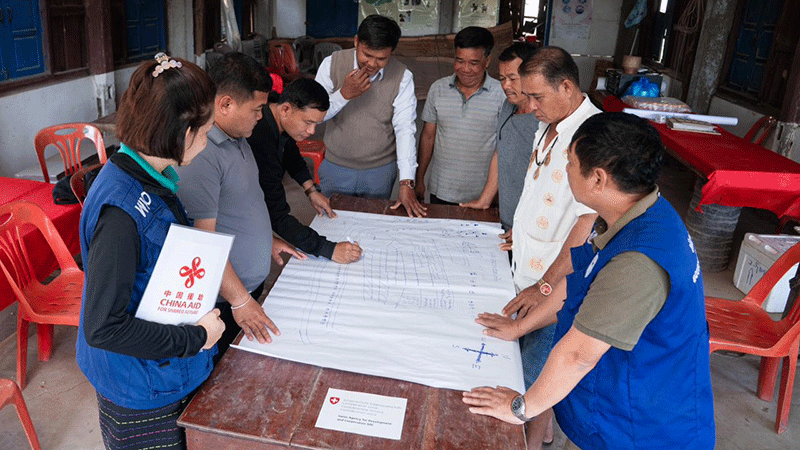
Elimination is currently a focus for the Ministry of Health and Ministry of Education and Sport, supported by WHO, and the Global Development and South-South Cooperation Fund (GDF) of China and the Swiss Agency for Development and Cooperation (SDC).
The recent support – US$1.41m via the Global Development and South-South Cooperation Fund of China, and US$1.09m from Switzerland – is enabling a range of comprehensive efforts in neighbouring districts in Laos and Cambodia, aiming to ensure zero cases of new locally-transmitted schistosomiasis infections in snails, animals, and humans, with verification of elimination by 2035.
Key activities in Laos include mass treatment to clear infections in children and adults in all high-risk villages, with more than 100,000 people anticipated to receive treatment; health education to raise awareness of risks and prevention; enhanced disease surveillance and building testing capacity; and improved access to clean water and sanitation facilities in villages to reduce transmission.
In support of this, technical assistance is being provided by China’s National Institute of Parasitic Diseases and the Swiss Tropical and Public Health Institute, via training and capacity building for Ministry of Health staff and provincial officials.
“The collaborative efforts between Laos, China, WHO and Switzerland exemplify the power of South-South cooperation, and world-class technical expertise, in tackling complex health issues,” said Chinese Ambassador to Laos, Ms Fang Hong.
“Leveraging our collective expertise and resources, we are confident that intensified interventions will lead to the complete elimination of this disease, safeguarding the well-being of thousands, especially children.
This project is not only about disease prevention but also about strengthening community resilience and empowering local development.”
“While sustained investment and commitment means that less than 1 percent of people living in high-risk locations are currently infected, the disease continues to affect thousands in Laos, especially children, making relegating this disease to the past a health priority,” said WHO Representative to Laos, Dr Timothy Armstrong.
“The disease spreads through everyday activities that bring people into contact with infested water from the Mekong River and its tributaries—such as washing, fishing, swimming (particularly for children) and collecting water—where poor hygiene and sanitation further heighten the risk. Thanks to generous support from China and Switzerland, and through joint cross-border efforts, we are working to ensure health for all.”
Deputy Head of the Khong District Health Office, Manivanh Khammanolard, has seen first-hand the impacts of schistosomiasis, and is proud to contribute to its elimination.
Regularly implementing elimination activities supported by China and Switzerland, Manivanh supports health promotion, as well as monitoring suspected cases, and treatment efforts.
She says: “It is difficult for people to avoid risky behaviours, because they rely on the river for daily life, including food and income – while some are unaware how dangerous schistosomiasis can be.”
“If schistosomiasis can be eliminated, the community will have better health, more children will be able to go to school, and people will have greater opportunities to work and improve their lives. Fortunately, through education, distribution of medicine, and improved access to clean water, sanitation and toilets especially, we can make progress.”
Given schistosomiasis spread via infested water, improvinghygiene and sanitation is a major focus for the project. In 116/202 villages across Champasack Province, community-led initiatives to eliminate schistosomiasis by combining deworming with WASH interventions (CL-SWASH) are underway.
As part of this approach, elected committee members conduct household visits to assess latrine use, sanitation practices, and water supply. In many cases, this has resulted in steady improvements, primarily making use of the community’s own resources.
Complementing these efforts, support is ensuring access to clean water and improved hygiene is more widely available in high-risk schools and communities, coupled with health education, particularly for children, to keep people safe.
Principal of Thakham Primary School, Mr Bounlaiy Sackpasith, knows how essential awareness of schistosomiasis is.
“As a teacher, an important role I play is integrating schistosomiasis lessons into our teaching curriculum,” he says. “Most students now have a better understanding of how dangerous the disease is, and how to prevent it, particularly with good hygiene.”
Finally, the most visible and crucial aspect of elimination efforts is mass administration of medication. In 2024, more than 95,000 people have received a single-dose of praziquantel – which fully eliminates schistosomiasis from the body.
“Eliminating schistosomiasis in the Mekong region is within reach – now more than ever, success relies on collective effort.We are witnessing this collaboration in action through treatment, surveillance, education, and WASH,” said Regional Director for the SDC in the Mekong Region, Jean-Gabriel Duss.
“Together, we can achieve it — that’s the spirit of our partnership among Laos, Cambodia, China, Switzerland, and WHO. From individuals and communities to national institutions, renowned research institutes, and global organisation, we are uniting to turn the impossible into reality and drive progress toward eliminating this disease once and for all.”
--Author: Officer-in-Charge Communications of World Health Organization, Ms Soudaphone Viravongsa.
(Latest Update May 14, 2026)
|

