 |
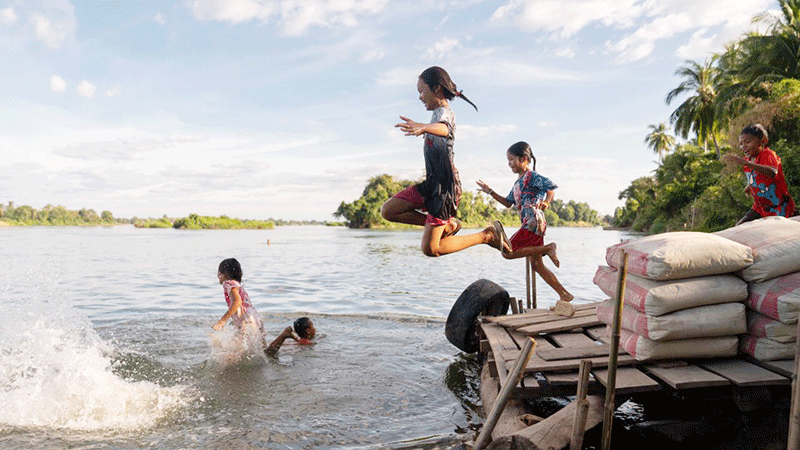
| --Photo credit: © WHO/Phoonsab Thevongsa |
Eliminating schistosomiasis: A blueprint for health and hope in Laos
The fight against communicable diseases is a long one. It requires decades of investment, perseverance and commitment – a situation particularly true for often under-resourced neglected tropical diseases.
But progress in Laos is proving that success is very much possible, which is an achievement worth recognising.
For decades, diseases like trachoma, and lymphatic filariasis burdened the people of Laos. One by one, thanks to determined national efforts and robust international support, these burdens have been lifted. Trachoma in 2017, and lymphatic filariasis in 2023. Malaria cases fell to 272 in 2025. Now, we are taking on schistosomiasis.
A parasitic disease spread by freshwater snails, schistosomiasis has long posed a significant public health risk in Laos, particularly in communities along the Mekong River where infection rates in 2003 exceeded 40 percent in some areas. The parasite’s microscopic larvae thrive in the very water that sustains daily life – for washing, fishing, and transport. The disease can cause debilitating symptoms like an enlarged liver, bleeding when going to the toilet, and even severe liver damage – with potentially fatal complications.
Efforts over the decades mean schistosomiasis is now found only in southern Champasack Province, with 120,000 people estimated to be at-risk across 202 villages. While sustained efforts have significantly reduced infection rates (less than 1 percent in high-risk areas), thousands are still affected, especially children. Eliminating this disease is a race to protect the health and futures of the most vulnerable – but it is a race we can win.
The progress we see today is a testament to partnership, collaboration and commitment.
The partnership between Laos Ministry of Health, WHO, the Global Development and South-South Cooperation Fund(GDF) of China and the Swiss Agency for Development and Cooperation (SDC) brings a dynamic blend of resources, technical expertise, and shared goals – proving that when the world works together, health for all is within reach.
China and Switzerland’s generous US$1.18 million contribution to Laos is an investment in human potential, enabling a comprehensive strategy built on multiple pillars: mass treatment in all villages in endemic areas, improved water and sanitation (WASH), health education in both community and school settings, and disease surveillance.
Technical expertise has ensured effective treatment and robust monitoring. A single-dose treatment given each year is clearing the parasite from infected individuals, providing immediate relief and preventing further transmission. In 2024, over 95,000 people were treated.
Meanwhile, support and training with experts from China’s National Institute of Parasitic Diseases and the Swiss Tropical and Public Health Institute has enabled stronger disease surveillance and improved laboratory work – essential for detecting cases and monitoring progress towards elimination.
Alongside these efforts, collaboration between the Lao and Cambodian Ministries of Health, exchanging data, lessons and solutions, is simultaneously addressing schistosomiasis on both sides of the Mekong.
But, perhaps most importantly has been commitment – at all levels.
Laos’ progress to eliminate schistosomiasis, and other diseases, is a testament to the dedication of frontline healthcare workers, community leaders, local, provincial and national health officials, political leaders and development partners – all striving together, over decades, to ensure health for all and that no one is left behind.
In a world beset by challenges, Laos’ journey towards schistosomiasis elimination is a beacon of hope. It proves that with sustained effort and multilateral collaboration, even the most persistent health challenges can be defeated.
The journey to a schistosomiasis-free Laos is about more than numbers; it’s about restoring well-being, freeing communities from the shadow of disease, allowing children to safely enjoy their beautiful home environment, and enabling families to grow and prosper, while still enjoying the rivers that are so integral to their way of life. It’s about building a healthier, more prosperous future.
While the work is not yet done, and a great deal of effort remains, amid these trying times it is important to remember and recognise that success is very much possible for health, and beyond.
We hope that, when achieved, the elimination of schistosomiasis in Laos will stand as a model for others – particularly as we turn to the next challenge. This is not just a public health achievement, but a demonstration that audacious development goals are well within reach, when addressed via unwavering commitment, sustained investment, technical expertise and collective efforts. This success shows us – as all of Laos’ previous disease elimination efforts have done – that even seemingly insurmountable tasks are within our reach.
Authors: Chinese Ambassador to Laos, Fang Hong, Regional Director for the SDC in the Mekong Region, Jean-Gabriel Duss and WHO Representative to Laos, Dr Tim Armstrong.
(Latest Update May 27, 2026)
|

